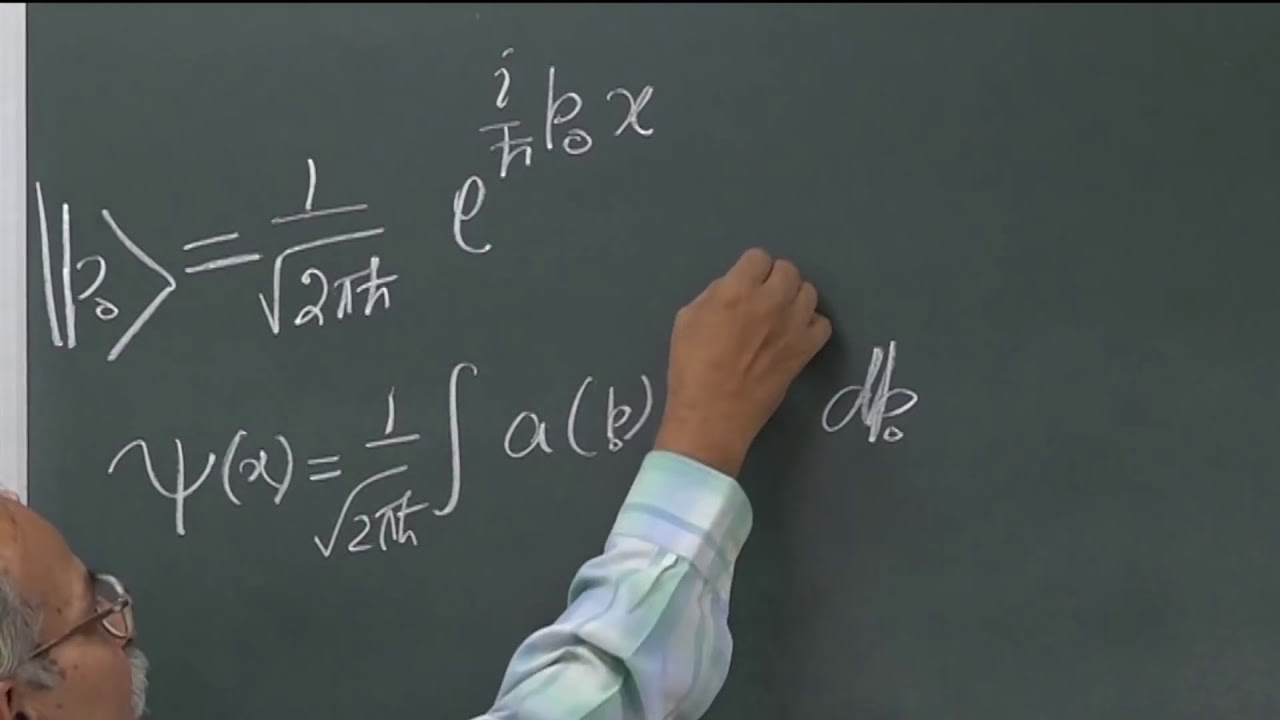
Lec 18 Learning Language - 2
Keywords
Summary
160 words
Critical Evaluation
Value of the Information & Strength of the Argument
The lecture provides a solid introduction to the mathematical formalism of quantum mechanics, particularly the concept of continuous bases and operators. The argumentation is logical and follows a pedagogical progression, starting from the review of discrete bases and extending to continuous ones. The instructor uses examples and analogies to clarify abstract concepts, such as comparing vector spaces to quantum state spaces. The value of the information is high for students seeking a clear explanation of these topics, but the lack of visual aids or derivations on screen may limit its accessibility.
Scientific Rigor, Source Quality, Title Accuracy
The scientific rigor is acceptable for a lecture, but the instructor does not cite any external sources or references. The content aligns with standard quantum mechanics textbooks, but the absence of citations reduces its verifiability. The title ‘Learning Language - 2’ is not descriptive of the content, which could mislead viewers. The lecture is part of a series, so the title may be meaningful in that context, but it does not stand alone.
179 words
Title / Content Match
The title 'Learning Language - 2' is vague and does not clearly indicate the quantum mechanics content, but it is part of a series, so it may be understood in context.
Quality & Reliability
7/10
The lecture is a formal educational presentation on quantum mechanics, covering mathematical formalism and operators. The content is consistent with standard quantum mechanics textbooks, but the transcription is noisy and lacks citations or references. The instructor appears knowledgeable, but the presentation is one-sided without external validation.
Key Moments
Markers derived by PSI from the transcript: the creator did not define chapters.
- Introduction and review of previous lecture on state spaces and wave functions.
- Discussion of discrete basis and expansion of wave functions in terms of basis states.
- Introduction of continuous basis and momentum eigenstates.
- Explanation of orthonormality in continuous basis using Dirac delta function.
- Definition of momentum operator and its action on momentum eigenstates.
- Definition of position operator and its action on position eigenstates.
- Introduction of Hamiltonian operator as sum of kinetic and potential energy operators.
Contribution & Novelties
The lecture offers a clear pedagogical explanation of continuous bases and operators in quantum mechanics, which is a fundamental topic. It emphasizes the role of the Dirac delta function in orthonormality and the correspondence between physical observables and operators. The lecture is particularly useful for students who are transitioning from discrete to continuous representations.
Pour aller plus loin :
- Hilbert space — Provides the mathematical foundation for quantum state spaces.
- Dirac delta function — Essential for understanding continuous bases and orthonormality.
- Operator (physics) — Explains the role of operators in quantum mechanics.
92 words
Radar Profile
The radar profile shows high scores in quantity of information and technical level, indicating a dense and advanced lecture. The quality and reliability scores are moderate, reflecting the lack of citations and the informal presentation style. The overall balance suggests a content-rich but not rigorously sourced educational video.