Keywords
Summary
223 words
Critical Evaluation
Value of the Information & Strength of the Argument
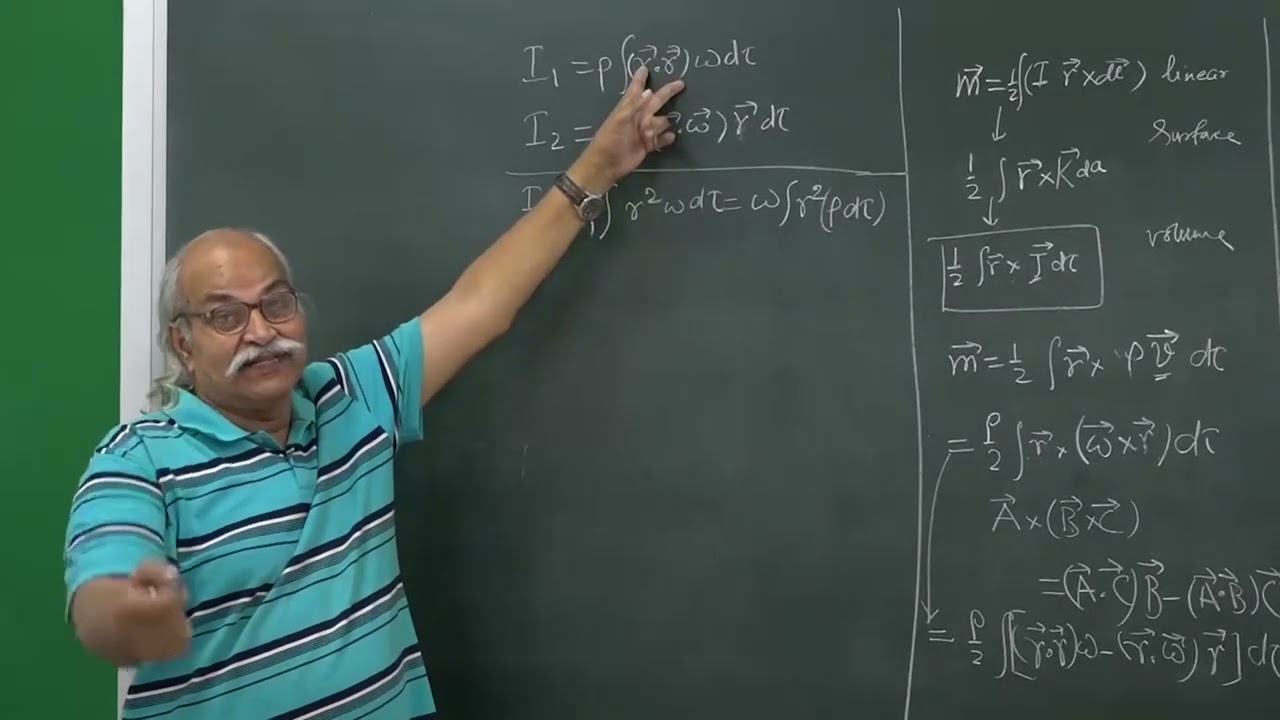
The lecture provides a thorough, step-by-step derivation of the magnetic moment of a rotating charged sphere, which is a classic problem in electromagnetism. The value lies in the detailed mathematical treatment, which illustrates the use of vector calculus and the connection to mechanics via moment of inertia. The argumentation is solid: each step is justified, and the instructor explicitly warns about the limitations of the simplified formula L = Iω, demonstrating scientific rigor. The use of symmetry arguments to simplify integrals is elegant and instructive.
Scientific Rigor, Source Quality, Title Accuracy
The lecture is scientifically rigorous, with no unsupported claims. The derivation is mathematically sound, and the instructor correctly identifies the conditions under which the simplified relation holds. No external sources are cited, which is typical for a lecture. The title ‘Problem Solving 3’ is generic but accurate; it does not mislead about the content. The lecture is self-contained and does not rely on external references.
165 words
Title / Content Match
The title 'Problem Solving 3' is generic but accurately reflects the content: a worked physics problem. It does not mislead.
Quality & Reliability
8/10
The lecture is a rigorous derivation of the magnetic moment of a rotating charged sphere, using vector calculus and analogies with mechanics. The reasoning is clear and mathematically sound, with no unsupported claims. The instructor emphasizes the importance of the principal axis condition for the L = Iω relation, demonstrating scientific caution.
Key Moments
Markers derived by PSI from the transcript: the creator did not define chapters.
- Introduction: recap of previous lecture and statement of the problem: magnetic moment of a rotating charged sphere.
- Definition of magnetic moment for volume current distributions: m = 1/2 ∫ r × J dτ.
- Substitution of J = ρv and v = ω × r into the integral.
- Application of vector triple product identity to expand r × (ω × r).
- Evaluation of I1: recognition of moment of inertia, yielding (3/5)QR²ω.
- Evaluation of I2: use of symmetry to show cross terms vanish, leaving (1/5)QR²ω.
- Combining results to get final magnetic moment m = (1/5)QR²ω.
- Discussion of alternative method using angular momentum and caution about principal axis condition.
Contribution & Novelties
The lecture provides a detailed derivation of the magnetic moment of a rotating charged sphere, which is a classic result. The novelty lies in the pedagogical approach, emphasizing the mathematical techniques and the physical insight that the simplified formula L = Iω is not always valid. This is a valuable reminder for students.
Pour aller plus loin :
- Magnetic moment — Wikipedia article providing background on magnetic moments.
- Moment of inertia — Wikipedia article on moment of inertia, relevant to the mechanical analogy.
- Vector triple product — Wikipedia article on vector triple product, used in the derivation.
97 words
Radar Profile
The radar profile shows high scores across all dimensions, indicating a well-balanced and reliable lecture. The quantity and quality of information are strong, with a high technical level and good reliability.