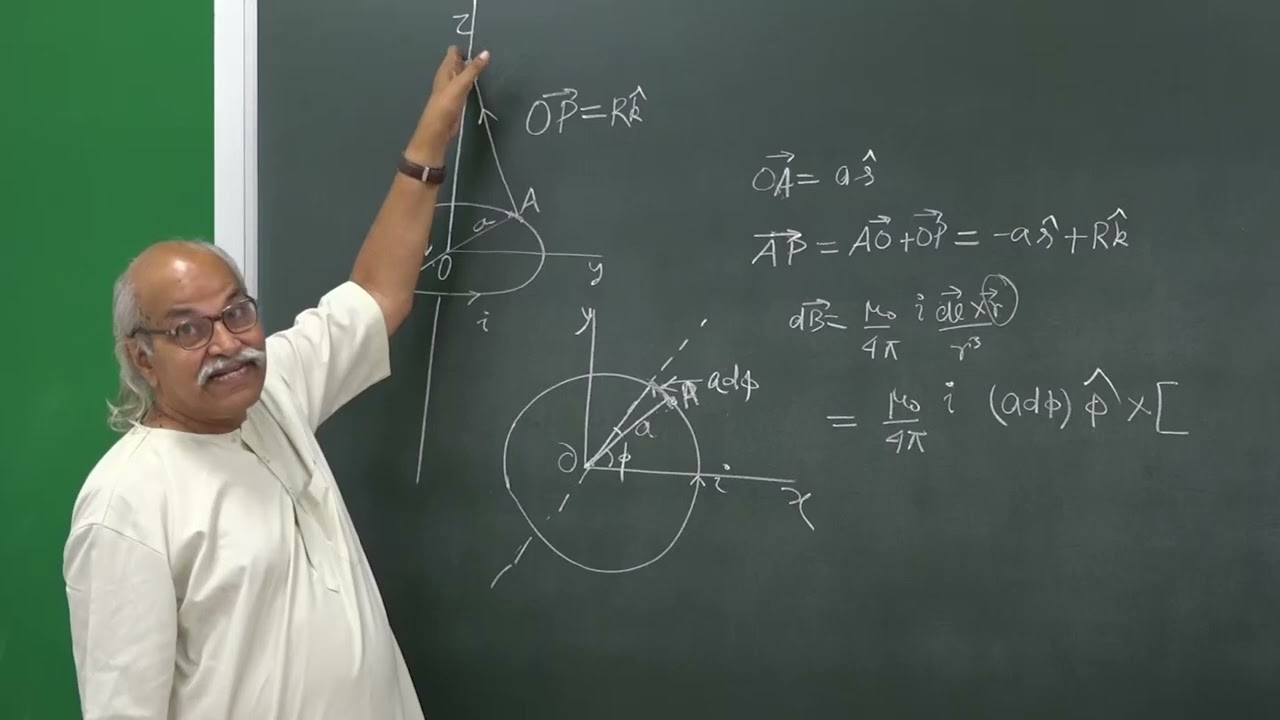
LEC 19 - Magnetic field due to a Circular Current
Keywords
Summary
204 words
Critical Evaluation
Value of the Information & Strength of the Argument
The lecture provides a clear and rigorous derivation of the magnetic field on the axis of a circular current loop. The argumentation is solid, with each step logically following from the previous one. The use of cylindrical coordinates is well-explained, and the cancellation of the perpendicular component due to symmetry is properly justified. The instructor also connects the result to the simpler case of the field at the center and discusses the qualitative field line pattern, which enhances the understanding of the physical situation. The value of the information is high for students learning electromagnetism, as it reinforces the application of the Biot-Savart law and vector calculus in a practical context.
Scientific Rigor, Source Quality, Title Accuracy
The lecture is scientifically rigorous, with a correct application of the Biot-Savart law and vector calculus. The derivation is presented in a step-by-step manner, and the mathematical manipulations are accurate. The title accurately reflects the content, which focuses on the magnetic field due to a circular current. No external sources are cited, but the lecture is self-contained and based on fundamental principles. The instructor’s explanations are clear and appropriate for an undergraduate physics audience.
200 words
Title / Content Match
The title accurately reflects the content, which focuses on deriving the magnetic field due to a circular current loop.
Quality & Reliability
8/10
The lecture provides a rigorous derivation of the magnetic field on the axis of a circular current loop using cylindrical coordinates and the Biot-Savart law. The mathematical steps are clear and correct, and the physical reasoning is sound. The presentation is suitable for an undergraduate physics audience.
Key Moments
Markers derived by PSI from the transcript: the creator did not define chapters.
- Introduction: setting up the problem of magnetic field due to a circular current loop.
- Setting up cylindrical coordinates and defining the current element.
- Writing the Biot-Savart law for the current element and simplifying the cross product.
- Integration over the loop: separating the axial and radial components.
- Showing that the radial component cancels due to symmetry.
- Final expression for the magnetic field on the axis.
- Special case: magnetic field at the center of the loop.
- Discussion of off-axis fields and numerical integration.
- Qualitative description of magnetic field lines around a current loop.
- Right-hand rule and relation between current direction and field lines.
Contribution & Novelties
The lecture provides a clear and detailed derivation of the magnetic field on the axis of a circular current loop, emphasizing the use of cylindrical coordinates and vector calculus. It reinforces the application of the Biot-Savart law and demonstrates the importance of symmetry in simplifying integrations. The instructor also discusses the qualitative field line pattern, which is useful for visualizing the field.
Pour aller plus loin :
- Biot-Savart law — The fundamental law used in the derivation.
- Cylindrical coordinate system — The coordinate system used throughout the lecture.
- Magnetic field of a circular loop — Provides additional context and related formulas.
101 words
Radar Profile
The radar profile shows high scores in information quantity, quality, technical level, and reliability, indicating a well-structured and accurate lecture. The content is technically demanding but clearly presented, making it suitable for students with a background in calculus and electromagnetism.