W4-01 Problem Solution-1 #Relativity #Physicslectures
Keywords
Summary
260 words
Critical Evaluation
Value of the Information & Strength of the Argument
The video provides clear, step-by-step solutions to standard special relativity problems, which is valuable for students learning the subject. The instructor emphasizes the importance of identifying proper time and rest length, and correctly applies Lorentz transformations and velocity addition. The argumentation is logically sound, with each step justified by the relevant equations. However, the presentation is somewhat informal, and the instructor occasionally makes minor verbal slips or rushes through derivations, which could confuse viewers. The problems are well-chosen to illustrate key concepts, but the video does not offer any novel insights beyond textbook material.
Scientific Rigor, Source Quality, Title Accuracy
The video is scientifically rigorous in its application of special relativity equations. The instructor correctly uses the Lorentz transformation, time dilation, length contraction, and velocity addition formulas. No external sources are cited, but the content is standard physics. The title accurately reflects the content, as it is a problem-solving session. The video does not include any commercial breaks or sponsorships. The instructor’s explanations are generally clear, though some steps are abbreviated, particularly in the clock synchronization problem. Overall, the scientific rigor is high, and the title is appropriate.
197 words
Title / Content Match
The title accurately describes the content: a problem-solving session on special relativity, as part of a lecture series.
Quality & Reliability
8/10
The lecture is a clear, step-by-step tutorial on solving standard special relativity problems. The instructor correctly applies Lorentz transformations, time dilation, length contraction, and velocity addition. The explanations are mathematically sound and consistent with established physics. However, the video lacks citations to external sources, and the presentation is informal, with some minor verbal slips and a few unclear moments (e.g., the derivation of the clock synchronization result is somewhat rushed). Overall, the content is reliable for educational purposes.
Key Moments
Markers derived by PSI from the transcript: the creator did not define chapters.
- Introduction: agenda is to solve problems on relativistic kinematics.
- Problem 1: particle in nuclear reactor leaves 1 cm track at 0.995c; calculate lifetime in lab frame.
- Solution: lab frame lifetime = distance/speed = 3.35e-11 s.
- Problem 1 part 2: lifetime in particle's frame (proper time) = 3.35e-12 s.
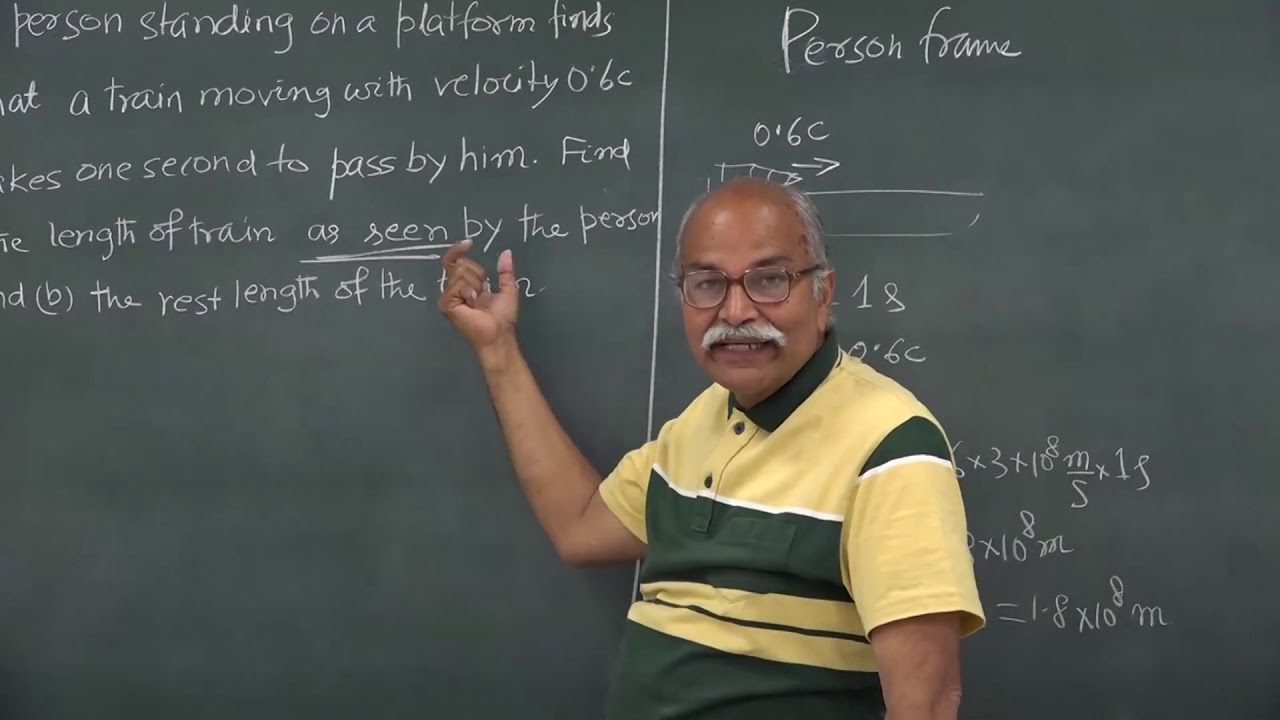
- Problem 2: train moving at 0.6c takes 1 s to pass a person; find length as seen by person.
- Solution: moving length = 1.8e8 m; rest length = 2.25e8 m.
- Problem 3: clocks A and B agree; find x-coordinate of event.
- Solution: x = (c^2/v) * t * (1 - sqrt(1 - v^2/c^2)).
- Problem 3 part 2: clock C opposite origin reads t/sqrt(1 - v^2/c^2).
- Problem 4: two rockets approaching Earth; find length of one in other's frame.
- Solution: relative speed = 0.8c; length = 0.6L0.
Contribution & Novelties
The video provides a clear, step-by-step walkthrough of classic special relativity problems, which is valuable for students. It reinforces the correct application of Lorentz transformations, time dilation, length contraction, and velocity addition. The instructor emphasizes the importance of distinguishing between proper and improper quantities, which is crucial for solving problems correctly. The video does not introduce new concepts but serves as a practical exercise.
Pour aller plus loin :
- Special relativity — Foundational theory; relevant for understanding the context.
- Lorentz transformation — Core equations used in the video.
- Time dilation — Key concept illustrated in Problem 1.
- Length contraction — Key concept illustrated in Problems 2 and 4.
- Velocity addition formula — Used in Problem 4.
116 words
Radar Profile
The radar profile shows high scores in quantity and quality of information, with a slightly lower technical level, indicating a solid educational resource that is accessible yet rigorous. The fiabilité is high, reflecting the correctness of the physics.