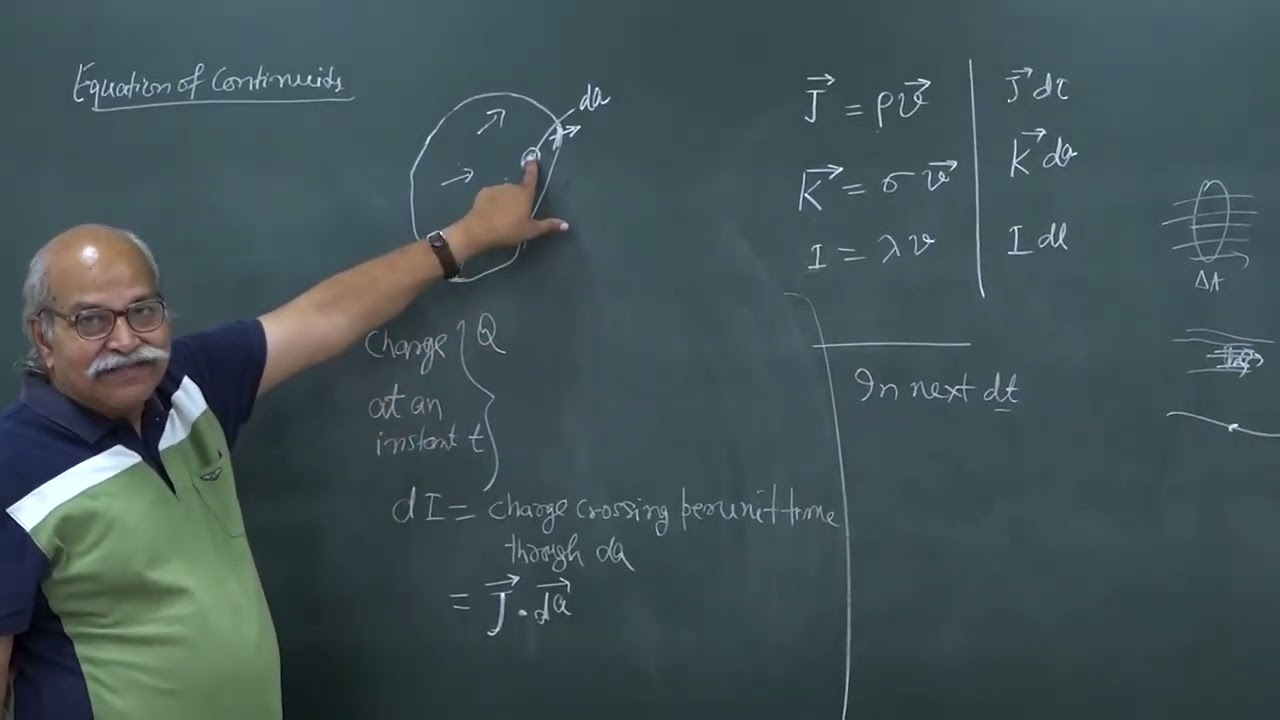
LEC 04 - Equation of continuity
Keywords
Summary
144 words
Critical Evaluation
Value of the Information & Strength of the Argument
The lecture provides a solid conceptual and mathematical foundation for the equation of continuity. It carefully defines current densities and derives the equation from the principle of charge conservation, using the divergence theorem to obtain the local form. The argumentation is logical and step-by-step, making it easy to follow. The instructor also clarifies common misconceptions, such as the vector nature of current. The value lies in its pedagogical clarity and the emphasis on the physical meaning behind the mathematics.
Scientific Rigor, Source Quality, Title Accuracy
The lecture is scientifically rigorous, with correct mathematical derivations and proper use of the divergence theorem. However, it does not cite specific sources, relying instead on standard textbook material (likely Griffiths’ ‘Introduction to Electrodynamics’). The title accurately reflects the content, which is focused on the continuity equation. The lecture is well-structured and technically sound, though it could benefit from referencing the textbook or other resources for further study.
162 words
Title / Content Match
The title accurately reflects the content, which focuses on deriving and explaining the equation of continuity in the context of electromagnetism.
Quality & Reliability
8/10
The lecture is mathematically rigorous, derives the continuity equation from first principles, and correctly applies the divergence theorem. The presentation is clear and systematic, though it relies on a standard textbook approach without citing external sources.
Key Moments
Markers derived by PSI from the transcript: the creator did not define chapters.
- Introduction to linear current density and its definition.
- Derivation of current as λv for linear currents.
- Discussion of current elements for volume, surface, and line currents.
- Introduction to the equation of continuity and its physical meaning.
- Derivation of the integral form using the divergence theorem.
- Explanation of the divergence operator in Cartesian, cylindrical, and spherical coordinates.
- Derivation of the differential form of the continuity equation.
Contribution & Novelties
The lecture provides a clear and detailed derivation of the continuity equation, emphasizing the physical principle of charge conservation. It is particularly useful for students who need a step-by-step explanation of the mathematical steps, including the application of the divergence theorem. The lecture also reviews the divergence operator in various coordinate systems, which is essential for electromagnetism.
Pour aller plus loin :
- Continuity equation (Wikipedia) — Provides a general overview and applications in various fields.
- Charge conservation (Wikipedia) — Explains the fundamental principle underlying the continuity equation.
- Divergence theorem (Wikipedia) — Details the mathematical theorem used in the derivation.
99 words
Radar Profile
The radar profile shows high scores across all dimensions, indicating a well-balanced lecture with strong technical depth, clear explanations, and reliable content. The lecture is particularly strong in the quantity and quality of information, as well as in its technical level.