W5-01 Problems related Length Contraction
Keywords
Summary
205 words
Critical Evaluation
Value of the Information & Strength of the Argument
The video provides a solid introduction to length contraction and its application to problem-solving. The value of the information is high for students learning special relativity, as it clarifies common misconceptions and demonstrates the correct use of the length contraction formula. The argumentation is logical and step-by-step, making it easy to follow. The instructor carefully distinguishes between proper length and contracted length and correctly applies the formula in each example. The solutions are mathematically sound, and the explanations of why certain components contract and others do not are clear. The video also correctly notes that length contraction applies to space itself, not just physical objects, which is an important conceptual point.
Scientific Rigor, Source Quality, Title Accuracy
The video is scientifically rigorous in its treatment of length contraction, with correct derivations and applications. However, it does not cite any external sources or references, which limits its scientific depth. The title accurately reflects the content, as the video is indeed about solving problems related to length contraction. The video does not mention any experimental evidence for length contraction, but it does note that the effects are observed in particle accelerators, which is a valid point. Overall, the scientific quality is good, but the lack of citations and experimental context prevents it from being excellent.
222 words
Title / Content Match
The title accurately reflects the content, which focuses on solving problems related to length contraction.
Quality & Reliability
7/10
The video provides a clear and correct derivation of length contraction formulas and applies them to three worked examples. The explanations are accurate and align with special relativity. However, the video lacks citations to external sources and does not discuss experimental verification, which slightly reduces its scientific rigor.
Key Moments
Markers derived by PSI from the transcript: the creator did not define chapters.
- Introduction to length contraction and review of the formula.
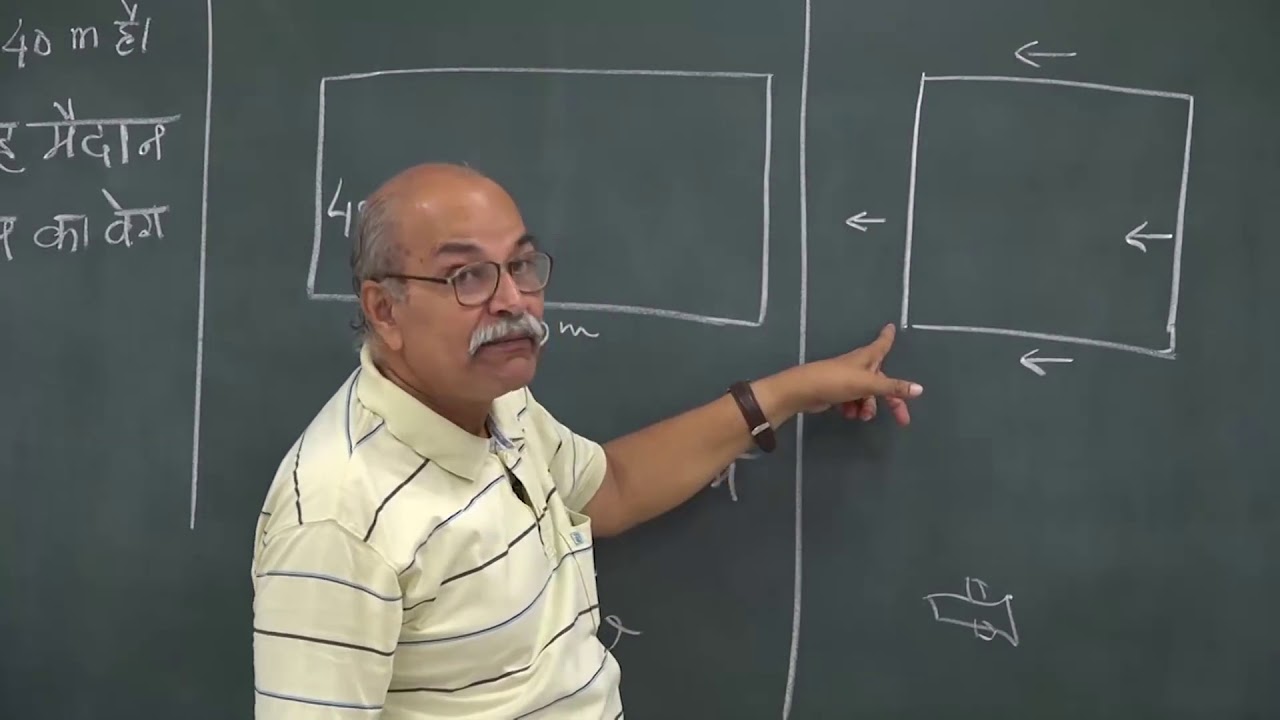
- First problem: rectangular field appears square from airplane; calculate speed.
- Second problem: train passing platform; find length in platform frame and proper length.
- Third problem: rod inclined at angle; derive angle transformation in moving frame.
- Discussion of length contraction as space contraction and its reality in accelerators.
Contribution & Novelties
The video provides a clear and systematic approach to solving length contraction problems, which is valuable for students. It emphasizes the conceptual understanding that length contraction applies to space itself, not just objects, and demonstrates this with examples involving distances between poles. The worked examples are typical but well-explained. For further exploration, one can look into the Lorentz transformation, the concept of proper time, and experimental evidence such as muon decay.
Pour aller plus loin :
- Lorentz transformation — Provides the mathematical foundation for length contraction.
- Muon decay experiment — Experimental evidence for time dilation and length contraction.
- Proper length — Definition and discussion of proper length in relativity.
109 words
Radar Profile
The radar profile shows a balanced performance across all dimensions, with slightly higher scores in quality of information and technical level, indicating a solid educational resource. The lower score in quantity of information reflects the limited number of examples and lack of external references.