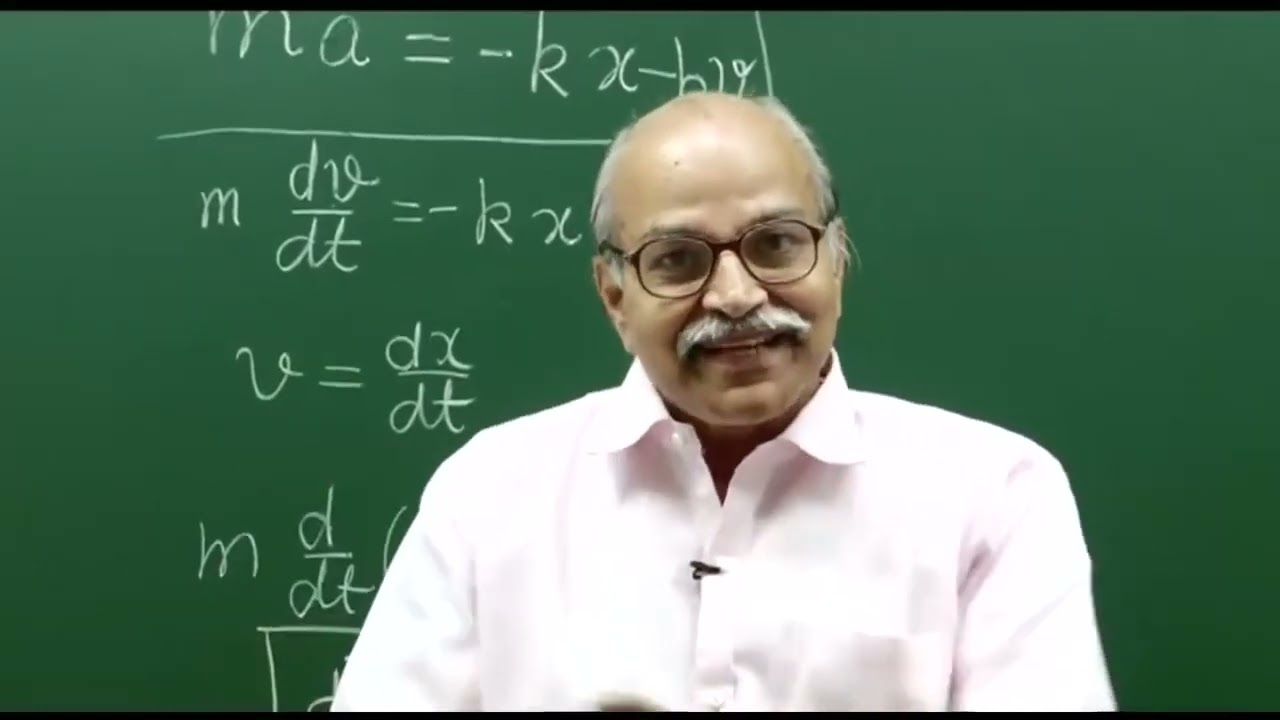
Exp 20 - Let us Resonate |Oscillation and Waves
Keywords
Summary
167 words
Critical Evaluation
Value of the Information & Strength of the Argument
The video provides valuable hands-on demonstrations that effectively illustrate the concept of resonance. The experiments are well-chosen and clearly show the dramatic increase in amplitude when the driving frequency matches the natural frequency. The argumentation is logical, building from basic principles of SHM and damping to the introduction of an external periodic force. The instructor explains the key equation for forced oscillations and highlights the role of the driving frequency in determining the response amplitude. The analogy to electrical circuits is insightful and helps to generalize the concept. However, the mathematical treatment is somewhat superficial, with the amplitude equation not fully derived, and the discussion of phase relationships is omitted. The argumentation is solid for an introductory level, but lacks depth for a more advanced audience.
Scientific Rigor, Source Quality, Title Accuracy
The scientific rigor is acceptable for an educational video. The physics is correct and the demonstrations are consistent with theoretical predictions. However, the video does not cite any external sources or references, which limits its scholarly value. The title accurately reflects the content, focusing on resonance. The presentation is informal and relies on live demonstrations rather than rigorous derivations, which is appropriate for a tutorial but may not satisfy viewers seeking a more formal treatment. The video does not include any advertising or sponsored content.
226 words
Title / Content Match
The title accurately reflects the content, which focuses on resonance in oscillating systems.
Quality & Reliability
7/10
The video provides a clear, step-by-step explanation of forced oscillations and resonance, supported by three live demonstrations. The physics is accurate and well-aligned with standard textbook treatments. However, the presentation is informal and lacks rigorous mathematical derivations, and no external sources are cited.
Key Moments
Markers derived by PSI from the transcript: the creator did not define chapters.
- Introduction to forced oscillations and resonance
- First demonstration: straw on wooden block, varying driving frequency
- Explanation of the forced oscillation equation and resonance condition
- Second demonstration: head massager with rods of different lengths
- Third demonstration: magnet in solenoid, resonance effect
- Analogy to electrical circuits: LCR circuit and tuning
- Preview of upcoming lectures on simple pendulum
Contribution & Novelties
The video offers a clear and engaging introduction to forced oscillations and resonance, using simple, reproducible experiments. Its main contribution is the pedagogical approach, making abstract concepts tangible through visual demonstrations. The analogy to electrical circuits is particularly effective in bridging mechanical and electrical oscillations.
Pour aller plus loin :
- Resonance (Wikipedia) — Provides a comprehensive overview of resonance in various physical systems.
- Harmonic oscillator (Wikipedia) — Discusses the mathematical treatment of oscillators, including forced and damped cases.
- RLC circuit (Wikipedia) — Explains the electrical analog of mechanical resonance and its applications in tuning.
94 words
Radar Profile
The radar profile shows a balanced performance across all dimensions, with slightly higher scores in quality of information and technical level, indicating a solid educational resource. The lower score in quantity of information reflects the video's concise length, while the high reliability score underscores the accuracy of the content.