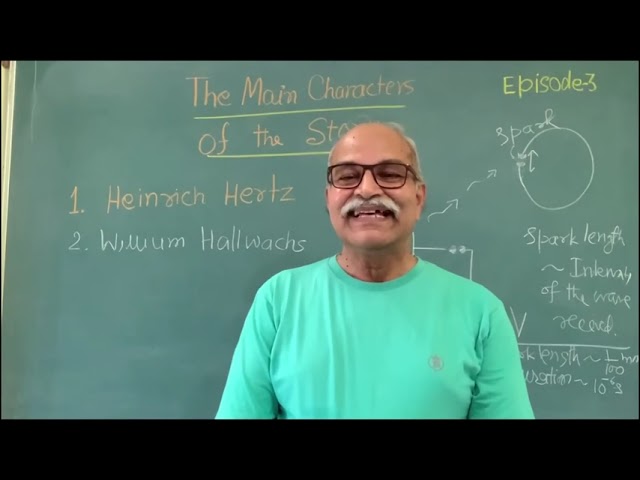
Episode 03 Hallwachs Experiment and its reconstruction
Keywords
Summary
150 words
Critical Evaluation
Value of the Information & Strength of the Argument
The video provides valuable historical context and a clear explanation of the physics behind Hallwachs’ experiment. The argumentation is solid, as the presenter logically connects Hertz’s observations to Hallwachs’ subsequent experiments. The demonstration is effective in illustrating the qualitative effect of UV light on charge dissipation. However, the video does not provide quantitative data or rigorous scientific analysis, and the presenter admits uncertainty about whether his homemade setup truly replicates the photoelectric effect.
Scientific Rigor, Source Quality, Title Accuracy
The presenter references historical sources, including a Physics Today article and descriptions of Hallwachs’ original equipment. However, he admits to relying on secondary sources for some details. The title accurately reflects the content. The video is scientifically rigorous in its explanation of the underlying physics, but the lack of primary sources and the qualitative nature of the demonstration limit its overall scientific rigor.
151 words
Title / Content Match
The title accurately reflects the content, which focuses on Hallwachs' experiment and its reconstruction.
Quality & Reliability
7/10
The video provides a detailed historical account of Hallwachs' experiment, with a clear explanation of the physics involved and a practical demonstration. However, the presenter admits to relying on secondary sources for some historical details, and the homemade setup may not perfectly replicate the original conditions.
Key Moments
Markers derived by PSI from the transcript: the creator did not define chapters.
- Introduction to the episode and recap of Hertz's experiments.
- Discussion of Hertz's apparatus and his observation of UV effect.
- Introduction of Hallwachs and his simplified experiment.
- Explanation of charging an electroscope by induction.
- Demonstration of the homemade electroscope and UV lamp experiment.
- Comparison of discharge times with and without UV light.
- Conclusion and preview of next episode on Thomson and Lenard.
Cited Sources
- Physics Today article on Hertz's equipment — Referenced in the video as a source for images of Hertz's original apparatus.
Concurring Sources
- Photoelectric effect - Wikipedia — Confirms the historical sequence of Hertz and Hallwachs experiments.
Contribution & Novelties
The video provides a clear and accessible explanation of Hallwachs’ experiment, which is often overshadowed by Hertz’s discovery. It offers a practical demonstration that viewers can replicate at home, making the historical experiment tangible. The presenter’s step-by-step explanation of charging an electroscope by induction is particularly instructive.
Pour aller plus loin :
- Photoelectric effect - Wikipedia — Provides a comprehensive overview of the phenomenon and its historical development.
- Hallwachs effect - Britannica — Discusses the contribution of Wilhelm Hallwachs to the discovery of the photoelectric effect.
- Wilhelm Hallwachs - Wikipedia — Biographical information about the physicist.
96 words
Radar Profile
The radar profile shows high scores in information quantity and technical level, indicating a content-rich video with moderate complexity. The quality and reliability scores are slightly lower, reflecting the reliance on secondary sources and the qualitative nature of the demonstration.