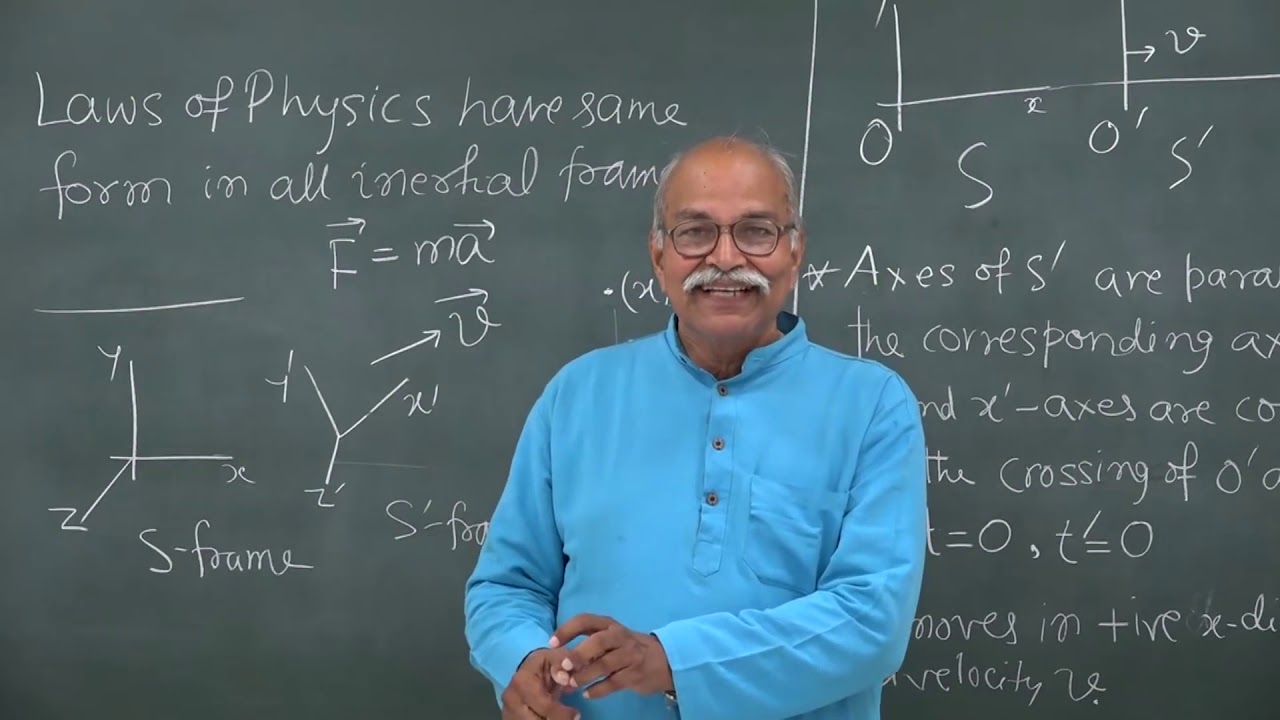
W2-01 Galilean Transformations
Keywords
Summary
133 words
Critical Evaluation
Value of the Information & Strength of the Argument
The lecture provides a clear and logical derivation of the Galilean transformations, building from the postulates of relativity. The argumentation is solid, with each step explicitly justified. The instructor carefully explains the assumptions and conventions used, making the derivation accessible. The value lies in its pedagogical clarity, though it does not offer new insights beyond standard textbook material.
Scientific Rigor, Source Quality, Title Accuracy
The lecture is scientifically rigorous, with correct mathematical derivations and clear explanations. However, it does not cite any external sources or references, relying solely on the instructor’s presentation. The title accurately reflects the content, which is a focused introduction to Galilean transformations. No comments were provided for analysis.
121 words
Title / Content Match
The title accurately reflects the content, which is a detailed introduction to Galilean transformations.
Quality & Reliability
8/10
The lecture is a clear, step-by-step derivation of Galilean transformations, grounded in the postulates of special relativity. It is mathematically rigorous and conceptually sound, though it does not cite external sources or discuss experimental verification.
Key Moments
Markers derived by PSI from the transcript: the creator did not define chapters.
- Introduction to the postulates of special relativity
- Setup of inertial frames S and S' with conventions
- Definition of an event and coordinates in both frames
- Derivation of position transformation equations
- Derivation of velocity transformation equations
- Derivation of acceleration transformation equations
- Discussion of reverse transformations and conclusion
Contribution & Novelties
The lecture provides a clear, step-by-step derivation of Galilean transformations, which is a fundamental topic in classical mechanics and relativity. It serves as a foundational introduction for students. For further exploration, consider the following:
- Galilean invariance — This concept is directly related to the invariance of Newton’s laws under Galilean transformations.
- Inertial frame of reference — The lecture relies on the concept of inertial frames, which is central to the discussion.
- Special relativity — The lecture sets the stage for special relativity, where Galilean transformations are replaced by Lorentz transformations.
90 words
Radar Profile
The radar profile shows high scores in information quantity, quality, and reliability, with a slightly lower technical level, indicating a well-structured and reliable lecture that is accessible to a general physics audience.