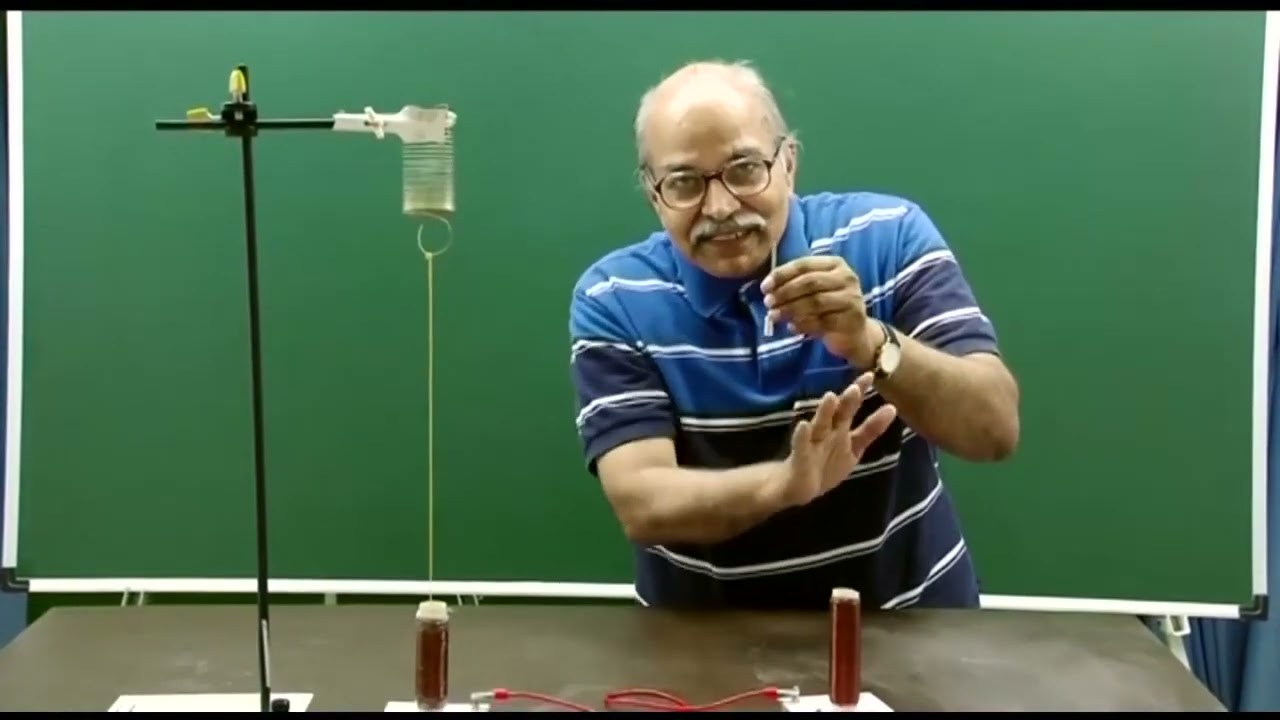
Exp 18 - Let us create Electric Current |Electricity -Magnetism
Keywords
Summary
196 words
Critical Evaluation
Value of the Information & Strength of the Argument
The video provides a clear and intuitive explanation of Faraday’s law, using multiple demonstrations to illustrate the concepts. The argumentation is logical and builds from the simple q(v x B) force to the concept of induced electric fields. The presenter correctly distinguishes between the two mechanisms of induction and emphasizes the physical principles. However, the explanation lacks mathematical rigor and does not provide formal derivations or quantitative analysis, which limits its depth for advanced learners.
Scientific Rigor, Source Quality, Title Accuracy
The scientific content is accurate and well-presented, with correct use of terminology and physical principles. The demonstrations are effective and support the explanations. However, the video does not cite any external sources or references, and the production quality is basic. The title accurately reflects the content, which is focused on creating electric current through electromagnetic induction.
146 words
Title / Content Match
The title accurately reflects the content, which focuses on creating electric current through electromagnetic induction.
Quality & Reliability
7/10
The video presents a clear and accurate explanation of Faraday's law of induction, with demonstrations and a correct physical interpretation. However, it lacks formal derivations and references to sources, and the production quality is basic.
Key Moments
Markers derived by PSI from the transcript: the creator did not define chapters.
- Introduction to Faraday's law and the classic experiment.
- Demonstration of moving magnet in and out of a coil, showing galvanometer deflection.
- Explanation of the magnetic force q(v x B) driving current when the coil moves.
- Second experiment with two solenoids and a magnet oscillating due to induced current.
- Explanation of induced electric field from changing magnetic field.
- Demonstration of wireless bulb lighting using AC coil and changing magnetic field.
- Final experiment with syringe and LEDs, showing both mechanisms combined.
- Summary of Faraday's law and the two ways to induce emf.
Contribution & Novelties
The video provides a hands-on demonstration of Faraday’s law, making the concept tangible. It clearly explains the two mechanisms of induction and highlights the role of induced electric fields. The experiments are simple and reproducible, which adds pedagogical value.
Pour aller plus loin :
- Faraday’s law of induction — Overview and mathematical formulation.
- Maxwell’s equations — Context of Faraday’s law within classical electromagnetism.
- Lenz’s law — Direction of induced current and conservation of energy.
74 words
Radar Profile
The radar profile shows high scores in information quality and reliability, with moderate scores in quantity and technical level. This indicates a solid educational video that is accurate but not highly technical or comprehensive.