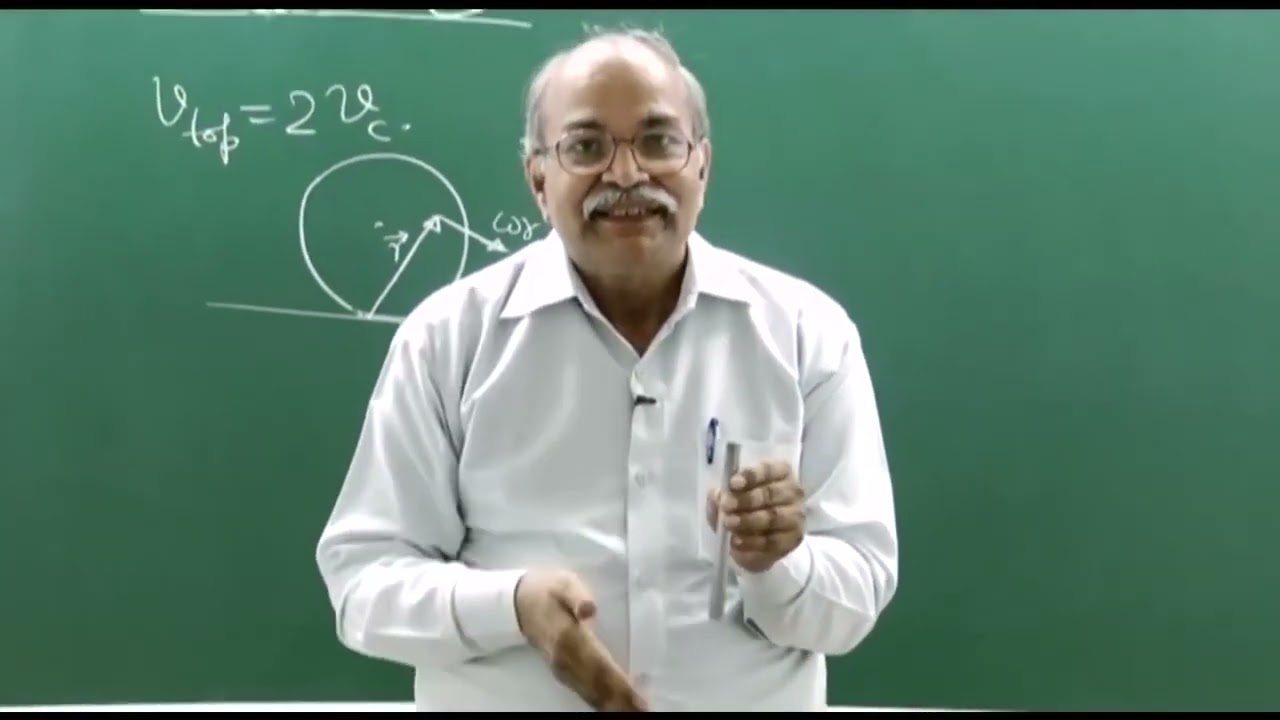
Exp 11 - Set the ball rolling | Mechanics
Keywords
Summary
140 words
Critical Evaluation
Value of the Information & Strength of the Argument
The video provides valuable insights into rolling motion through clear demonstrations and a solid theoretical framework. The argumentation is logical and well-structured: it starts with a qualitative definition, then presents an experiment to illustrate the velocity relationship, and finally derives the acceleration for a sphere on an incline. The experiments are simple yet effective in visualizing the concepts. The derivation is rigorous, correctly applying Newton’s laws and the no-slip condition. The comparison between sphere and disc is a good pedagogical extension, though the instructor does not complete the derivation for the disc, leaving it as an exercise. Overall, the content is accurate and the reasoning is sound.
Scientific Rigor, Source Quality, Title Accuracy
The video is scientifically rigorous in its explanations and derivations. The experiments are well-designed and the theoretical analysis is consistent with standard physics. However, the video does not cite any external sources or references, which limits its scholarly depth. The title accurately reflects the content, focusing on rolling motion experiments. The video is a tutorial, so it does not claim to present new research, but rather to explain established principles. The lack of citations is a minor weakness, but the content itself is reliable.
206 words
Title / Content Match
The title accurately reflects the content, which focuses on rolling motion experiments and analysis.
Quality & Reliability
8/10
The video provides a clear, step-by-step demonstration and derivation of rolling motion, with experiments that visually confirm theoretical predictions. The physics is accurate and well-explained, though it lacks formal citations and references.
Key Moments
Markers derived by PSI from the transcript: the creator did not define chapters.
- Introduction to rolling motion and its importance.
- Definition of rolling motion and no-slip condition.
- Experiment with cylinder and scale to show top point velocity is double center velocity.
- Demonstration with hands to illustrate the same principle.
- Experiment with steel and glass balls rolling down an incline, showing independence of mass and size.
- Theoretical derivation of acceleration for a sphere on an incline.
- Comparison of sphere and disc rolling down an incline, sphere moves faster.
Contribution & Novelties
The video provides a clear and accessible demonstration of rolling motion, reinforcing fundamental concepts through hands-on experiments. Its originality lies in the pedagogical approach, using simple materials to illustrate the velocity relationship and the independence of acceleration from mass and size. The derivation is standard but well-presented.
Pour aller plus loin :
- Rolling motion — Wikipedia article on rolling motion, covering the kinematics and dynamics.
- Moment of inertia — Wikipedia article explaining moment of inertia, crucial for understanding rotational dynamics.
- No-slip condition — Section on the no-slip condition in the rolling article, detailing the constraint between linear and angular velocity.
100 words
Radar Profile
The radar profile shows high scores in quality of information and reliability, with moderate scores in quantity and technical level. This indicates a focused, accurate tutorial that provides essential content without excessive depth or breadth.