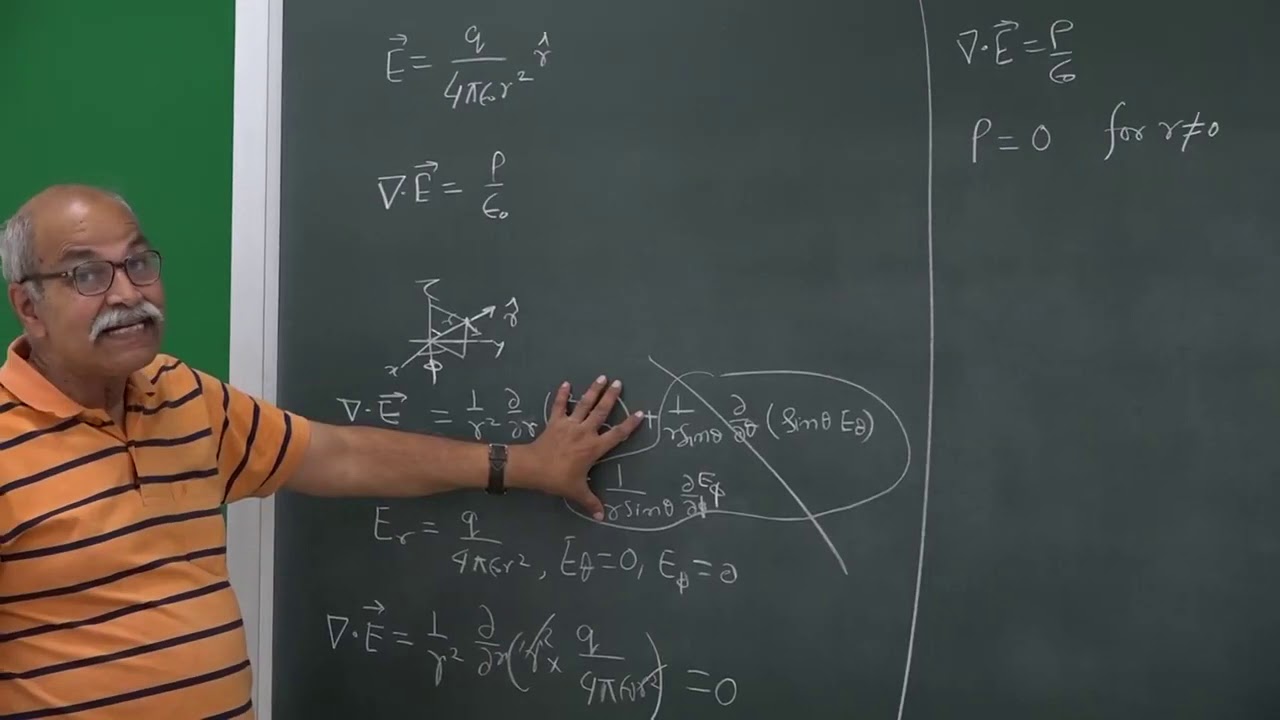
LEC 7 Charge distribution for k/r^2 field |Gauss's law
Keywords
Summary
156 words
Critical Evaluation
Value of the Information & Strength of the Argument
The lecture provides a clear and rigorous derivation of the charge distribution for a given electric field, illustrating the application of Gauss’s law in both differential and integral forms. The argumentation is solid, with careful handling of the singularity at the origin and the introduction of the Dirac delta function as a mathematical tool. The value lies in the pedagogical clarity and the step-by-step reasoning, which helps students understand the connection between field and source.
Scientific Rigor, Source Quality, Title Accuracy
The scientific rigor is high, as the lecture is based on fundamental principles of electrostatics and mathematical analysis. The sources are not explicitly cited, but the content aligns with standard textbooks on electromagnetism. The title accurately reflects the content, and the lecture is well-structured. No comments were provided for analysis.
140 words
Title / Content Match
The title accurately reflects the content: deriving the charge distribution for a k/r^2 electric field using Gauss's law.
Quality & Reliability
9/10
Lecture by a renowned physicist (H C Verma), rigorous mathematical derivation, clear pedagogical approach, and consistent use of Gauss's law and Dirac delta function.
Key Moments
Markers derived by PSI from the transcript: the creator did not define chapters.
- Introduction to the problem: given E = k/r^2, find the charge distribution.
- Review of Gauss's law in differential form and the divergence operator.
- Setting up spherical coordinates and expressing the divergence in that system.
- Computing the divergence for r ≠ 0 and finding it to be zero.
- Handling the singularity at the origin and introducing the Dirac delta function.
- Verifying the three properties of the Dirac delta function for the charge density.
- Concluding that the charge distribution is a point charge at the origin and summarizing the result.
Cited Sources
- Classical Electromagnetism-1 (Electrostatics) Playlist — The lecture is part of this playlist, which covers the full course on electrostatics.
Concurring Sources
- Classical Electromagnetism-1 (Electrostatics) Playlist — The lecture is part of this playlist, which covers the full course on electrostatics.
Contribution & Novelties
The lecture provides a clear pedagogical derivation of the charge distribution for a k/r^2 field, emphasizing the use of the Dirac delta function to represent point charges. It bridges the gap between the differential and integral forms of Gauss’s law, offering a rigorous treatment of the singularity at the origin.
Pour aller plus loin :
- Dirac delta function — Essential for understanding point charge representation.
- Gauss’s law — Fundamental law relating electric flux to enclosed charge.
- Divergence theorem — Mathematical tool connecting surface and volume integrals.
86 words
Radar Profile
The radar profile shows high scores in quantity, quality, technical level, and reliability, indicating a well-rounded and authoritative lecture. The strong technical level and reliability reflect the rigorous mathematical treatment and the expertise of the lecturer.