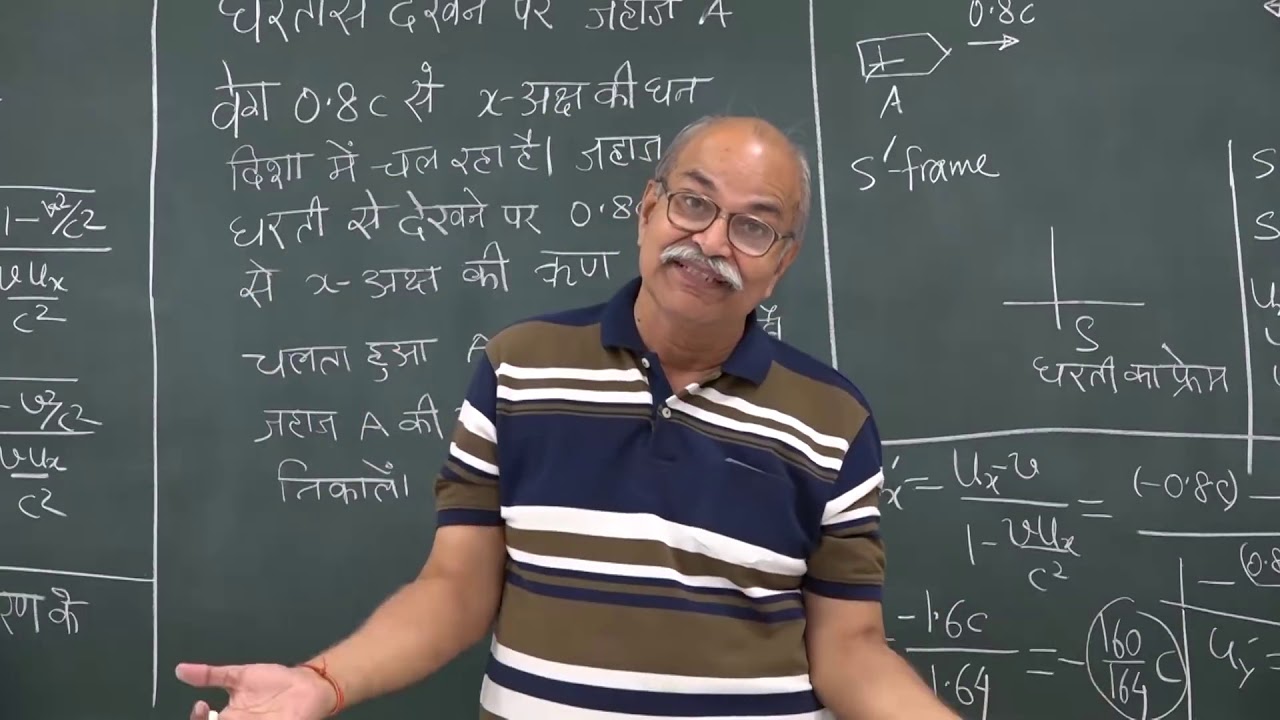
W5-03 Problems related to velocity addition
Keywords
Summary
175 words
Critical Evaluation
Value of the Information & Strength of the Argument
The video provides valuable worked examples that illustrate the application of velocity addition formulas in special relativity. The argumentation is solid: the instructor carefully sets up each problem, defines the frames, and applies the Lorentz transformation correctly. The results are consistent with the theory, and the discussion reinforces key concepts such as the invariance of the speed of light and the impossibility of superluminal speeds. The examples are well-chosen to demonstrate common pitfalls and the necessity of using relativistic formulas rather than classical Galilean addition.
Scientific Rigor, Source Quality, Title Accuracy
The scientific rigor is adequate for an educational video: the derivations are based on established equations, and the logic is sound. However, no external sources are cited, and the video does not provide derivations of the transformation equations themselves, assuming prior knowledge. The title accurately reflects the content, which is focused on solving velocity addition problems. The video does not include any references to literature or external resources, which limits its utility for further study.
175 words
Title / Content Match
The title accurately reflects the content, which focuses on solving problems related to velocity addition in special relativity.
Quality & Reliability
7/10
The video is a physics lecture that correctly applies the Lorentz transformation equations to solve two standard problems in special relativity. The reasoning is clear and the results are consistent with established theory. However, the video lacks citations to external sources and does not provide rigorous derivations, relying on previously established formulas.
Key Moments
Markers derived by PSI from the transcript: the creator did not define chapters.
- Introduction and review of Lorentz transformation for velocities
- Problem 1: Two airplanes moving at relativistic speeds; setup and application of velocity addition
- Calculation of relative velocity of airplane B as seen from airplane A
- Discussion of result: relative velocity is less than speed of light
- Problem 2: Electromagnetic wave in a moving frame; setup and application of velocity transformation
- Derivation showing speed of light is invariant in all frames
- Conclusion: no object can exceed speed of light; light speed is constant
Contribution & Novelties
The video provides clear, step-by-step solutions to two classic problems in special relativity, demonstrating the application of velocity addition formulas. It reinforces the invariance of the speed of light and the impossibility of superluminal speeds. While the content is not novel, it serves as a useful pedagogical resource.
Pour aller plus loin :
- Special relativity — Overview of the theory.
- Velocity addition formula — Detailed derivation and applications.
- Lorentz transformation — Mathematical foundation.
73 words
Radar Profile
The radar profile shows high scores in quality of information and technical level, indicating a solid educational content. The quantity of information is moderate, and the global reliability is good, though limited by the lack of citations.