W8-03 Magnetic field a consequence of relativity
Keywords
Summary
210 words
Critical Evaluation
Value of the Information & Strength of the Argument
The lecture provides a clear and rigorous derivation of the magnetic field from electrostatics and special relativity. The argumentation is logical and step-by-step, starting with a paradox and resolving it through a concrete model. The use of length contraction and force transformation is well-explained, and the final result matches the standard Biot-Savart law for a long straight wire. The value lies in demonstrating the deep connection between electricity and magnetism through relativity, which is a fundamental insight in physics. The reasoning is solid, with no apparent logical gaps, and the mathematical steps are clearly presented.
Scientific Rigor, Source Quality, Title Accuracy
The lecture is scientifically rigorous, with accurate physics and clear derivations. However, it does not cite any external sources, which is typical for a lecture but limits the ability to verify claims independently. The title accurately reflects the content, as the lecture indeed shows that magnetic fields are a consequence of relativity. The presentation is well-structured, and the mathematical notation is consistent. The lack of citations is a minor weakness, but the content itself is reliable.
186 words
Title / Content Match
The title accurately reflects the content, which demonstrates that magnetic fields arise as relativistic corrections to electric fields.
Quality & Reliability
8/10
The lecture provides a rigorous derivation of the magnetic field from electrostatics and special relativity, using clear mathematical steps and physical reasoning. The content is accurate and well-structured, though it lacks citations to external sources.
Key Moments
Markers derived by PSI from the transcript: the creator did not define chapters.
- Introduction: overview of the course and the question of how relativity relates to electric and magnetic fields.
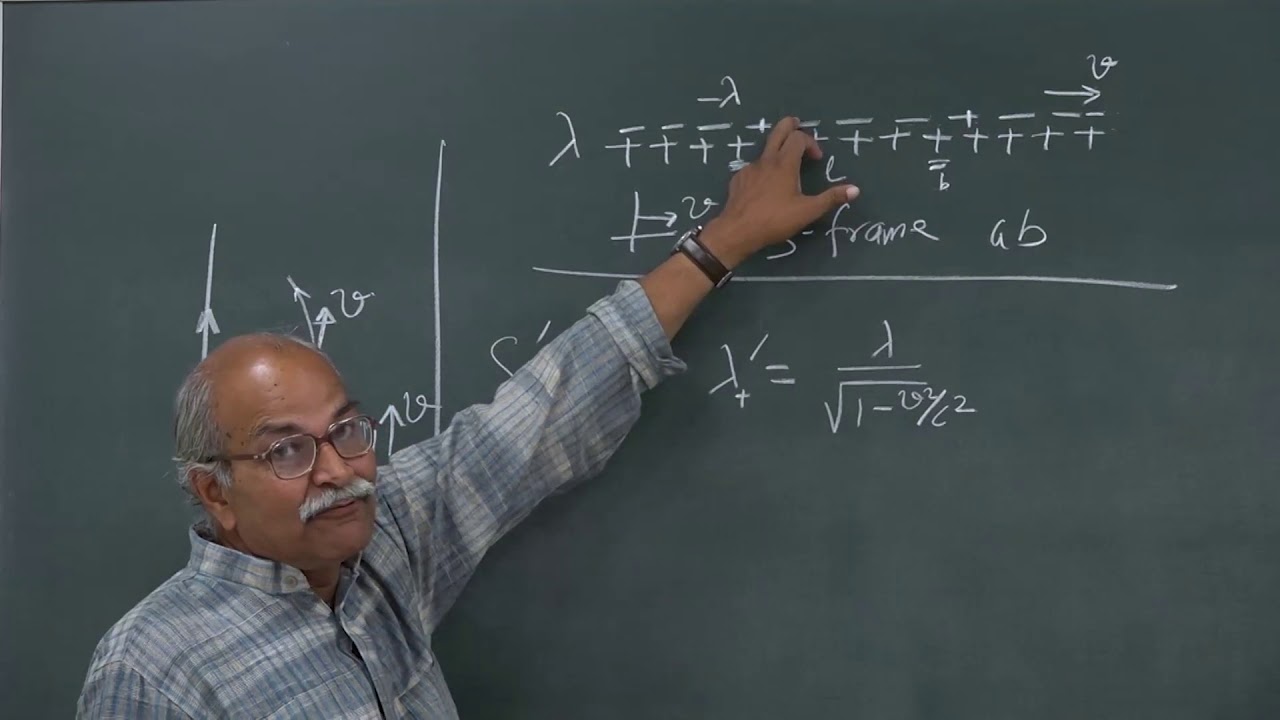
- Presentation of the paradox: a moving charge near a current-carrying wire experiences a magnetic force, but in a frame moving with the charge, the charge is at rest and should not feel a magnetic force.
- Introduction of the model: two superimposed line charges, one positive stationary and one negative moving with velocity v.
- Analysis in the moving frame: length contraction leads to a net charge density, resulting in an electric field.
- Calculation of the electric field and force on a test charge in the moving frame.
- Use of the relativistic force transformation to find the force in the lab frame.
- Identification of the force as magnetic, with the magnetic field expressed as B = μ₀I/(2πy).
- Conclusion: magnetism is a relativistic phenomenon, and the magnetic field arises from the relativistic transformation of electric fields.
Contribution & Novelties
The lecture provides a clear and accessible derivation of the magnetic field from electrostatics and special relativity, which is a fundamental insight in physics. It offers a pedagogical approach that resolves common paradoxes and deepens understanding of electromagnetism.
Pour aller plus loin :
- Special relativity — Provides the foundational principles of relativity used in the derivation.
- Magnetic field — Overview of magnetic fields and their properties.
- Biot–Savart law — The law that gives the magnetic field due to a current element, which the lecture derives for a long straight wire.
90 words
Radar Profile
The radar profile shows high scores in information quality, technical level, and reliability, with a slightly lower score in information quantity, indicating a focused and rigorous lecture that may not cover a broad range of topics but excels in depth.