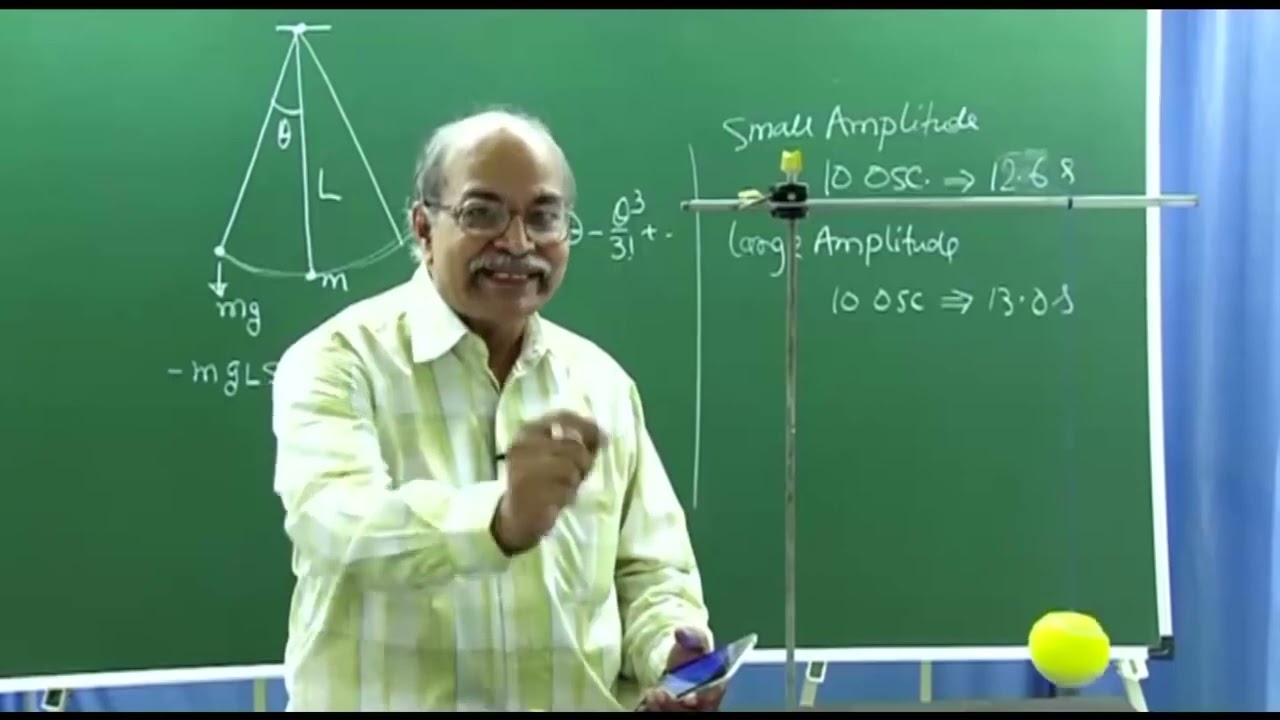
Exp 21 - Simple Pendulum is not that simple |Oscillation and Waves
Keywords
Summary
170 words
Critical Evaluation
Value of the Information & Strength of the Argument
The video provides valuable insights into the limitations of the simple pendulum model. It clearly demonstrates the amplitude dependence of the period, which is often overlooked in introductory physics. The presenter supports his claims with a simple experiment and a mathematical derivation of the first-order correction. The argumentation is logical and easy to follow, though the experimental data is not rigorously analyzed (only one trial per amplitude). The demonstration of the rotating ellipse is particularly interesting, showing a non-intuitive phenomenon. However, the explanation for the rotation is qualitative and could be more detailed.
102 words
Title / Content Match
The title accurately reflects the content: it demonstrates that the simple pendulum is not as simple as often taught, showing amplitude effects and plane rotation.
Quality & Reliability
7/10
The video presents a clear experimental demonstration of the amplitude dependence of the pendulum period, with a mathematical derivation of the first-order correction. However, the experiment is not rigorously controlled (no precise angle measurement, single trial), and the presenter acknowledges potential timing errors. The explanation of the rotating ellipse is qualitative and lacks a full mathematical treatment.
Key Moments
Markers derived by PSI from the transcript: the creator did not define chapters.
- Introduction to the simple pendulum and derivation of the time period formula.
- Explanation of the small-angle approximation and its limitations.
- Experiment: measuring time for 10 oscillations at small amplitude.
- Experiment: measuring time for 10 oscillations at large amplitude.
- Discussion of experimental errors and need for multiple trials.
- Derivation of the more accurate formula for time period with amplitude correction.
- Demonstration of the rotating ellipse when transverse velocity is given.
- Explanation of why the plane of oscillation changes due to non-ideal suspension.
Cited Sources
- Mechanics (book by Sanjay and Griffiths) — Mentioned as a reference for the mathematics of the rotating ellipse.
Concurring Sources
- Pendulum (Wikipedia) — Confirms the standard formula and amplitude correction.
Contribution & Novelties
The video provides a clear experimental demonstration of the amplitude dependence of the pendulum period, which is often not emphasized in standard textbooks. It also shows the non-intuitive phenomenon of plane rotation when the pendulum is released with a transverse velocity, and explains it qualitatively. The presenter offers practical tips for starting a pendulum smoothly.
Pour aller plus loin :
- Pendulum (Wikipedia) — Overview of pendulum physics, including amplitude effects.
- Pendulum (mathematics) — Detailed mathematical treatment of the pendulum equation.
- Foucault pendulum — Related phenomenon of plane rotation due to Earth’s rotation.
92 words
Radar Profile
The radar profile shows balanced scores across information quantity, quality, technical level, and reliability, indicating a solid educational video with minor limitations in experimental rigor.