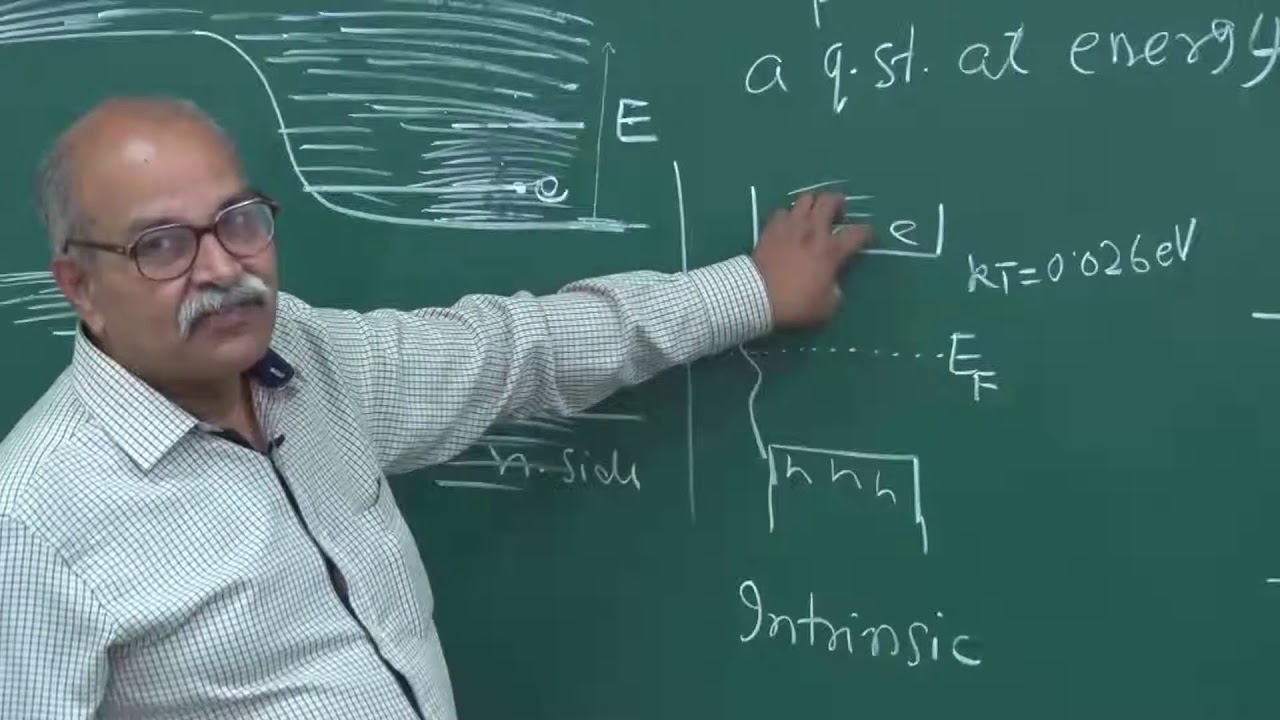
W6-02 Fermi function and Fermi energy #SemiconductorPhysics #HCVerma
Keywords
Summary
198 words
Critical Evaluation
Value of the Information & Strength of the Argument
The lecture provides a clear and logical explanation of the Fermi function and its application to semiconductors. The argumentation is solid, building from the physical motivation (need to know electron distribution) to the mathematical definition and graphical interpretation. The instructor effectively uses intuitive reasoning, such as the behavior at absolute zero and the effect of temperature, to make the concept accessible. The discussion of intrinsic, p-type, and n-type semiconductors is well-structured, showing how the Fermi level shifts and how this affects carrier concentrations. The introduction of density of states is crucial and well-integrated, as it completes the picture of electron distribution. The argumentation is coherent and free of logical gaps, making it a valuable educational resource.
Scientific Rigor, Source Quality, Title Accuracy
The scientific rigor is high: the Fermi function and density of states are presented accurately, and the physical reasoning is consistent with standard semiconductor theory. However, the lecture does not cite any external sources, which limits the ability to verify claims independently. The title accurately reflects the content, focusing on the Fermi function and Fermi energy. The lecture is part of a series, and the instructor references previous material, which helps contextualize the topic. Overall, the content is reliable, but the lack of citations is a minor weakness.
219 words
Title / Content Match
The title accurately reflects the content, which focuses on the Fermi function and Fermi energy in the context of semiconductor physics.
Quality & Reliability
8/10
The lecture is pedagogically clear, mathematically correct, and consistent with standard semiconductor physics. The derivation of the Fermi function and density of states is accurate, and the explanation of band bending and carrier distribution is sound. However, no external sources are cited, and the presentation is purely theoretical without experimental verification.
Key Moments
Markers derived by PSI from the transcript: the creator did not define chapters.
- Introduction and recap of band bending in PN junction
- Introduction of Fermi function and its definition
- Plot of Fermi function at T=0K and at room temperature
- Application to intrinsic semiconductor: Fermi level at midgap
- Application to p-type and n-type semiconductors: Fermi level shifts
- Explanation of single Fermi level in equilibrium and band alignment in PN junction
- Introduction of density of states and its energy dependence
- Graphical representation of density of states and Fermi function
- Product of Fermi function and density of states gives electron distribution
- Summary and preview of drift current
Contribution & Novelties
This lecture provides a clear and systematic introduction to the Fermi function and its application to semiconductors, which is a foundational concept in solid-state physics. The instructor’s pedagogical approach, using graphical interpretations and intuitive explanations, makes the material accessible. The lecture also introduces the density of states, which is essential for calculating carrier concentrations. The integration of these concepts to explain carrier distribution in different semiconductor types is well done. For further exploration, one can refer to standard textbooks on semiconductor physics, such as ‘Solid State Electronic Devices’ by Streetman and Banerjee, or online resources like the HyperPhysics pages on Fermi energy and density of states.
Pour aller plus loin :
- Fermi–Dirac statistics — Provides the theoretical background of the Fermi function.
- Density of states — Explains the concept in detail, including its derivation for free electrons.
- Semiconductor — Overview of semiconductor properties and band structure.
146 words
Radar Profile
The radar profile shows high scores in information quantity, quality, and reliability, with a slightly lower technical level, indicating a well-balanced and accessible lecture for an introductory semiconductor physics course.