W9-03 Electromagnetic field Tensor
Keywords
Summary
160 words
Critical Evaluation
Value of the Information & Strength of the Argument
The lecture provides a clear and rigorous derivation of the magnetic field of a moving charge using Lorentz transformations, which is a valuable pedagogical approach. The argumentation is solid, as each step is carefully explained and the connection to the Biot-Savart law is highlighted. The introduction of the electromagnetic field tensor is well-motivated, showing how the electric and magnetic fields are components of a single tensor. The lecturer emphasizes the mathematical structure, which is essential for a deep understanding of electromagnetism in special relativity.
Scientific Rigor, Source Quality, Title Accuracy
The lecture is scientifically rigorous, with derivations based on established principles of special relativity and electrodynamics. However, no external sources are cited, and the content is presented as a lecture rather than a peer-reviewed work. The title accurately reflects the content, as the lecture indeed focuses on the electromagnetic field tensor. The presentation is consistent with standard textbooks on the subject, such as Griffiths’ ‘Introduction to Electrodynamics’.
166 words
Title / Content Match
The title accurately reflects the content, which focuses on deriving the electromagnetic field tensor from Lorentz transformations.
Quality & Reliability
8/10
The lecture is mathematically rigorous, deriving the magnetic field of a moving charge from Lorentz transformations and introducing the electromagnetic field tensor. The presentation is clear and logically structured, with explicit derivations and comparisons to Biot-Savart law. However, the video lacks citations to external sources and the content is not peer-reviewed, but it is consistent with standard special relativity and electrodynamics.
Key Moments
Markers derived by PSI from the transcript: the creator did not define chapters.
- Introduction and recap of transformation equations for electric and magnetic fields.
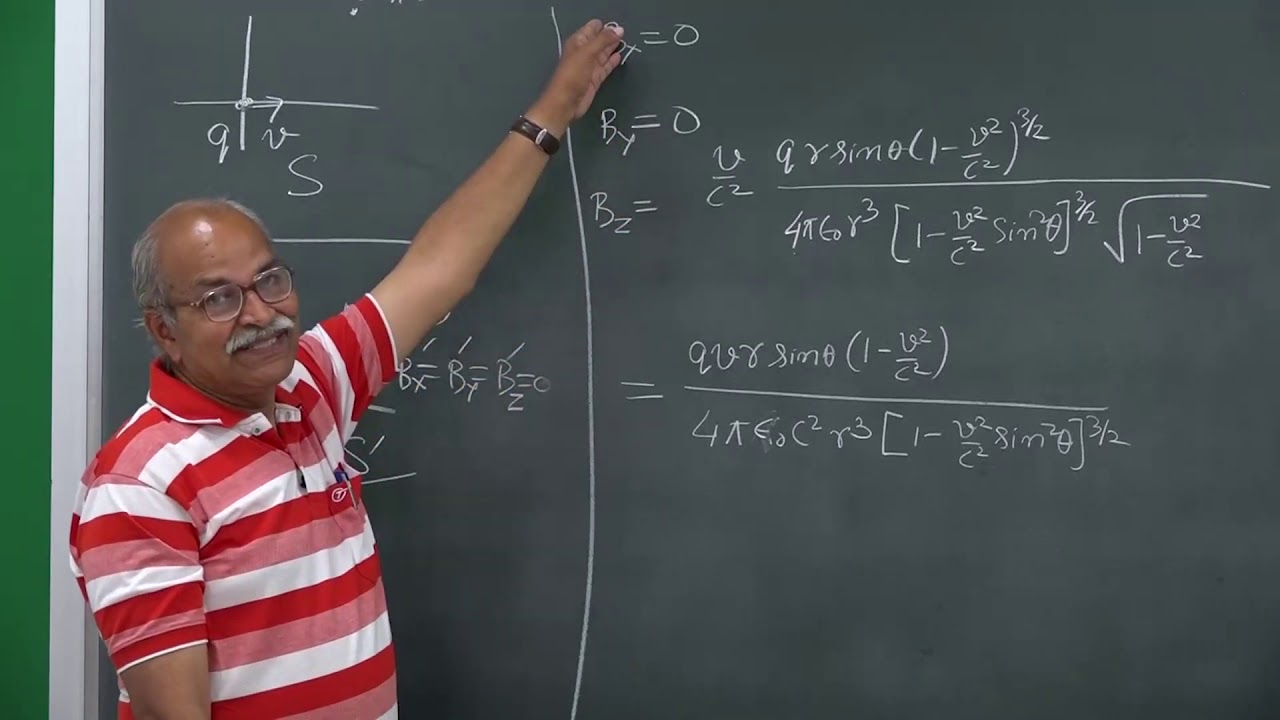
- Derivation of magnetic field of a moving charge using Lorentz transformations.
- Comparison with Biot-Savart law and low-velocity approximation.
- Introduction to four-vectors and Lorentz transformation matrix.
- Definition of second-rank tensors and construction of electromagnetic field tensor.
- Transformation of electromagnetic field tensor under Lorentz transformations.
- Preview of Minkowski diagrams and conclusion.
Concurring Sources
- Introduction to Electrodynamics — Standard textbook covering electromagnetic field tensor and special relativity.
Contribution & Novelties
The lecture provides a clear and detailed derivation of the electromagnetic field tensor, which is a fundamental concept in special relativity. It bridges the gap between the transformation equations for electric and magnetic fields and the tensor formulation, making the material accessible to students. The comparison with the Biot-Savart law is particularly instructive.
Pour aller plus loin :
- Electromagnetic tensor - Wikipedia — Provides a comprehensive overview of the tensor and its properties.
- Special relativity - Wikipedia — Background on the theory and its postulates.
- Lorentz transformation - Wikipedia — Details on the transformation rules used in the lecture.
99 words
Radar Profile
The radar profile shows high scores in technical level and information quality, indicating a rigorous and detailed lecture. The moderate scores in quantity and reliability suggest that while the content is substantial, it lacks external references and may not cover all aspects of the topic.