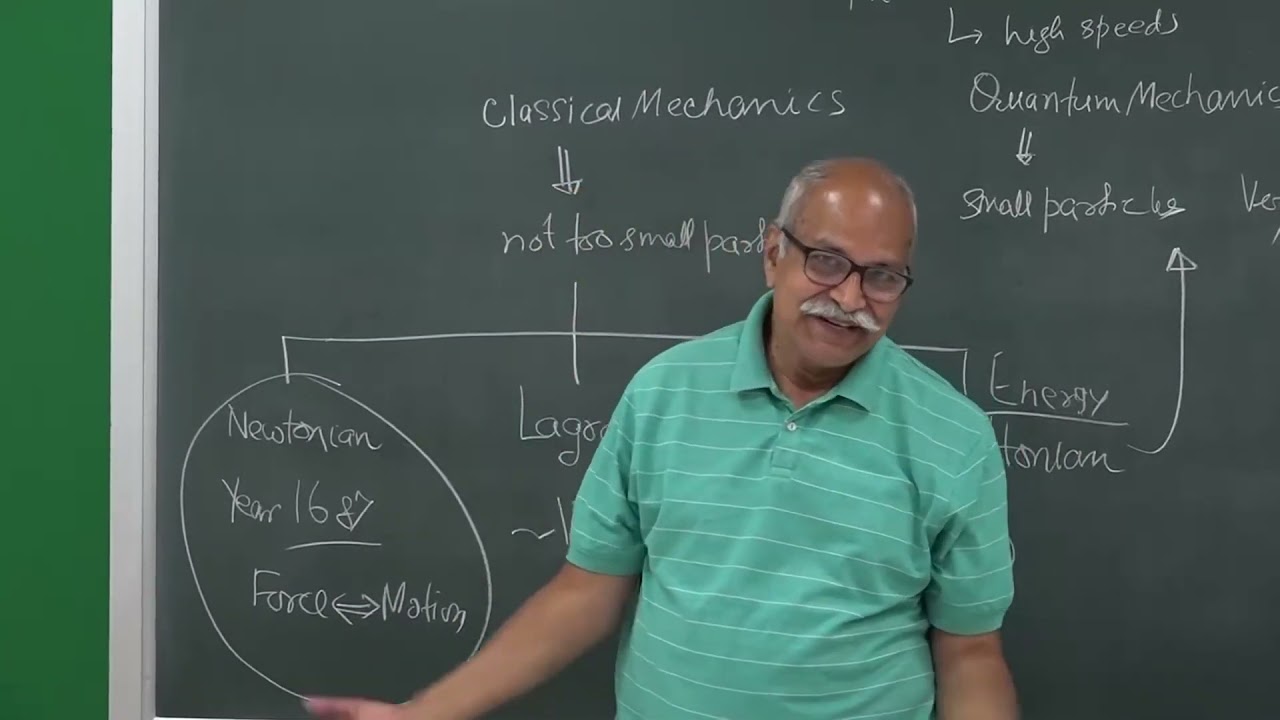
Lecture 01 Newtons 3rd law once again
Keywords
Summary
151 words
Critical Evaluation
Value of the Information & Strength of the Argument
The lecture provides a solid foundational understanding of Newton’s laws, with clear explanations and illustrative examples. The argumentation is logical and well-structured, building from the definition of classical mechanics to the specifics of each law. The discussion of the first law’s role in defining inertial frames is particularly valuable, as it clarifies a common misconception. The example of the pendulum in an accelerating car effectively demonstrates the limitations of the first law in non-inertial frames. The treatment of the third law, including the weak and strong forms, is thorough and correct. However, the lecture does not delve into advanced applications or modern perspectives, and it lacks citations to primary sources.
Scientific Rigor, Source Quality, Title Accuracy
The scientific rigor is adequate for an introductory lecture; the content is accurate and consistent with standard physics textbooks. However, no sources are cited, and the lecture does not reference experimental evidence or historical documents. The title is somewhat misleading as it suggests a focus solely on the third law, but the lecture covers all three laws and broader context. This mismatch is minor and does not significantly detract from the content’s value.
198 words
Title / Content Match
The title 'Newtons 3rd law once again' is somewhat misleading as the lecture covers all three laws and the broader context of classical mechanics, but it does revisit the third law in detail.
Quality & Reliability
7/10
The lecture is a clear and accurate exposition of Newton's laws, with a correct emphasis on the distinction between inertial and non-inertial frames and the weak/strong forms of the third law. However, it is a basic introductory lecture without citations or references to primary sources, and it does not address modern nuances or experimental verifications.
Key Moments
Markers derived by PSI from the transcript: the creator did not define chapters.
- Introduction to the course and overview of mechanics branches.
- Discussion of classical mechanics formulations: Newtonian, Lagrangian, Hamiltonian.
- Explanation of Newton's first law and its role in defining inertial frames.
- Example of pendulum in accelerating car to illustrate non-inertial frames.
- Statement of Newton's second law and its validity in inertial frames.
- Introduction to Newton's third law and common misconceptions.
- Explanation of weak and strong forms of the third law.
Contribution & Novelties
The lecture offers a clear pedagogical explanation of Newton’s laws, particularly emphasizing the conceptual distinction between inertial and non-inertial frames and the simultaneous nature of action-reaction forces. It provides a useful framework for students transitioning from high school to university-level mechanics.
Pour aller plus loin :
- Newton’s laws of motion — Overview and historical context.
- Inertial frame of reference — Detailed explanation of inertial frames and their significance.
- Action–reaction principle — Further discussion on the third law and its applications.
80 words
Radar Profile
The radar profile shows high scores in quality and reliability, moderate in quantity and technical level, indicating a solid introductory lecture with accurate content but limited depth and no external references.