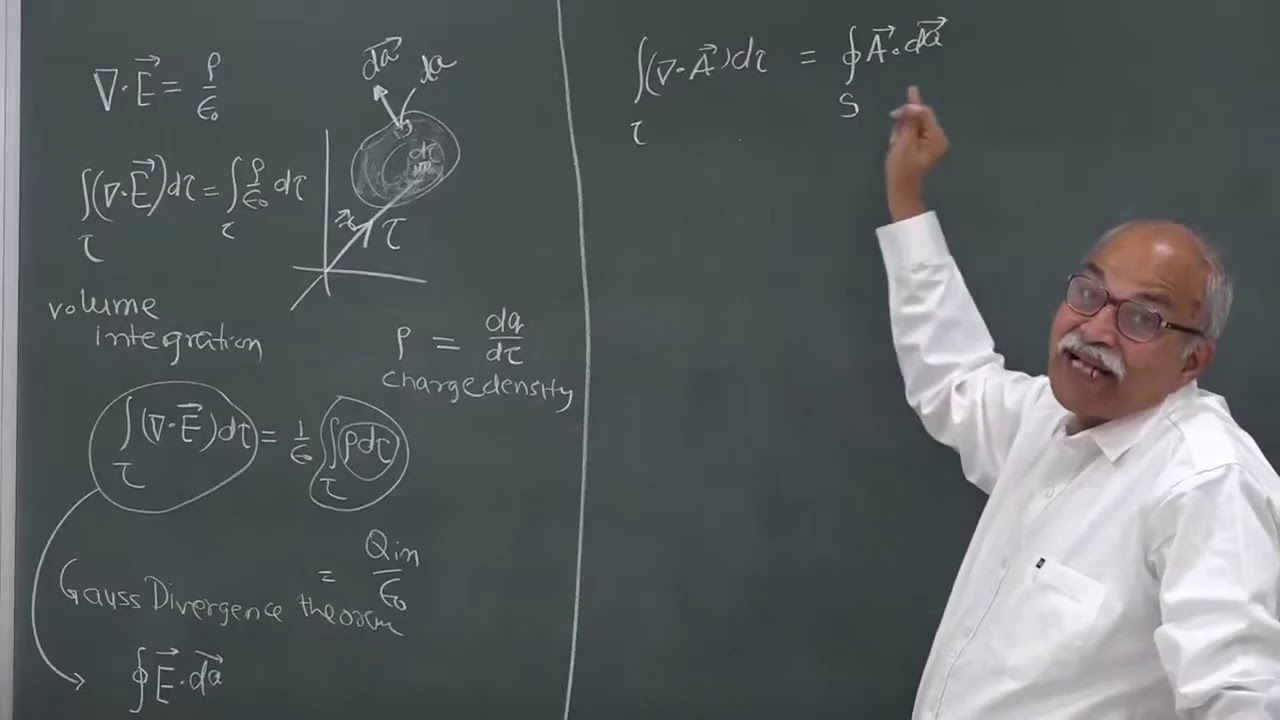
LEC 8 Integral form of Gauss's law | Gauss's law
Keywords
Summary
197 words
Critical Evaluation
Value of the Information & Strength of the Argument
The lecture provides a clear and rigorous derivation of the integral form of Gauss’s law from the differential form using the divergence theorem. The argumentation is logical and step-by-step, making it accessible to students. The professor emphasizes the physical meaning of each term and the importance of symmetry in applying Gauss’s law. He also addresses common misconceptions, such as the role of external charges in the electric field. The value lies in the pedagogical clarity and the emphasis on conceptual understanding, which is typical of Prof. Verma’s teaching style.
Scientific Rigor, Source Quality, Title Accuracy
The lecture is scientifically rigorous, with a solid mathematical foundation. The professor does not cite external sources, but the content is standard in classical electromagnetism textbooks. The title accurately reflects the content, as the lecture is specifically about the integral form of Gauss’s law. The video is part of a structured course, indicating a systematic approach. No comments were provided for analysis.
166 words
Title / Content Match
The title accurately reflects the content: the lecture focuses on the integral form of Gauss's law, deriving it from the differential form and applying it to symmetric charge distributions.
Quality & Reliability
8/10
The lecture is delivered by a renowned physicist and educator, Prof. H.C. Verma, known for his clear and rigorous teaching. The content is mathematically sound and follows standard derivations from Maxwell's equations. The video is part of a structured course on Classical Electromagnetism, indicating a systematic approach.
Key Moments
Markers derived by PSI from the transcript: the creator did not define chapters.
- Review of the differential form of Gauss's law: divergence of E equals rho/epsilon0.
- Derivation of the integral form by integrating the divergence over a volume and applying the divergence theorem.
- Explanation that the electric field in the integral includes contributions from all charges, while the right-hand side only includes enclosed charge.
- Application to a point charge: choosing a spherical Gaussian surface and using symmetry to simplify the flux integral.
- Discussion on the importance of symmetry in choosing Gaussian surfaces and the concept of spherical symmetry.
- Example of a uniformly charged sphere: finding the electric field inside and outside using Gauss's law.
- Graph of electric field vs. distance for a uniformly charged sphere, showing linear increase inside and inverse square outside.
- Conclusion and preview of other symmetries to be discussed in the next lecture.
Cited Sources
- Classical Electromagnetism-1 (Electrostatics) Playlist — Complete course playlist by Prof. H.C. Verma, containing this lecture and others.
Concurring Sources
- Gauss's law - Wikipedia — Standard reference for Gauss's law, consistent with the lecture content.
Contribution & Novelties
The lecture provides a clear and rigorous derivation of the integral form of Gauss’s law, emphasizing the physical interpretation and the role of symmetry. It is particularly valuable for students preparing for competitive exams like IIT JAM, CSIR NET, and GATE, as it builds a strong conceptual foundation.
Pour aller plus loin :
- Gauss’s law - Wikipedia — Overview of Gauss’s law, its integral and differential forms, and applications.
- Divergence theorem - Wikipedia — Mathematical theorem used to convert volume integrals to surface integrals.
- Electric flux - Wikipedia — Definition and concept of electric flux, central to Gauss’s law.
99 words
Radar Profile
The radar profile shows high scores in quantity and quality of information, with a slightly lower but still solid technical level. The global reliability is high, reflecting the expertise of the lecturer. The overall balance indicates a well-structured and informative lecture.