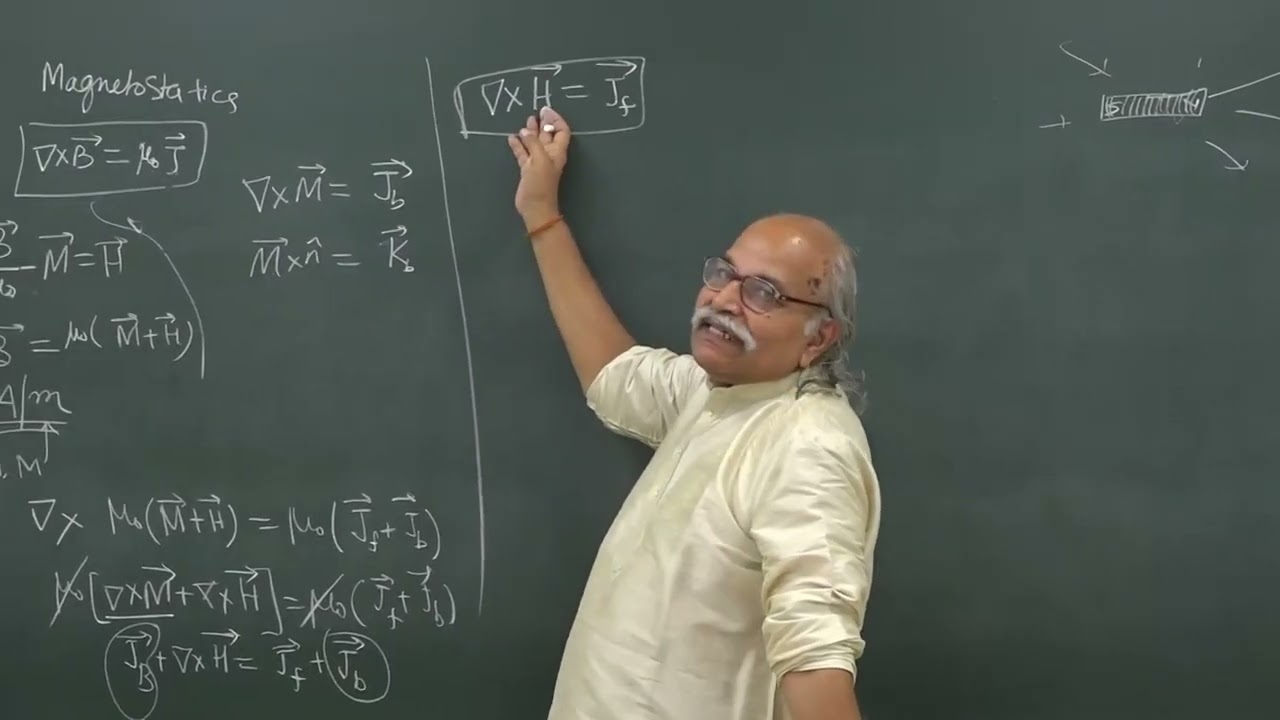
LEC 39 - H-Field and Free Current #magnetostatics #H-Charge Density Model #hcverma
Keywords
Summary
199 words
Critical Evaluation
Value of the Information & Strength of the Argument
The lecture provides a clear and rigorous derivation of the equations governing the H-field, highlighting the importance of both curl and divergence in determining a vector field. The argumentation is solid, using mathematical derivations and physical examples to illustrate the concepts. The analogy with electrostatics is well-explained and offers a powerful tool for solving magnetostatic problems. The value lies in clarifying a common point of confusion and providing a systematic approach to understanding H-field sources.
Scientific Rigor, Source Quality, Title Accuracy
The lecture is scientifically rigorous, with derivations consistent with standard electromagnetism. No external sources are cited, but the content is based on fundamental principles. The title accurately reflects the content, focusing on the H-field and free currents. The lecture is part of a series, and the instructor assumes prior knowledge of vector calculus and basic electromagnetism.
146 words
Title / Content Match
The title accurately reflects the content, focusing on the H-field and free currents, with a mention of the H-charge density model.
Quality & Reliability
8/10
The lecture is a rigorous derivation of magnetostatic equations, consistent with standard physics. The instructor uses clear mathematical steps and physical reasoning, though no external sources are cited.
Key Moments
Markers derived by PSI from the transcript: the creator did not define chapters.
- Introduction: recap of H-field dual behavior and outline of the lecture.
- Derivation of curl H = J_f from curl B = μ0 J and B = μ0(M + H).
- Discussion of examples: long rod vs. disc, showing bound currents can affect H.
- Explanation that a vector field is determined by both curl and divergence; introduction of div H = -div M.
- Analogy with electrostatics: -div M acts as a charge density for H.
- Detailed analysis of divergence of M at surfaces, leading to surface 'H-charge'.
- Further analogy: when free currents are absent, curl H = 0, making the problem electrostatic-like.
- Conclusion: promise of examples in the next lecture.
Contribution & Novelties
The lecture provides a clear pedagogical explanation of the H-field sources, emphasizing the role of divergence of magnetization. It introduces the concept of ‘H-charge density’ as an analogy to electric charge, which is a useful mental model. The approach of using both curl and divergence to determine H is a valuable insight for students.
Pour aller plus loin :
- Magnetostatics — Provides background on magnetostatic equations.
- Magnetic field — General overview of magnetic fields and H-field.
- Maxwell’s equations — Context for the equations used in the lecture.
87 words
Radar Profile
The radar profile shows high scores in information quality and technical level, with slightly lower scores in quantity and reliability due to the lack of external sources. The lecture is dense and technical, suitable for advanced students.