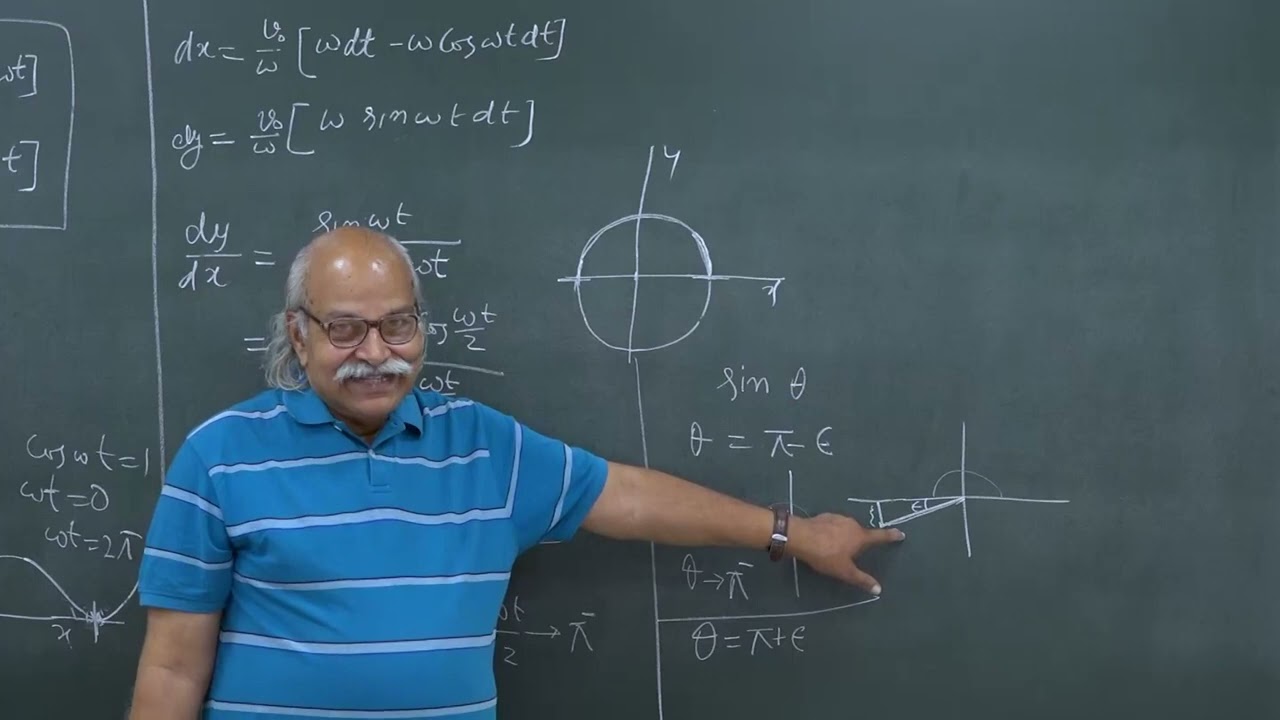
LEC 14 - Crossed E B Field 2
Keywords
Summary
134 words
Critical Evaluation
Value of the Information & Strength of the Argument
The lecture provides a thorough mathematical derivation of the cycloid path, including a careful limit analysis to determine the slope at the cusp. The argumentation is solid, building on previous derivations and using frame transformations to simplify the problem. The use of Desmos to visualize the trajectories enhances understanding and confirms the analytical results. The lecture effectively demonstrates the power of choosing an appropriate reference frame to simplify complex motion.
79 words
Title / Content Match
The title accurately reflects the content, which continues the analysis of charged particle motion in crossed electric and magnetic fields.
Quality & Reliability
8/10
The lecture is mathematically rigorous, deriving equations step-by-step and using computational verification (Desmos). The physics is standard and correctly applied. No external sources are cited, but the content is self-contained and logically consistent.
Key Moments
Markers derived by PSI from the transcript: the creator did not define chapters.
- Recap of previous lecture: particle in crossed E and B fields, frame transformation, parametric equations.
- Derivation of dy/dx and limit analysis at the point where y=0.
- Identification of the path as a cycloid and discussion of cusp behavior.
- Introduction of initial velocity v0/2 and transformation to S' frame.
- Derivation of new parametric equations for the trajectory.
- Desmos visualization of the new trajectory showing loops.
- Preview of upcoming cases with initial velocities v0 and 2v0.
Contribution & Novelties
This lecture provides a clear, step-by-step derivation of the cycloid path for a charged particle in crossed fields, including a rigorous limit analysis to determine the slope at the cusp. It demonstrates the utility of frame transformations and computational verification. The lecture is part of a series, so its novelty lies in the pedagogical approach and the explicit treatment of the initial velocity cases.
Pour aller plus loin :
- Cycloid — Wikipedia article on cycloids, the curve traced by a point on a rolling circle.
- Lorentz force — Wikipedia article on the Lorentz force law, fundamental to the motion of charged particles in electromagnetic fields.
- E×B drift — Wikipedia article on guiding center drift, including E×B drift, which is relevant to the frame transformation used.
125 words
Radar Profile
The radar profile shows high scores in information quantity, quality, and technical level, with a slightly lower but still strong reliability score. This indicates a technically dense and reliable lecture, suitable for an audience with some physics background.