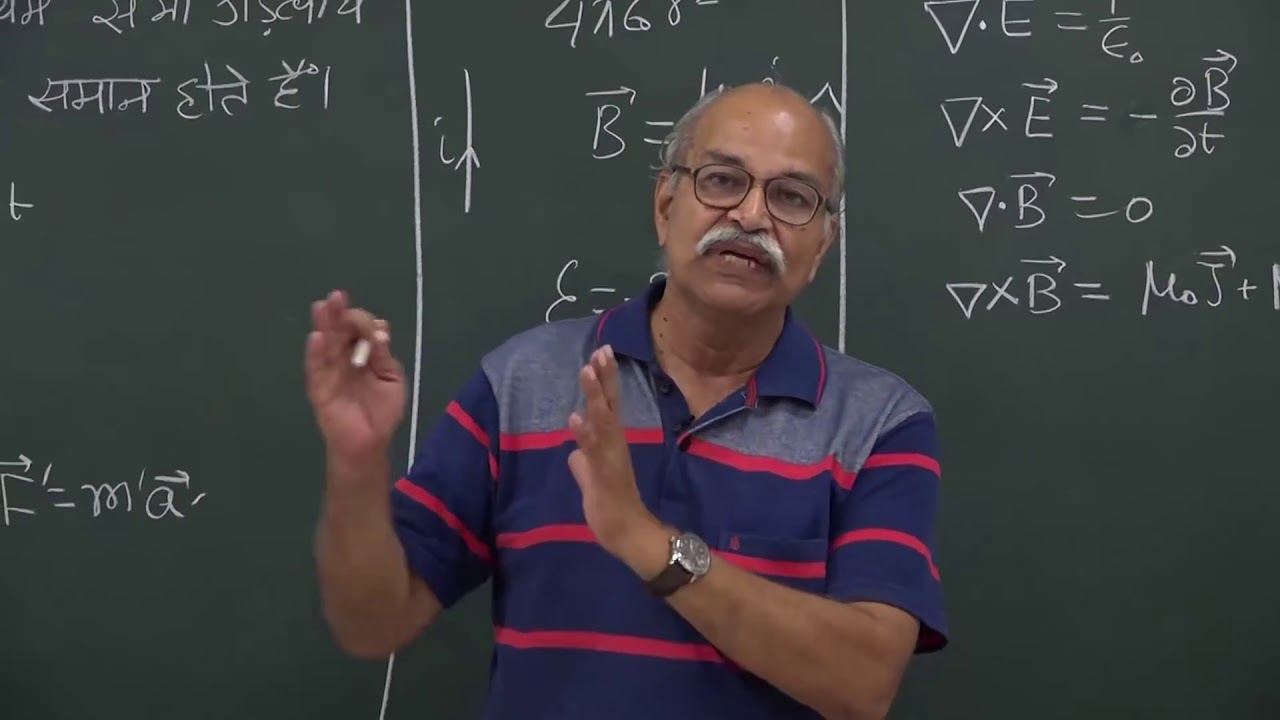
W2-01 Non Invariance of Maxwell's laws under (GT) #Relativity #Physics #Lectures
Keywords
Summary
164 words
Critical Evaluation
Value of the Information & Strength of the Argument
The lecture provides a clear and logical argument for the non-invariance of Maxwell’s equations under Galilean transformations. It effectively uses the wave equation derived from Maxwell’s equations to show that the speed of light is constant in all frames, which contradicts the Galilean velocity addition. The historical narrative about the ether and the Michelson-Morley experiment is well-integrated, and the derivation of the expected time difference is detailed and instructive. However, the argumentation could be strengthened by explicitly stating the assumptions and limitations of the Galilean transformation and by providing more rigorous mathematical steps. The value of the information is high for an introductory course on relativity, as it sets up the motivation for special relativity.
Scientific Rigor, Source Quality, Title Accuracy
The lecture is scientifically accurate in its main points, but it lacks explicit citations to primary sources. The title accurately reflects the content. The presentation is rigorous in its derivations, though some steps are glossed over. The lecture does not mention any sources, but the historical context is correctly presented. The adequacy between title and content is excellent. No comments were provided for analysis.
194 words
Title / Content Match
The title accurately reflects the content, which focuses on the non-invariance of Maxwell's laws under Galilean transformations.
Quality & Reliability
7/10
The lecture is a formal educational presentation on the non-invariance of Maxwell's equations under Galilean transformations. It explains the historical context and the Michelson-Morley experiment, but lacks citations to primary sources and contains some imprecisions in the derivation and notation.
Key Moments
Markers derived by PSI from the transcript: the creator did not define chapters.
- Introduction to the lecture and review of Galilean transformations and the principle of relativity.
- Discussion of Maxwell's equations and their role in electromagnetism.
- Derivation of the wave equation from Maxwell's equations and identification of the speed of light.
- Explanation of the conflict between Maxwell's equations and Galilean transformations.
- Introduction to the luminiferous ether and the search for a preferred frame.
- Description of the Michelson-Morley experiment setup and its purpose.
- Derivation of the time for light to travel along the direction of Earth's motion.
- Derivation of the time for light to travel perpendicular to Earth's motion.
- Comparison of the two times and the expected fringe shift.
- Conclusion and preview of the next lecture.
Contribution & Novelties
This lecture provides a clear pedagogical explanation of why Maxwell’s equations are not invariant under Galilean transformations, using the wave equation and the Michelson-Morley experiment. It effectively bridges the gap between classical mechanics and special relativity. The lecture is part of a series, so it builds on previous knowledge and sets up future topics.
Pour aller plus loin :
- Michelson-Morley experiment — The historical experiment that failed to detect the ether, leading to the development of special relativity.
- Luminiferous aether — The hypothetical medium for light propagation, which was disproved by the Michelson-Morley experiment.
- Maxwell’s equations — The set of equations that describe electromagnetism and predict the speed of light.
110 words
Radar Profile
The radar profile shows a balanced performance across all dimensions, with slightly higher scores in information quantity and quality, reflecting the lecture's comprehensive coverage and clear explanations. The technical level is moderate, suitable for an introductory course, and the reliability is good, though not perfect due to lack of citations.