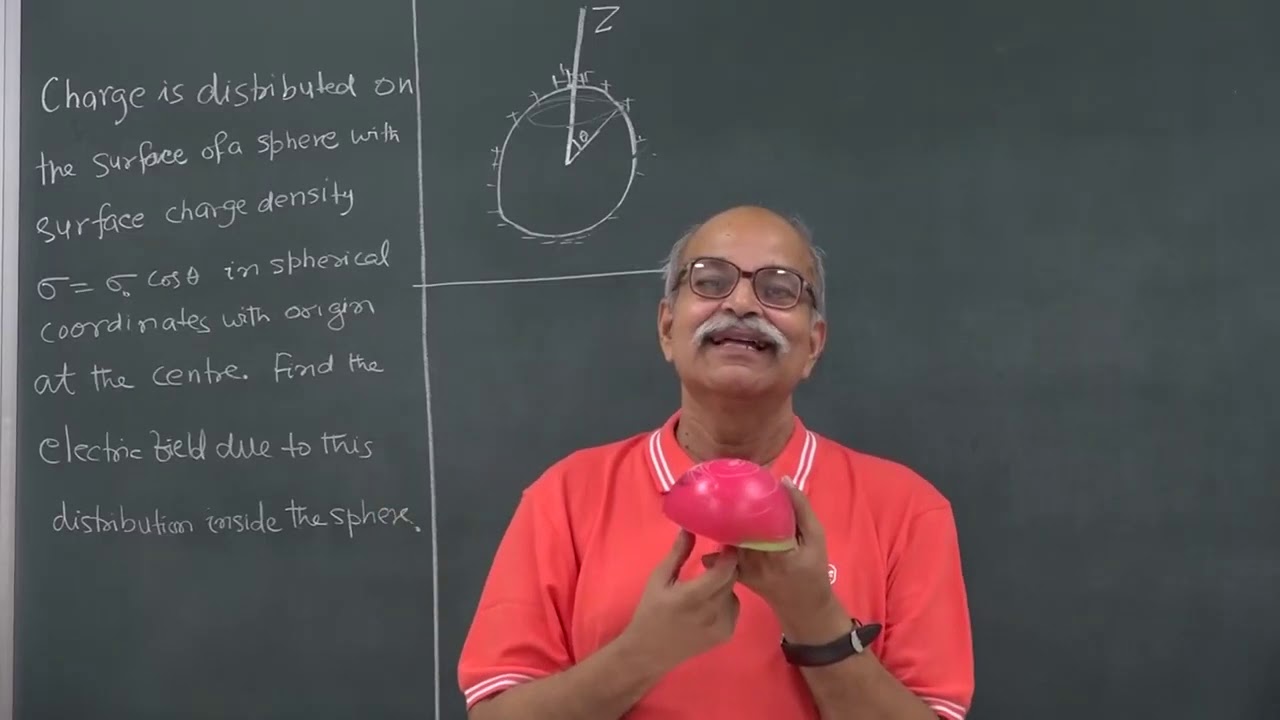
LEC 12 Gauss's law applied to asymmetrical charge distribution | Gauss's law
Keywords
Summary
144 words
Critical Evaluation
Value of the Information & Strength of the Argument
The lecture provides valuable insight into applying Gauss’s law to non-symmetric charge distributions by using superposition. The argumentation is rigorous and logically structured, starting from known results for uniformly charged spheres and building up to the final expression. The derivation is clear and mathematically sound, with careful attention to vector directions and magnitudes. The lecturer also connects the result to the limit of a thin sheet, reinforcing the conceptual understanding. The value lies in demonstrating a technique that extends the utility of Gauss’s law beyond symmetric cases, which is a key skill in electrostatics.
Scientific Rigor, Source Quality, Title Accuracy
The scientific rigor is high, as the lecture follows standard derivations and the physics is correct. No external sources are cited, but the content is based on well-established principles. The title accurately describes the content, focusing on the application of Gauss’s law to an asymmetrical charge distribution. The lecture is part of a larger course on classical electromagnetism, and the quality is consistent with the instructor’s reputation. The lack of citations is not a major issue for a lecture, as the derivations are self-contained and verifiable.
195 words
Title / Content Match
The title accurately reflects the content: the lecture applies Gauss's law to a non-symmetric charge distribution (two overlapping spheres) and derives the resulting uniform field.
Quality & Reliability
8/10
Lecture by a renowned physicist (H.C. Verma) known for clarity and rigor. The content is mathematically sound and consistent with standard electrostatics. No citations are given, but the derivations are standard and verifiable.
Key Moments
Markers derived by PSI from the transcript: the creator did not define chapters.
- Introduction to the lecture and review of Gauss's law.
- Discussion of charge distributions with symmetry and the need for superposition.
- Setup of the problem: two overlapping spheres with opposite charge densities.
- Derivation of the electric field inside the overlapping region using superposition.
- Result: uniform electric field inside the sphere, proportional to the displacement.
- Discussion of the limit to a surface charge and the field due to a charged plane.
- Summary and conclusion, emphasizing the usefulness of the result.
Cited Sources
- Classical Electromagnetism-1 (Electrostatics) Playlist — The lecture is part of this playlist, which contains the full course.
Concurring Sources
- Gauss's law - Wikipedia — The lecture's use of Gauss's law aligns with the standard formulation and applications described in this reference.
Contribution & Novelties
The lecture provides a clear demonstration of applying Gauss’s law to a non-symmetric charge distribution by using the superposition principle. The key novelty is the derivation of a uniform electric field inside a sphere with a surface charge distribution that results from the superposition of two uniformly charged spheres. This result is not only elegant but also useful for solving more complex problems. The lecture also bridges the gap between volume and surface charge distributions, showing how a thin slab can be approximated as a surface charge.
Pour aller plus loin :
- Gauss’s law - Wikipedia — Provides a comprehensive overview of Gauss’s law and its applications.
- Superposition principle - Wikipedia — Explains the principle of superposition in physics, which is central to the lecture’s method.
- Electric field - Wikipedia — Offers background on electric fields and their calculation.
139 words
Radar Profile
The radar profile shows high scores in all dimensions, with a slight emphasis on technical level and reliability, reflecting the lecture's rigorous mathematical treatment and the instructor's authority. The balanced scores indicate a well-rounded educational content.
💬 No comments were provided for analysis.