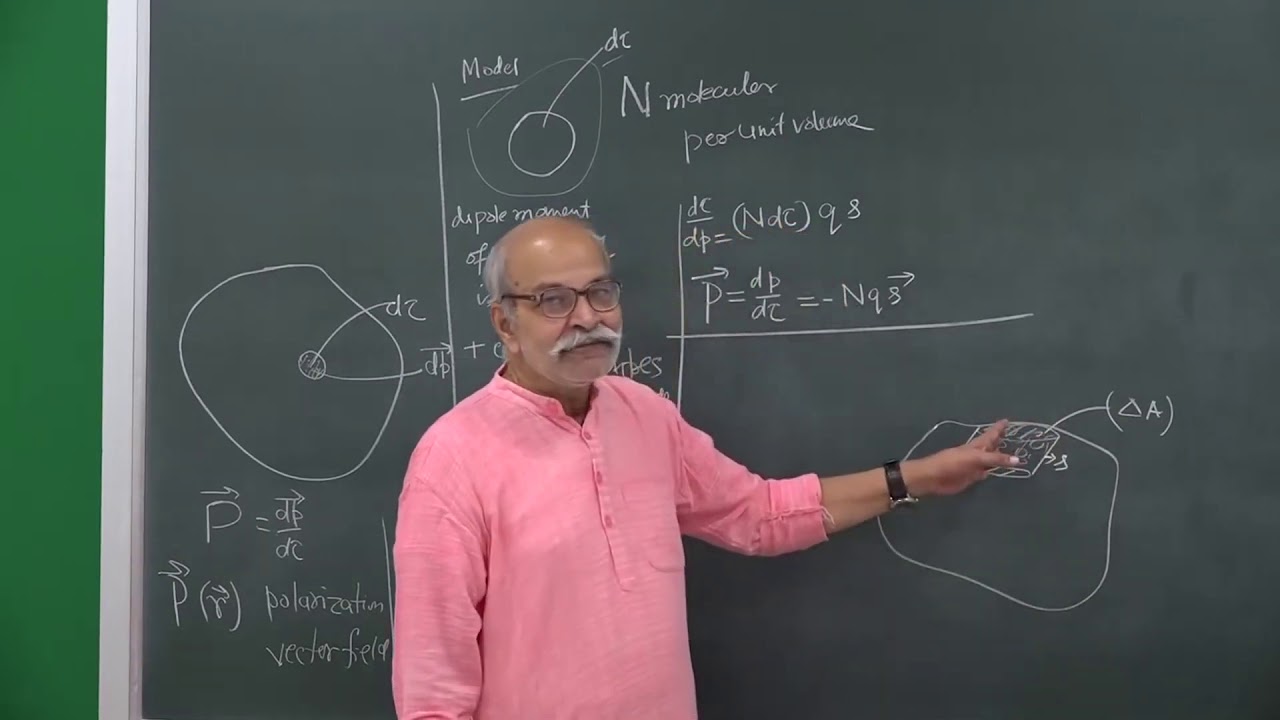
LEC 34 Bound charge densities
Keywords
Summary
195 words
Critical Evaluation
Value of the Information & Strength of the Argument
The lecture provides a clear and rigorous derivation of bound charge densities, which is fundamental to understanding electrostatics in dielectrics. The argumentation is solid, building from a simple atomic model to the macroscopic polarization vector, and then using vector calculus to derive the surface and volume bound charges. The use of the divergence theorem is well-explained, and the physical interpretation is emphasized throughout. The value lies in the pedagogical clarity and the step-by-step approach, making complex concepts accessible to students.
Scientific Rigor, Source Quality, Title Accuracy
The scientific rigor is high, as the lecture follows standard textbook derivations and mathematical consistency. However, no external sources are cited within the lecture itself, and the only source provided is the playlist link. The title accurately reflects the content, focusing specifically on bound charge densities. The lecture is part of a structured course, indicating a systematic approach to the subject.
156 words
Title / Content Match
The title accurately reflects the content, which focuses on deriving and explaining bound charge densities in dielectrics.
Quality & Reliability
8/10
The lecture is delivered by a renowned physicist, Prof. H.C. Verma, known for his pedagogical clarity. The content is mathematically rigorous, deriving bound surface and volume charge densities from first principles using divergence theorem. The presentation is systematic and accurate, though it lacks explicit citations to external sources.
Key Moments
Markers derived by PSI from the transcript: the creator did not define chapters.
Cited Sources
- Classical Electromagnetism-1 (Electrostatics) Playlist — The complete lecture series by Prof. H.C. Verma, of which this lecture is a part.
Concurring Sources
- Classical Electromagnetism-1 (Electrostatics) Playlist — The lecture is part of a series, indicating consistency with the broader course content.
Contribution & Novelties
This lecture provides a clear and intuitive derivation of bound charge densities, which is a cornerstone in understanding dielectrics. The approach of using a simple atomic model to build up to the macroscopic polarization vector is particularly effective for students. The lecture emphasizes the physical meaning of bound charges as opposed to free charges, which is often a point of confusion.
Pour aller plus loin :
- Polarization density — Wikipedia article providing a comprehensive overview of polarization density and related concepts.
- Gauss’s law — Fundamental law used in the derivation of bound charges.
- Divergence theorem — Mathematical theorem used to relate surface and volume integrals.
105 words
Radar Profile
The radar profile shows a balanced performance across all dimensions, with slightly lower scores in 'quantite_information' and 'niveau_technique' compared to 'qualite_information' and 'fiabilite_globale'. This indicates a lecture that is technically sound and reliable, but may not cover an extensive amount of material or delve into extremely advanced topics.