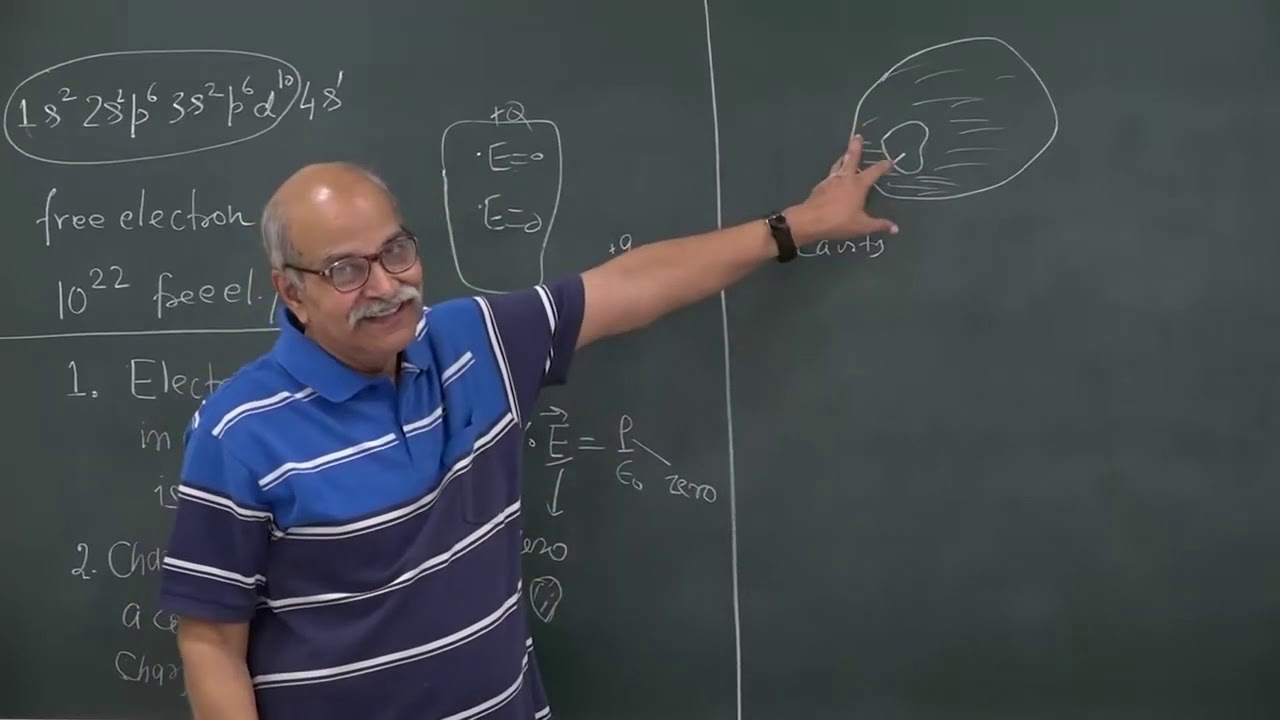
LEC 21 Electric field in presence of conductors
Keywords
Summary
170 words
Critical Evaluation
Value of the Information & Strength of the Argument
The lecture provides a clear and logical explanation of fundamental concepts in electrostatics. The argumentation is solid, building from the definition of free electrons to the derivation of zero electric field inside a conductor, and then to the consequences for charge distribution. The use of Gauss’s law and the principle of superposition is rigorous. The instructor also addresses common misconceptions and provides intuitive justifications, such as why field lines cannot abruptly change direction without charges. The value lies in the pedagogical clarity and the step-by-step reasoning, which is suitable for students at the undergraduate level.
Scientific Rigor, Source Quality, Title Accuracy
The scientific rigor is high, as the lecture is based on well-established principles of electromagnetism. The instructor does not cite external sources, but the content is standard textbook material. The title accurately reflects the content, which is specifically about electric fields in the presence of conductors. The lecture is part of a larger course, and the playlist link is provided for further context. No comments were analyzed for this video.
180 words
Title / Content Match
The title accurately reflects the content, which focuses on the behavior of electric fields in the presence of conductors.
Quality & Reliability
8/10
Lecture by a renowned physicist, logically structured, with rigorous derivations based on Maxwell's equations and electrostatic principles. The content is accurate and well-explained, though it is a pedagogical presentation rather than a peer-reviewed source.
Key Moments
Markers derived by PSI from the transcript: the creator did not define chapters.
- Introduction to conductors and free electrons
- Explanation of copper's electron configuration and free electrons
- Statement: electric field inside a conductor is zero in electrostatic equilibrium
- Derivation using Gauss's law: charge density inside conductor is zero
- Discussion on charge residing on the surface of a conductor
- Introduction to cavities in conductors and induced charges
- Proof that electric field inside a cavity is zero using line integrals
- Summary of key results and preview of future lectures
Cited Sources
- Classical Electromagnetism-1 (Electrostatics) Playlist — Complete playlist of the lecture series by Prof. H.C. Verma
Concurring Sources
- Classical Electromagnetism-1 (Electrostatics) Playlist — The lecture is part of a series, and the playlist provides additional context and continuity.
Contribution & Novelties
The lecture provides a clear and rigorous explanation of the behavior of electric fields in conductors, emphasizing the zero field inside and the distribution of charges. It offers intuitive justifications and mathematical derivations that are valuable for students. The novelty lies in the pedagogical approach and the comprehensive treatment of cavities.
Pour aller plus loin :
- Gauss’s law — Fundamental law used to derive charge density inside conductors.
- Electrostatic induction — Phenomenon explaining charge redistribution on conductors.
- Faraday cage — Practical application of zero electric field inside a conductor.
89 words
Radar Profile
The radar profile shows high scores in quantity and quality of information, with a moderate technical level, indicating a lecture that is both informative and accessible. The overall reliability is high, reflecting the authoritative nature of the instructor.