W3-02 Lines spread into rectangles #SemiconductorPhysics
Keywords
Summary
163 words
Critical Evaluation
Value of the Information & Strength of the Argument
The lecture provides a solid conceptual foundation for understanding energy bands in solids. It uses multiple complementary approaches—qualitative, molecular orbital, and periodic potential—which reinforces the concept and caters to different learning styles. The argumentation is logical and builds step by step, from single atoms to molecules to solids. The explanation of bonding and anti-bonding orbitals in hydrogen is particularly clear and helps justify why hydrogen is diatomic while helium is not. The instructor also emphasizes the key point that the number of quantum states is conserved, which is crucial for understanding band filling. However, the lecture is purely conceptual and does not include any mathematical derivations or quantitative examples, which might be a limitation for advanced students.
Scientific Rigor, Source Quality, Title Accuracy
The lecture is scientifically rigorous, presenting standard solid-state physics concepts accurately. The instructor does not cite any external sources, but the content is well-established and consistent with textbooks. The title ‘Lines spread into rectangles’ is a creative metaphor for energy levels broadening into bands, and it accurately reflects the content. The lecture is part of a structured course, and the instructor references previous lectures, indicating a coherent curriculum. There are no external sources cited, but the quality of the explanation is high.
214 words
Title / Content Match
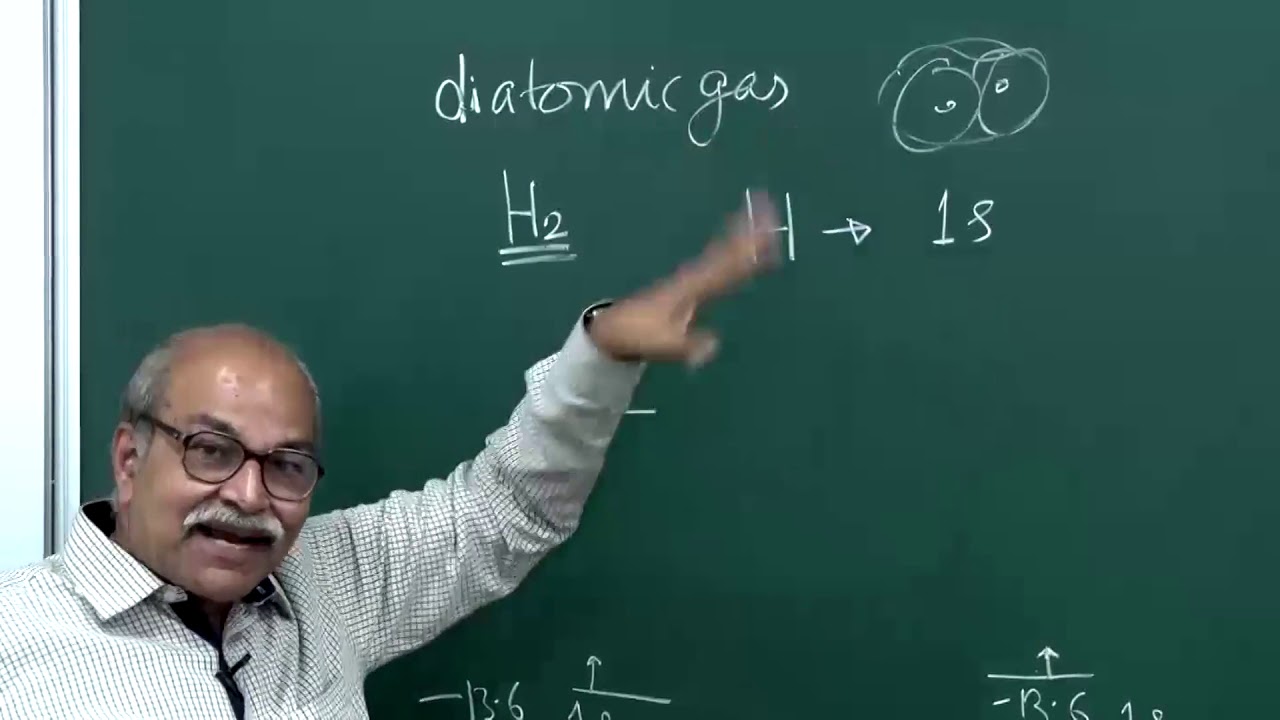
The title is somewhat cryptic but accurately reflects the content: the lecture explains how discrete energy levels (lines) spread into energy bands (rectangles) when atoms form a solid.
Quality & Reliability
8/10
The lecture provides a clear and rigorous explanation of the formation of energy bands in solids, using multiple approaches (qualitative, molecular orbital, and periodic potential). The physics is accurate and well-structured, though it lacks citations to external sources.
Key Moments
Markers derived by PSI from the transcript: the creator did not define chapters.
- Recap of multi-electron atoms and central potential approximation
- Qualitative explanation of energy level splitting in solids
- Introduction to LCAO method for hydrogen molecule
- Explanation of bonding and anti-bonding orbitals
- Why helium is monoatomic
- Extension to many atoms and formation of energy bands
- Periodic potential approach and Bloch's theorem
- Summary of band structure and gaps
- Preview of next lecture on conductors, insulators, semiconductors
Contribution & Novelties
The lecture provides a clear pedagogical explanation of how energy bands form in solids, using multiple approaches. It effectively bridges the gap between atomic physics and solid-state physics. The use of the hydrogen molecule as an example to illustrate bonding and anti-bonding orbitals is particularly instructive.
Pour aller plus loin :
- Bloch’s theorem — Provides the mathematical foundation for energy bands in periodic potentials.
- Linear combination of atomic orbitals — Explains the LCAO method used in the lecture.
- Band theory — Overview of band structure and its implications for electrical conductivity.
91 words
Radar Profile
The radar profile shows high scores in information quantity, quality, and reliability, with a slightly lower technical level, indicating a lecture that is informative and accurate but not highly advanced. The overall balance suggests a solid educational resource for understanding energy bands.