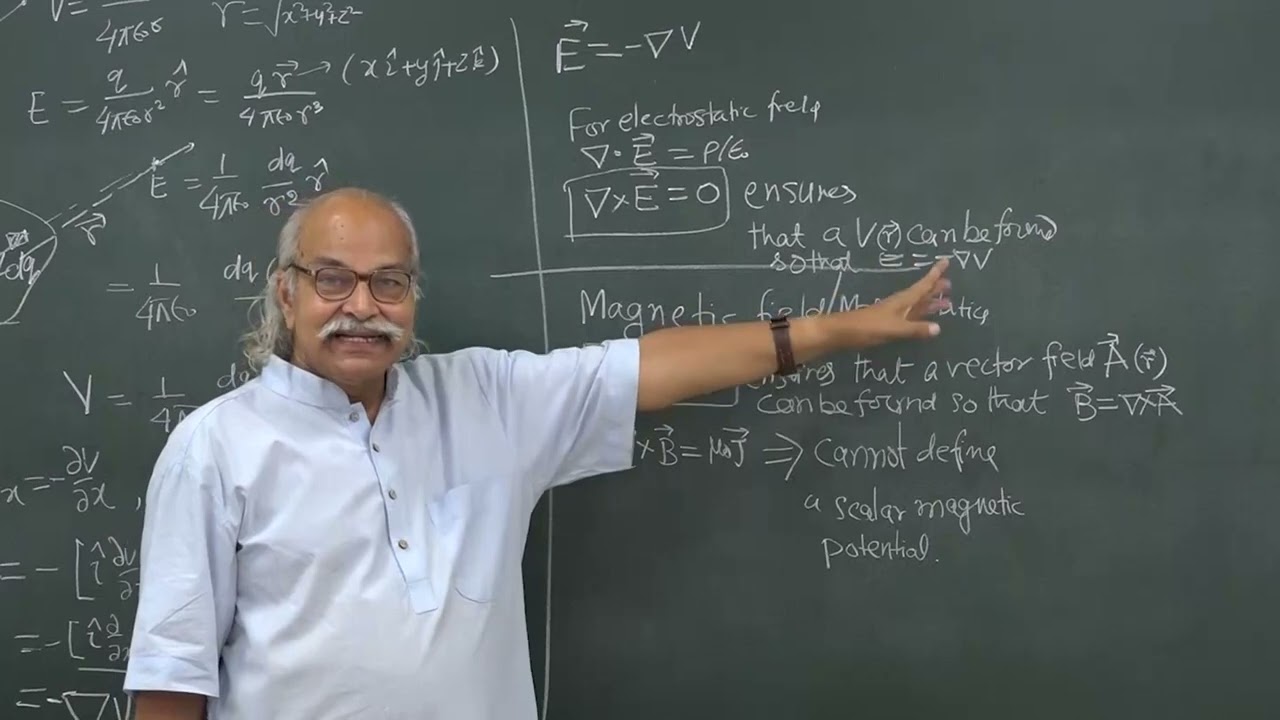
LEC 28 - Vector Potential Equation
Keywords
Summary
126 words
Critical Evaluation
Value of the Information & Strength of the Argument
The lecture provides a solid mathematical foundation for the vector potential, deriving it from Maxwell’s equations and highlighting the analogy with electrostatics. The argumentation is clear and logical, building step by step from known results to the final integral expression. The instructor emphasizes the importance of gauge choice and the uniqueness of the potential, which is crucial for understanding the concept. The value lies in its pedagogical clarity and the thorough derivation, making it useful for students of electromagnetism.
Scientific Rigor, Source Quality, Title Accuracy
The lecture is scientifically rigorous, with correct mathematical derivations and a clear presentation. However, it does not cite any external sources, which limits its verifiability. The title accurately reflects the content, focusing on the vector potential equation. The presentation is self-contained and does not rely on external references, which is acceptable for a lecture but may be a drawback for those seeking further reading.
158 words
Title / Content Match
The title accurately reflects the content, which focuses on the derivation and properties of the magnetic vector potential.
Quality & Reliability
8/10
The lecture is mathematically rigorous, deriving the vector potential from Maxwell's equations and providing a clear analogy with electrostatics. The presentation is logical and complete, though it lacks explicit references to external sources.
Key Moments
Markers derived by PSI from the transcript: the creator did not define chapters.
- Introduction to magnetic vector potential and review of electrostatics.
- Discussion of curl and divergence for electric and magnetic fields.
- Definition of vector potential A and its non-uniqueness.
- Choice of Coulomb gauge (∇·A = 0).
- Derivation of ∇²A = -μ₀J using vector identity.
- Analogy with Poisson's equation and solution for A.
- Integral expression for A in terms of current density.
- Extension to surface and line currents.
Contribution & Novelties
The lecture provides a clear and detailed derivation of the magnetic vector potential, emphasizing the mathematical structure and analogy with electrostatics. It is a standard topic in electromagnetism, but the presentation is accessible and well-structured.
Pour aller plus loin :
- Magnetic vector potential - Wikipedia — Overview and applications.
- Gauge fixing - Wikipedia — Discussion of gauge choices.
- Poisson’s equation - Wikipedia — Mathematical background.
65 words
Radar Profile
The radar profile shows high scores across all dimensions, indicating a well-rounded and reliable lecture. The strengths are in information quantity and quality, with a slightly lower score in technical depth due to the introductory nature.