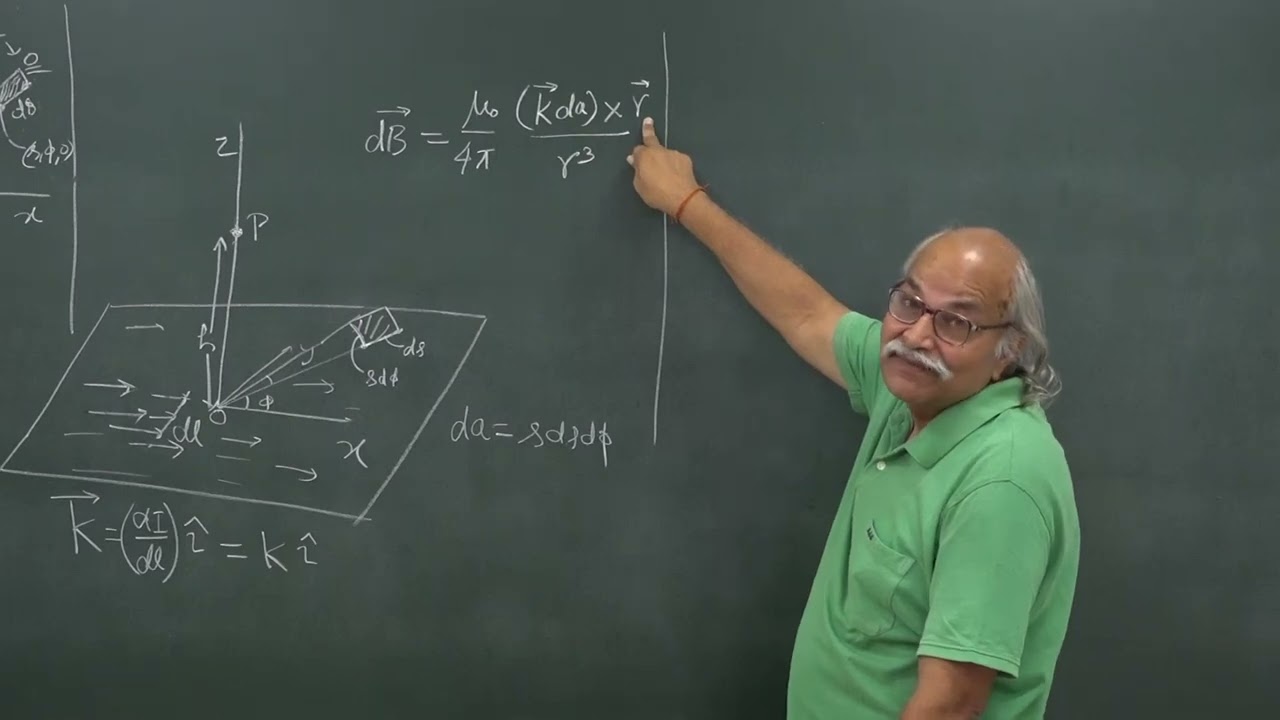
LEC 21 - Magnetic Field due to a Surface Current #amperelaw
Keywords
Summary
179 words
Critical Evaluation
Value of the Information & Strength of the Argument
The lecture provides a clear and rigorous derivation of the magnetic field due to an infinite surface current. The argumentation is logical and step-by-step, making it easy to follow. The use of cylindrical coordinates is well-motivated to simplify the integration. The result is physically intuitive and consistent with standard electromagnetism. The lecture also highlights the independence of the field from distance, which is a key insight. However, the presentation is purely theoretical and does not include experimental verification or practical applications, which would enhance its value.
Scientific Rigor, Source Quality, Title Accuracy
The lecture is scientifically rigorous, with a correct application of the Biot-Savart law. The mathematical steps are accurate, and the final result matches standard textbook solutions. However, no external sources are cited, and the lecture does not reference any textbooks or papers. The title is appropriate, though it mentions Ampere’s law while the derivation uses Biot-Savart law; this is a minor discrepancy. The content is well-structured and pedagogically sound.
170 words
Title / Content Match
The title accurately reflects the content, which focuses on calculating the magnetic field due to a surface current using Ampere's law (though the derivation uses Biot-Savart law).
Quality & Reliability
8/10
The lecture is a clear, step-by-step derivation of the magnetic field due to an infinite surface current using the Biot-Savart law. The mathematical steps are logical and the result is consistent with standard physics textbooks. The presentation is rigorous, though it lacks references to external sources and does not discuss experimental verification.
Key Moments
Markers derived by PSI from the transcript: the creator did not define chapters.
- Introduction to surface currents and definition of surface current density K.
- Setting up the problem: infinite XY plane with uniform current in X direction.
- Derivation of the Biot-Savart law for a surface current element.
- Introduction of cylindrical polar coordinates to simplify integration.
- Evaluation of the cross product and separation of integrals.
- Integration over φ and s, leading to the final result.
- Discussion of the result: magnetic field is independent of height and direction.
- Homework: calculate field below the plane and conclusion.
Contribution & Novelties
The lecture provides a clear and detailed derivation of the magnetic field due to an infinite surface current, which is a fundamental topic in electromagnetism. The use of cylindrical coordinates is a pedagogical strength, making the integration tractable. The result is a classic example of a uniform magnetic field on one side of a current sheet. This lecture is particularly useful for students learning to apply the Biot-Savart law to distributed currents.
Pour aller plus loin :
- Biot–Savart law — Foundational law used in the derivation.
- Ampère’s circuital law — Alternative method to derive the same result.
- Surface current density — Definition and context.
104 words
Radar Profile
The radar profile shows high scores in quality of information, technical level, and reliability, with a slightly lower score in quantity of information due to the focused scope of the lecture. The overall profile indicates a solid educational resource for advanced physics students.