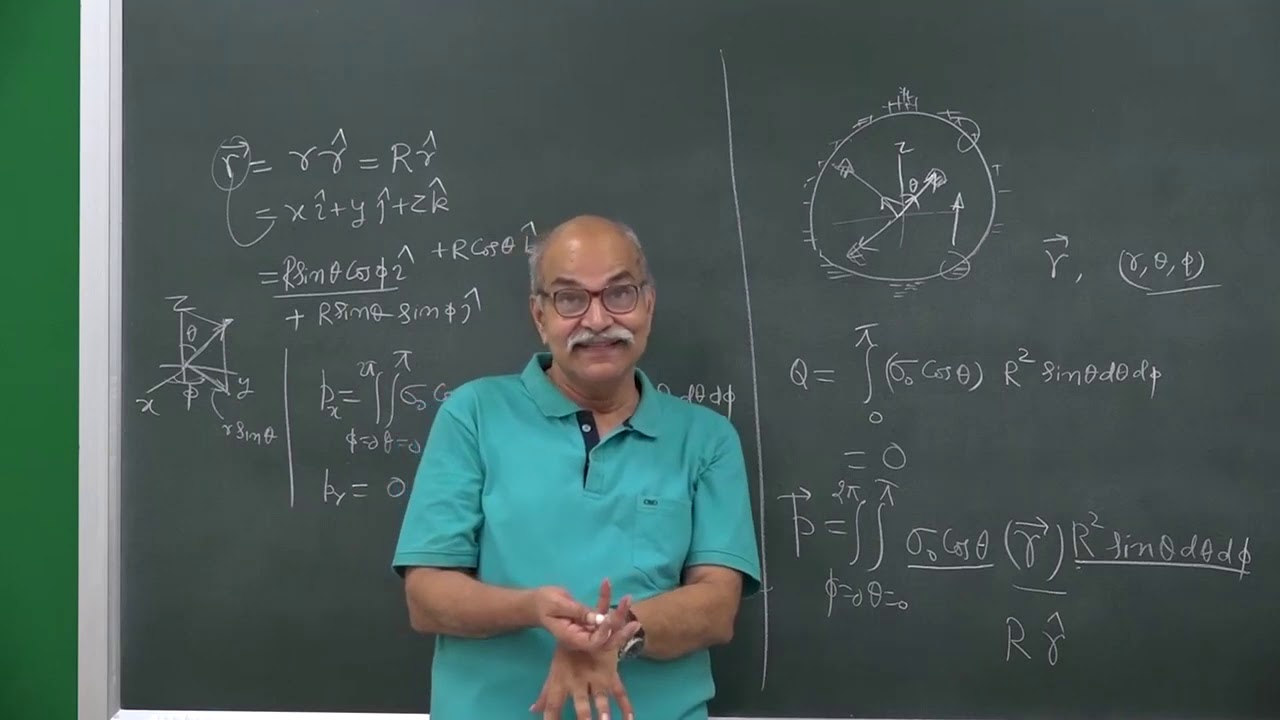
LEC 19 Monopole and Dipole distribution
Keywords
Summary
167 words
Critical Evaluation
Value of the Information & Strength of the Argument
The lecture provides a clear and rigorous derivation of the multipole expansion, focusing on the monopole and dipole terms. The argumentation is logical and step-by-step, with careful handling of mathematical approximations. The value lies in the pedagogical approach, which bridges physical intuition and mathematical formalism. The derivation of the dipole potential and field is complete and correct, and the discussion of the dipole moment’s properties is insightful. The lecture also highlights the importance of the dipole term in understanding charge distributions, making it a valuable resource for students.
Scientific Rigor, Source Quality, Title Accuracy
The scientific rigor is high, as the lecture is based on fundamental principles of electrostatics and follows a systematic derivation. However, no external sources are cited, and the content relies solely on the lecturer’s expertise. The title accurately reflects the content, focusing on monopole and dipole distributions. The lecture is part of a larger course on classical electromagnetism, and the playlist link in the description provides context for the series. Overall, the content is reliable and well-structured.
180 words
Title / Content Match
The title accurately reflects the content, which focuses on the monopole and dipole terms in the multipole expansion of the electrostatic potential.
Quality & Reliability
8/10
The lecture is delivered by a renowned physicist, Prof. H.C. Verma, known for his pedagogical clarity. The content is mathematically rigorous, deriving the multipole expansion from first principles. The presentation is clear and systematic, though it lacks explicit citations to external sources.
Key Moments
Markers derived by PSI from the transcript: the creator did not define chapters.
- Introduction to monopole and dipole distributions; review of potential due to charge distribution.
- Definition of dipole moment for discrete and continuous charge distributions.
- Derivation of potential due to a dipole distribution using spherical coordinates.
- Taylor expansion and approximation for distant points; evaluation of integrals.
- Expression for potential in terms of dipole moment; discussion of dipole moment properties.
- Example of uniformly charged sphere; potential outside equivalent to point charge.
- Derivation of electric field from potential using gradient in spherical coordinates.
- Final expression for dipole field; conclusion and remarks.
Cited Sources
- Classical Electromagnetism-1 (Electrostatics) Playlist — Complete lecture series by Prof. H.C. Verma, providing context for this lecture.
Concurring Sources
- Classical Electromagnetism-1 (Electrostatics) Playlist — The lecture is part of a series, and the content is consistent with standard textbooks on electrostatics.
Contribution & Novelties
This lecture offers a clear and rigorous derivation of the multipole expansion, focusing on the monopole and dipole terms. It provides a solid foundation for understanding more advanced topics in electromagnetism. The pedagogical approach, combining physical intuition with mathematical detail, is particularly valuable for students.
Pour aller plus loin :
- Multipole expansion — Overview of the general multipole expansion in electrostatics.
- Electric dipole moment — Detailed discussion of the electric dipole moment and its applications.
- Spherical harmonics — Mathematical tools used in the general multipole expansion.
86 words
Radar Profile
The radar profile shows high scores in quantity and quality of information, with a moderate level of technical depth. The reliability is strong, reflecting the lecturer's expertise. The overall balance indicates a well-structured and informative lecture suitable for advanced students.