Keywords
Summary
143 words
Critical Evaluation
Value of the Information & Strength of the Argument
The lecture provides a clear and rigorous derivation of the conditions for steady precession of a symmetric top, a classic problem in rigid body dynamics. The argumentation is logical and step-by-step, making it accessible to advanced undergraduate students. The second problem on the rolling hoop is also well-analyzed, demonstrating the application of angular momentum and rolling constraints. The value lies in the pedagogical clarity and the depth of the derivations, which are typical of Prof. Verma’s teaching style.
Scientific Rigor, Source Quality, Title Accuracy
The lecture is scientifically rigorous, with all derivations based on fundamental principles of classical mechanics. No external sources are cited, but the content is self-contained and mathematically sound. The title accurately reflects the content, as it is the final problem-solving lecture of the course. The lecture is part of a well-structured course, and the professor’s expertise adds to its credibility.
153 words
Title / Content Match
The title accurately reflects the content: it is the final lecture of a classical mechanics course, focusing on problem-solving.
Quality & Reliability
8/10
The lecture is delivered by a renowned physicist (Prof. H.C. Verma) and presents rigorous derivations based on classical mechanics principles. The content is mathematically sound and pedagogically clear, though it is a lecture rather than a peer-reviewed source.
Key Moments
Markers derived by PSI from the transcript: the creator did not define chapters.
- Introduction and overview of the lecture
- Problem statement: symmetric top steady precession
- Setting up principal axes and angular velocity
- Deriving angular momentum and torque
- Obtaining the quadratic equation for precession rate
- Condition for real precession: spin threshold
- Solving for slow and fast precession rates
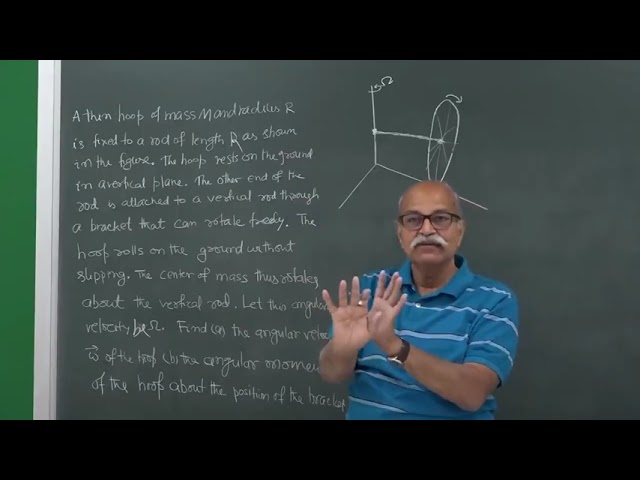
- Second problem: rolling hoop on a rod
- Finding angular velocity of the hoop using no-slip condition
- Calculating angular momentum about the bracket
- Conclusion and closing remarks
Contribution & Novelties
This lecture provides a thorough derivation of the steady precession condition for a symmetric top, which is a classic problem in classical mechanics. The approach is systematic and emphasizes the use of principal axes and the rotating frame. The second problem on the rolling hoop is also instructive, illustrating the application of rolling constraints and angular momentum. The lecture is valuable for students preparing for competitive exams like IIT JAM, CSIR NET, and GATE.
Pour aller plus loin :
- Symmetric top precession — Wikipedia article on precession, providing background on the phenomenon.
- Euler’s equations — Wikipedia article on Euler’s equations for rigid body dynamics, which are relevant to the derivation.
- Moment of inertia — Wikipedia article on moment of inertia, essential for understanding the calculations.
125 words
Radar Profile
The radar profile shows high scores in all dimensions, indicating a well-rounded lecture with substantial information, technical depth, and reliability. The lecture is particularly strong in quantitative information and technical level, reflecting its problem-solving nature.