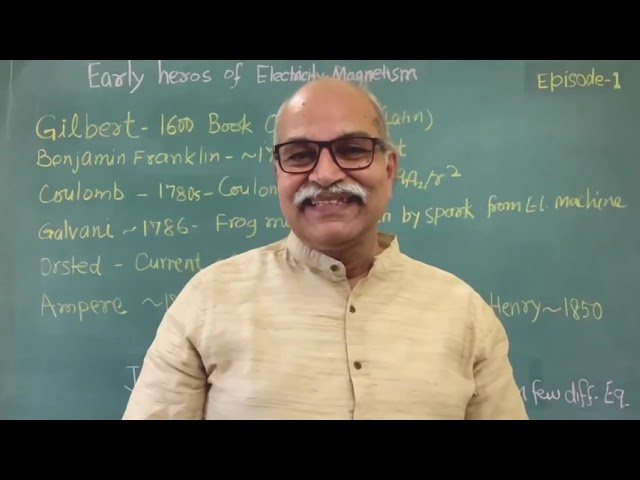
Episode 01 Early Heroes of Electricity - Magnetism
Keywords
Summary
159 words
Critical Evaluation
Value of the Information & Strength of the Argument
The video provides a valuable historical context for the photoelectric effect, connecting it to the broader development of electromagnetism. The argumentation is coherent, presenting a chronological narrative that builds understanding. However, the presenter does not provide deep technical details or rigorous scientific analysis, focusing instead on storytelling and historical anecdotes. The value lies in its educational approach, making complex topics accessible to a general audience.
Scientific Rigor, Source Quality, Title Accuracy
The video references Nobel Prize presentation speeches and mentions key scientists, but it does not provide specific citations or links to primary sources. The title accurately reflects the content, which is a historical overview of early electricity and magnetism. The scientific rigor is moderate; the presenter relies on well-known historical facts but does not delve into technical details or provide evidence for claims. The video is suitable for a general audience interested in the history of physics.
157 words
Title / Content Match
The title accurately reflects the content, focusing on early heroes in electricity and magnetism.
Quality & Reliability
7/10
The video provides a historical narrative of early discoveries in electricity and magnetism, with references to Nobel Prize speeches and key scientists. It is informative but lacks detailed citations and rigorous verification of claims.
Key Moments
Markers derived by PSI from the transcript: the creator did not define chapters.
- Introduction to the course and its purpose
- Mention of Einstein's Nobel Prize centenary and the photoelectric effect
- Overview of three Nobel Prizes related to photoelectric effect
- Definition of photoelectric effect
- Historical timeline: Gilbert, Franklin, Coulomb
- Galvani, Oersted, Ohm, Faraday, Henry
- Maxwell's equations and prediction of electromagnetic waves
- Connection between light and electromagnetism
- Conclusion and preview of next episode
Cited Sources
- Nobel Prize in Physics 1905 - Presentation Speech — Referenced for Philipp Lenard's Nobel Prize and his work on cathode rays.
- Nobel Prize in Physics 1921 - Presentation Speech — Referenced for Einstein's Nobel Prize for the photoelectric effect.
- Nobel Prize in Physics 1923 - Presentation Speech — Referenced for Millikan's Nobel Prize for work on elementary charge and photoelectric effect.
Concurring Sources
- Nobel Prize in Physics 1905 - Presentation Speech — Confirms the details about Lenard's Nobel Prize and his work on cathode rays.
- Nobel Prize in Physics 1921 - Presentation Speech — Confirms Einstein's Nobel Prize for the photoelectric effect.
- Nobel Prize in Physics 1923 - Presentation Speech — Confirms Millikan's Nobel Prize for work on elementary charge and photoelectric effect.
Contribution & Novelties
The video offers a narrative approach to teaching physics, emphasizing the historical development of ideas leading to the photoelectric effect. It highlights the contributions of multiple scientists and the significance of the Nobel Prizes. The novelty lies in its storytelling method, which may engage learners who prefer contextual learning.
Pour aller plus loin :
- Maxwell’s equations — Essential for understanding the unification of electricity and magnetism.
- Photoelectric effect — Directly related to the course’s main topic.
- History of electromagnetism — Provides broader context for the early heroes mentioned.
88 words
Radar Profile
The radar profile shows moderate scores across all dimensions, indicating a balanced but not deeply technical presentation. The video excels in providing historical context but lacks advanced technical depth.