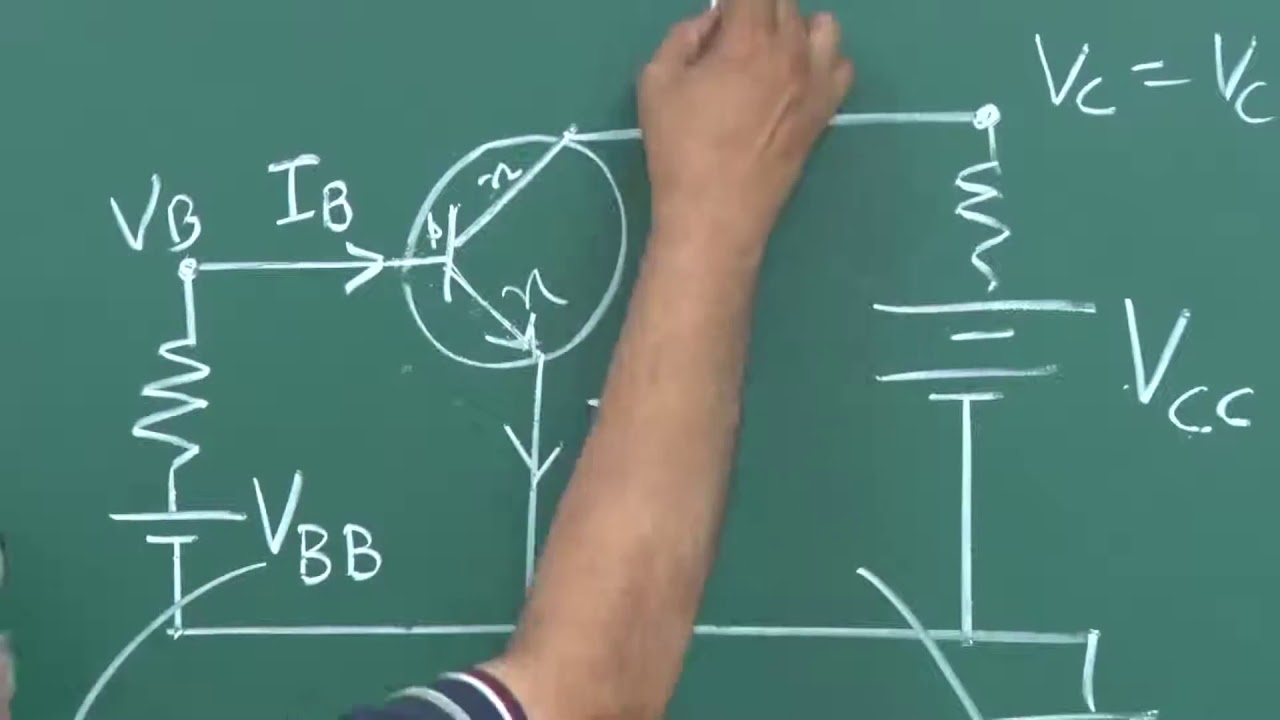
W9-02 How do currents flow in a transistor
Keywords
Summary
209 words
Critical Evaluation
Value of the Information & Strength of the Argument
The lecture provides a thorough and logical explanation of transistor current flow, building from basic PN junction physics to the specific design of a transistor. The argumentation is solid: the instructor clearly explains why the base is thin and lightly doped, and how this leads to the desired current amplification. He uses diagrams and step-by-step reasoning to make the concepts accessible. The value lies in its pedagogical clarity and accurate physical description, which is suitable for students learning semiconductor devices.
Scientific Rigor, Source Quality, Title Accuracy
The lecture is scientifically rigorous, presenting standard semiconductor physics without errors. However, it does not cite any external sources, relying solely on the instructor’s expertise. The title accurately reflects the content, which is a tutorial on current flow in transistors. The lecture is well-structured and technically sound, though it would benefit from referencing textbooks or research articles to enhance credibility.
155 words
Title / Content Match
The title accurately reflects the content, which focuses on explaining the mechanisms of current flow in a transistor.
Quality & Reliability
8/10
The lecture provides a clear, step-by-step explanation of transistor current flow, grounded in semiconductor physics. The instructor uses established principles (PN junction behavior, minority carrier injection) and correctly describes the role of doping and base width. The content is accurate and well-structured, though it lacks citations to external sources.
Key Moments
Markers derived by PSI from the transcript: the creator did not define chapters.
- Introduction to transistor structure and symbols
- Biasing conditions: forward bias for base-emitter, reverse bias for base-collector
- Common emitter configuration and voltage/current notations
- Mechanism of current flow: minority carrier injection from emitter to base
- Role of thin base and light doping in minimizing recombination
- Collection of electrons by reverse-biased collector junction
- Summary and preview of next lecture on biasing effects
Contribution & Novelties
The lecture provides a clear and detailed explanation of the physical mechanism of current flow in a transistor, emphasizing the importance of base width and doping levels. It is a valuable educational resource for understanding transistor operation.
Pour aller plus loin :
- Bipolar junction transistor — Overview of BJT operation and characteristics.
- Minority carrier injection — Explanation of the injection process in semiconductor junctions.
- Common emitter amplifier — Configuration and analysis of common emitter circuits.
75 words
Radar Profile
The radar profile shows high scores in information quantity, quality, and reliability, with a slightly lower technical level, indicating a well-balanced educational lecture that is both informative and accessible.