Exp 01 - From Shadows to Diffraction | Optics
Keywords
Summary
179 words
Critical Evaluation
Value of the Information & Strength of the Argument
The video provides valuable hands-on demonstrations that illustrate key concepts in optics, such as the ray optics approximation and the transition to wave optics. The argumentation is logical and builds from simple observations to more complex phenomena. The instructor effectively uses the experiments to motivate the need for a wave model of light, showing the limitations of ray optics. The explanations are clear and accessible, making the content valuable for learners at various levels.
83 words
Title / Content Match
The title accurately reflects the content, which moves from shadow formation (ray optics) to diffraction (wave optics).
Quality & Reliability
7/10
The video presents a series of simple experiments to illustrate the transition from ray optics to wave optics, with clear explanations and demonstrations. The scientific content is accurate and well-presented, though it lacks formal citations and in-depth mathematical treatment.
Key Moments
Markers derived by PSI from the transcript: the creator did not define chapters.
- Introduction to the course and its approach
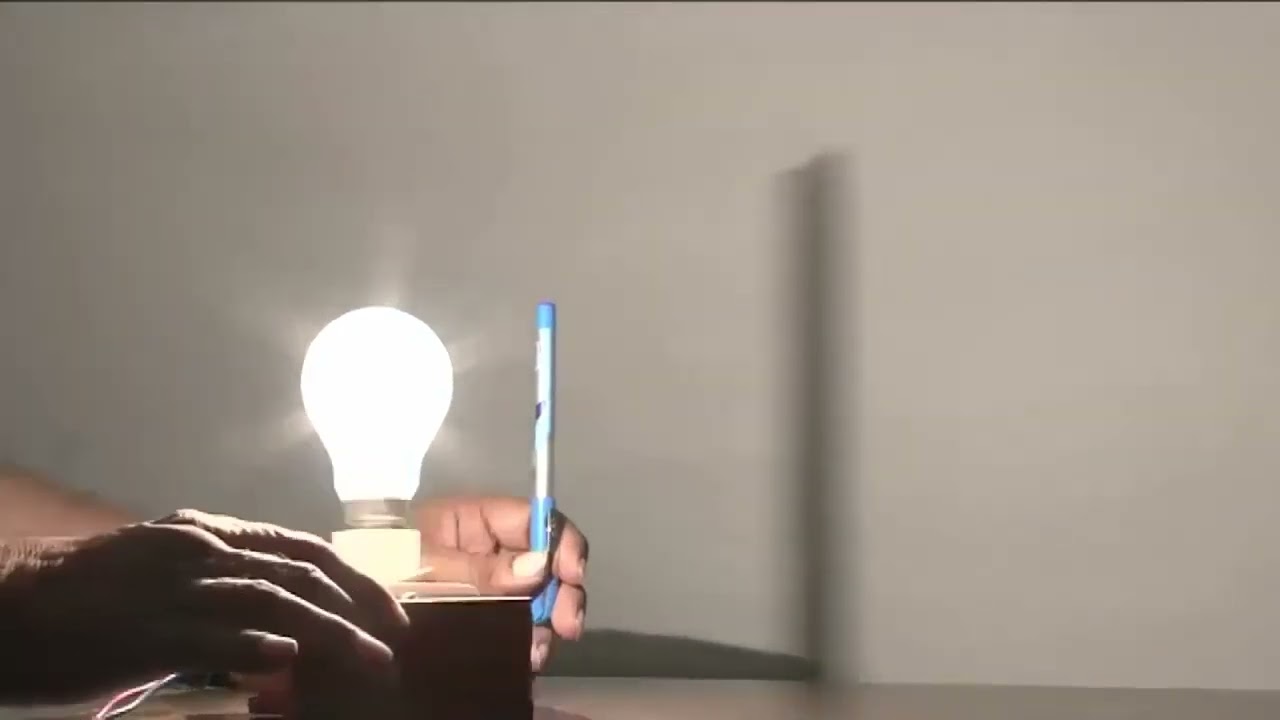
- First experiment: shadow of a pen, observing sharpness changes
- Demonstration of shadow changes with bulb rotation
- Experiments with different shaped apertures and sunlight
- Explanation of why the spot becomes circular at large distances
- Laser experiment: blocking light with a large object
- Diffraction pattern with a thin wire
- Discussion on when ray optics is valid vs. wave optics
Contribution & Novelties
The video offers a unique pedagogical approach by using simple, self-designed experiments to illustrate fundamental concepts in optics. It bridges the gap between ray optics and wave optics, providing intuitive demonstrations that are often missing in traditional textbooks. The emphasis on observation and explanation encourages active learning.
Pour aller plus loin :
- Diffraction — Overview of diffraction phenomena.
- Ray optics — Explanation of geometrical optics approximation.
- Huygens–Fresnel principle — Theoretical basis for wave propagation.
74 words
Radar Profile
The radar profile shows high scores in quality of information and technical level, indicating a well-structured and informative video. The quantity of information is moderate, and the overall reliability is good, though the lack of citations slightly reduces the score.