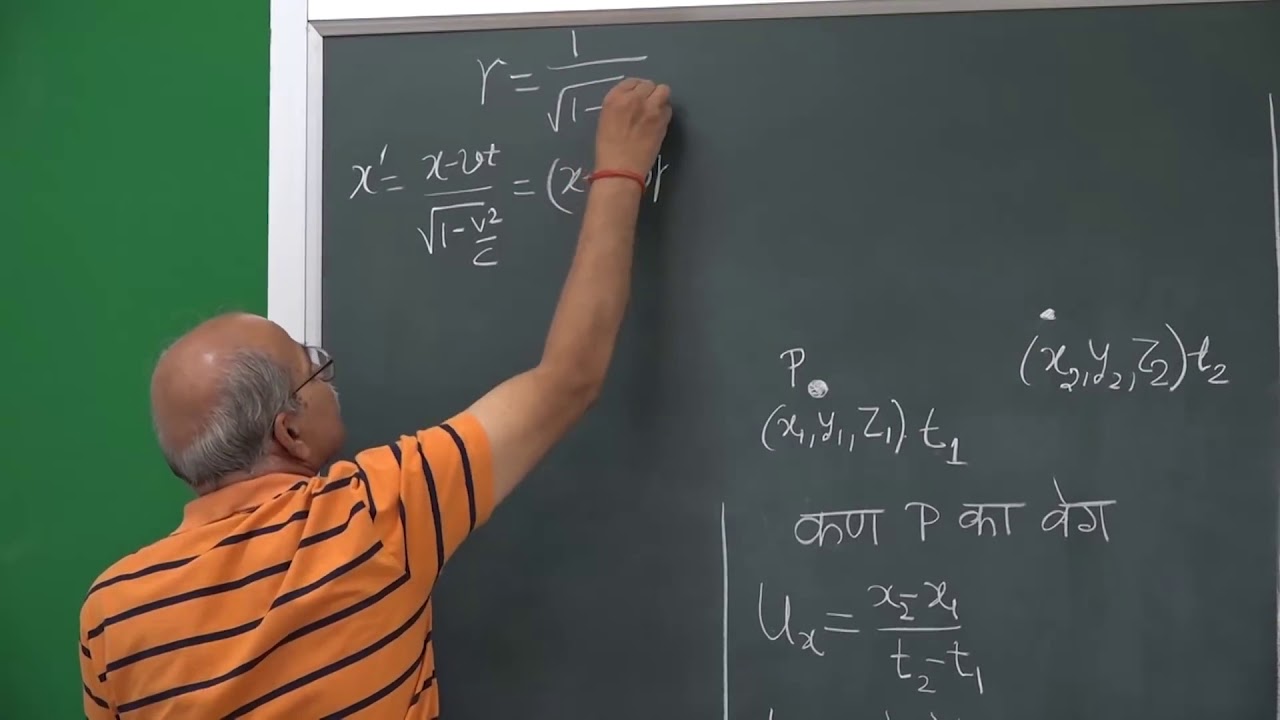
W5-02 Addition of Velocities
Keywords
Summary
189 words
Critical Evaluation
Value of the Information & Strength of the Argument
The video provides a solid derivation of the relativistic velocity addition formulas, which is the core value. The argumentation is logical and follows a clear mathematical path from the Lorentz transformations to the final formulas. The instructor carefully explains each step, making it accessible to students with a basic understanding of special relativity. The comparison with Galilean transformations at the end reinforces the conceptual understanding. However, the presentation lacks a discussion of the physical implications or applications of these formulas, which could enhance the value. The argumentation is rigorous but could benefit from more intuitive explanations.
Scientific Rigor, Source Quality, Title Accuracy
The scientific rigor is good: the derivation is mathematically correct and the steps are clearly explained. The video does not cite any external sources, but it is a tutorial based on standard textbook material. The title accurately reflects the content. The video does not include any references to scientific papers or textbooks, which is typical for an educational lecture. The lack of sources is not a major issue for a tutorial, but it limits the ability to verify the information independently. The content is consistent with established physics.
199 words
Title / Content Match
The title accurately reflects the content, which is a lecture on the addition of velocities in special relativity.
Quality & Reliability
7/10
The video provides a clear derivation of the relativistic velocity addition formulas using Lorentz transformations. The mathematical steps are correct and the explanation is thorough, though the presentation is informal and lacks references to external sources.
Key Moments
Markers derived by PSI from the transcript: the creator did not define chapters.
- Introduction to the topic of addition of velocities and transformation of velocities.
- Definition of velocity as displacement over time and setup of two inertial frames.
- Derivation of the x-component of velocity transformation using Lorentz transformations.
- Derivation of the y-component of velocity transformation, including the gamma factor.
- Derivation of the z-component and summary of the velocity addition formulas.
- Comparison with Galilean transformations and discussion of the low-velocity limit.
- Conclusion and final remarks.
Contribution & Novelties
The video provides a clear and detailed derivation of the relativistic velocity addition formulas, which is a fundamental topic in special relativity. It is particularly useful for students who want to understand the mathematical steps behind the formulas. The presentation is step-by-step, making it easy to follow. However, it does not offer new insights beyond standard textbook derivations.
Pour aller plus loin :
- Special relativity - Wikipedia — Provides a comprehensive overview of the theory, including velocity addition.
- Lorentz transformation - Wikipedia — Details the mathematical foundation used in the derivation.
- Velocity addition formula - HyperPhysics — A concise reference for the velocity addition formulas.
105 words
Radar Profile
The radar profile shows high scores in quantity and quality of information, with a moderate technical level. The reliability is also high, indicating that the video is informative and trustworthy, though it could be more technically advanced.