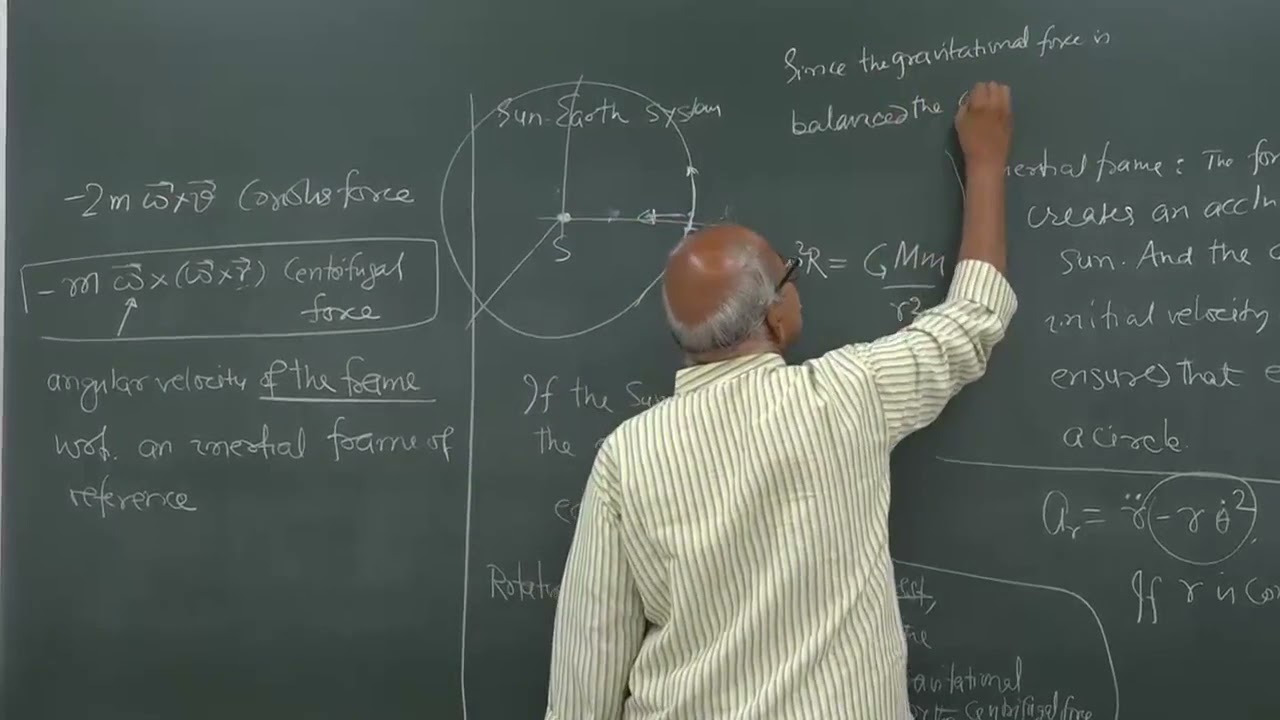
Lecture 18 Problems on rotating frames
Keywords
Summary
156 words
Critical Evaluation
Value of the Information & Strength of the Argument
The lecture provides some value in demonstrating how to set up and solve problems in rotating frames, particularly the use of centrifugal and Coriolis forces. However, the argumentation is weak due to the poor quality of the transcription and the instructor’s unclear delivery. The derivations are not presented systematically, and key steps are often missing or garbled. The instructor also makes some statements that are not rigorously justified, such as the balance of forces on a particle on a rotating disk. Overall, the content is not presented with sufficient clarity or depth to be a reliable learning resource.
Scientific Rigor, Source Quality, Title Accuracy
The lecture does not cite any sources, and the description only contains hashtags and a note about the topic. The title accurately reflects the content, but the scientific rigor is low. The instructor does not provide references to textbooks or papers, and the explanations are not precise. The transcription is also full of errors, which further undermines the reliability of the content. There are no comments provided for analysis.
182 words
Title / Content Match
The title accurately describes the content: a lecture on problems involving rotating frames.
Quality & Reliability
5/10
The lecture is a tutorial on rotating frames, but the transcription is heavily garbled and incomplete, making it difficult to follow the derivations. The instructor's explanations are unclear, and the audio quality seems poor. No sources are cited, and the content is not rigorous enough for a formal physics lecture.
Key Moments
Markers derived by PSI from the transcript: the creator did not define chapters.
- Introduction to rotating frames and fictitious forces
- Discussion of centrifugal force and its dependence on position
- Example: particle on a rotating disk, forces and equations of motion
- Explanation of why objects on Earth are not flung off due to rotation
- Derivation of the equation of motion for a particle in a rotating frame
- Discussion of Coriolis force and its effect on motion
- Conclusion and summary of key points
Contribution & Novelties
The lecture attempts to provide worked examples for problems on rotating frames, which is useful for students. However, the presentation is not original and follows standard textbook treatments. The main contribution is the selection of problems, but the execution is flawed due to poor audio and transcription.
Pour aller plus loin :
- Fictitious force — Overview of fictitious forces in non-inertial frames.
- Coriolis force — Detailed explanation of the Coriolis effect.
- Rotating reference frame — Mathematical treatment of rotating frames.
80 words
Radar Profile
The radar profile shows low scores across all dimensions, with a slightly higher score for technical level, indicating that the content is technical but poorly presented and unreliable.