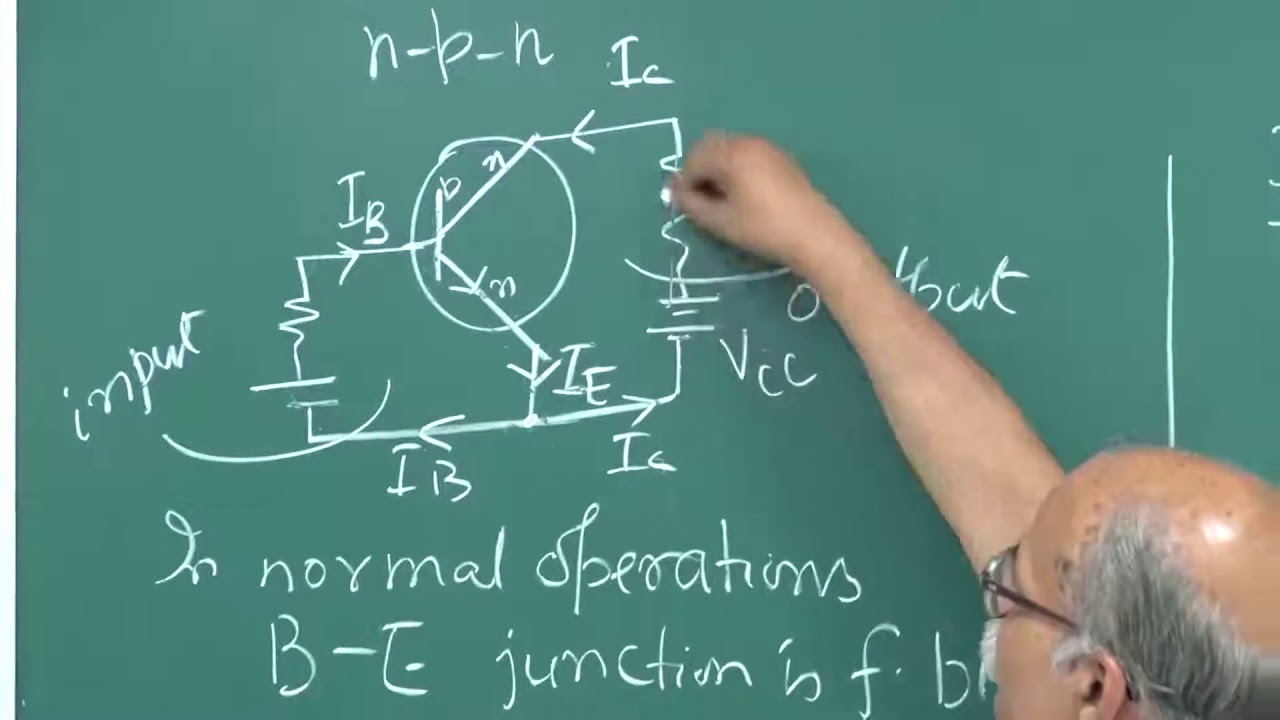
W10-01 Cut off to Active Saturation #SemiconductorPhysics
Keywords
Summary
134 words
Critical Evaluation
Value of the Information & Strength of the Argument
The lecture provides a solid foundation in transistor operation, clearly explaining the physical mechanisms behind the three operating regions. The argumentation is logical and builds step by step, from the basic current flow to the definition of beta and alpha, and then to the characteristics. The instructor uses analogies and visual descriptions to make the concepts accessible. The value lies in its pedagogical clarity and the emphasis on understanding the physics rather than just memorizing equations. The explanation of why the collector current saturates and why the output characteristics are flat in the active region is particularly insightful.
Scientific Rigor, Source Quality, Title Accuracy
The lecture is scientifically rigorous, with accurate physics and consistent terminology. No external sources are cited, but the content is standard textbook material and the instructor’s explanations are correct. The title accurately reflects the content, focusing on the three regions. The lecture is well-structured and the diagrams, though not visible in the transcript, are implied to support the explanations. The overall quality is high for an educational lecture.
181 words
Title / Content Match
The title accurately reflects the content, which focuses on the three operating regions of a transistor: cutoff, active, and saturation.
Quality & Reliability
8/10
The lecture is a clear and accurate exposition of transistor operation, covering active, cutoff, and saturation regions with correct physics. The instructor explains concepts methodically, using diagrams and equations. No sources are cited, but the content is standard textbook material. The presentation is didactic and internally consistent.
Key Moments
Markers derived by PSI from the transcript: the creator did not define chapters.
- Recap of transistor current mechanism and biasing
- Definition of beta and alpha, relation between currents
- Introduction of active region and its conditions
- Explanation of cutoff region
- Explanation of saturation region and its conditions
- Introduction to transistor characteristics
- Input characteristics of the transistor
- Output characteristics and saturation/active regions
- Effect of increasing vce and ib on output characteristics
- Summary and transition to next lecture
Contribution & Novelties
The lecture provides a clear and systematic explanation of the three operating regions of a BJT, which is fundamental to understanding transistor circuits. It emphasizes the physical conditions for each region and the resulting current-voltage relationships. The lecture is particularly useful for students who need to grasp the concepts before moving to circuit analysis.
Pour aller plus loin :
- Bipolar junction transistor — Comprehensive overview of BJT operation and characteristics.
- Transistor — General article on transistors, including history and types.
- Semiconductor device — Background on semiconductor devices and their physics.
90 words
Radar Profile
The radar profile shows high scores in quantity and quality of information, with a moderate technical level. This indicates a lecture that is informative and accurate, but not overly advanced. The fiabilite is high, reflecting the correctness of the content.