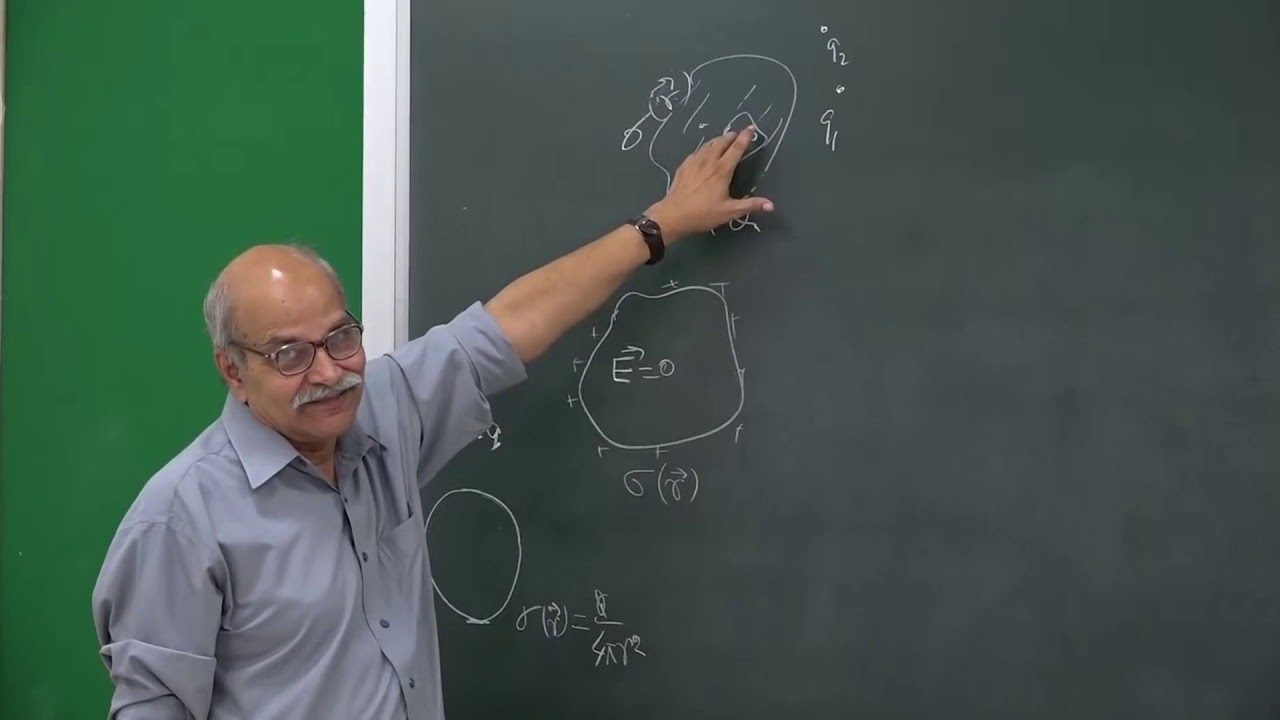
LEC 22 Electric field across a conducting surface
Keywords
Summary
186 words
Critical Evaluation
Value of the Information & Strength of the Argument
The lecture provides a clear and rigorous derivation of the boundary conditions for the electric field, which are fundamental in electromagnetism. The argumentation is solid, building from basic principles (Gauss’s law, conservative field) and using clear geometric constructions. The instructor also connects the results to the physical intuition of conductors, enhancing understanding. The value lies in the pedagogical approach, making complex concepts accessible.
Scientific Rigor, Source Quality, Title Accuracy
The scientific rigor is high, as the derivations follow standard textbook methods. The instructor is a well-known physicist, adding credibility. The title accurately reflects the content. No external sources are cited, but the lecture is part of a structured course. The description provides a link to the full playlist, which is a useful resource.
132 words
Title / Content Match
The title accurately reflects the content: the lecture focuses on deriving the boundary conditions for the electric field across a conducting surface.
Quality & Reliability
8/10
The lecture is delivered by a renowned physicist, Prof. H.C. Verma, known for his pedagogical clarity. The content is rigorous, deriving boundary conditions from fundamental principles (Gauss's law, conservative field). The presentation is clear, with step-by-step derivations. Minor limitations: the audio transcription is imperfect, and the video is a recording of a live lecture with some digressions.
Key Moments
Markers derived by PSI from the transcript: the creator did not define chapters.
- Introduction and review of conductor properties in electrostatics.
- Discussion on charge distribution on conductors and cavities.
- Introduction to the concept of boundary conditions for electric fields.
- Derivation of the continuity of tangential component using a rectangular loop.
- Derivation of the discontinuity of normal component using a Gaussian pillbox.
- Application to conducting surface: tangential component zero, normal component equals sigma/epsilon_0.
- Summary and conclusion.
Cited Sources
- Classical Electromagnetism-1 (Electrostatics) Playlist — Full playlist of the course, providing context and additional lectures.
Concurring Sources
- Boundary conditions in electromagnetism — Standard reference for boundary conditions, consistent with the lecture.
Contribution & Novelties
The lecture provides a clear and rigorous derivation of boundary conditions for the electric field, specifically applied to conducting surfaces. It emphasizes the physical intuition behind the results, making it valuable for students. The novelty lies in the pedagogical approach, breaking down complex derivations into understandable steps.
Pour aller plus loin :
- Boundary conditions in electromagnetism — Overview of boundary conditions for electric and magnetic fields.
- Gauss’s law — Fundamental law used in the derivation.
- Electrostatics — General background on electrostatics.
81 words
Radar Profile
The radar profile shows high scores in information quality and technical level, indicating a rigorous and detailed lecture. The quantity of information is also high, but the overall score is slightly lower due to the lack of external sources and the lecture format.