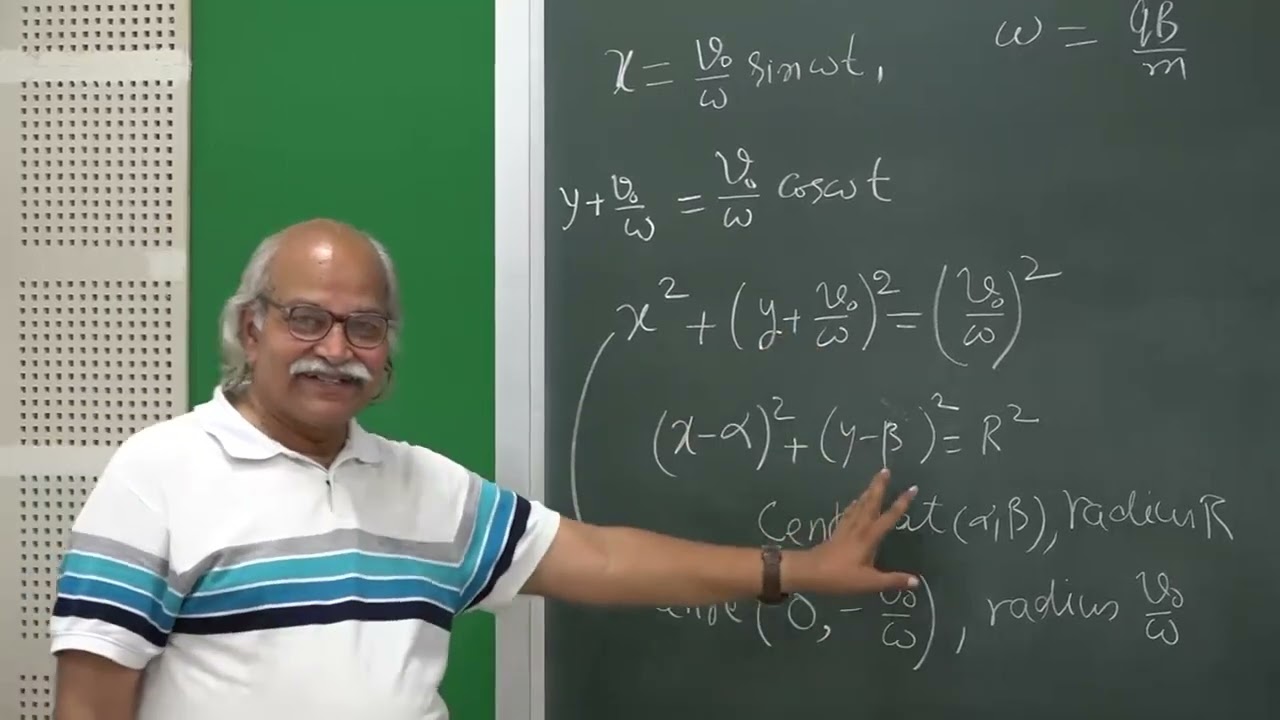
LEC 09 - Motion in Magnetic Field-2
Keywords
Summary
151 words
Critical Evaluation
Value of the Information & Strength of the Argument
The lecture provides a solid, step-by-step derivation of the equations of motion for a charged particle in a uniform magnetic field, starting from the Lorentz force and solving the differential equations. The argumentation is logical and clear, with careful attention to dimensional analysis and physical interpretation. The instructor explains the significance of each step and connects the mathematics to the physical behavior, such as the direction of bending and the helical path. The value lies in its pedagogical clarity, making complex concepts accessible. However, the lecture does not introduce new or advanced material; it is a standard treatment found in many textbooks. The argumentation is sound and consistent, with no apparent errors.
Scientific Rigor, Source Quality, Title Accuracy
The lecture is scientifically rigorous, with a clear derivation based on fundamental principles. No external sources are cited, but the content is standard and well-established. The title accurately reflects the content, as it is a continuation of a previous lecture on the same topic. The lecture does not reference any specific research or publications, but this is typical for an educational tutorial. The presentation is precise and mathematically correct, with appropriate use of vector calculus and differential equations. The only minor issue is that the lecture assumes prior knowledge of the Lorentz force and basic calculus, but this is appropriate for the target audience.
231 words
Title / Content Match
The title accurately reflects the content, which is a continuation of a previous lecture on motion in a magnetic field.
Quality & Reliability
8/10
The lecture is a clear, step-by-step derivation of charged particle motion in a uniform magnetic field, based on fundamental physics principles (Lorentz force, circular motion). The reasoning is rigorous and mathematically consistent. No external sources are cited, but the content is standard textbook material. The presentation is didactic and accurate, with minor simplifications typical of introductory physics.
Key Moments
Markers derived by PSI from the transcript: the creator did not define chapters.
- Recap of previous lecture: motion of charged particle in uniform magnetic field, equations for x and y positions.
- Derivation of the equation of the path by eliminating time, resulting in a circle equation.
- Identification of the center and radius of the circular path, and dimensional analysis.
- Physical interpretation: direction of bending for positive and negative charges, and effect of reversing magnetic field.
- Generalization to initial velocity with a z-component, leading to helical motion and pitch calculation.
- Discussion of particle entering a region of magnetic field, path is circular arc then straight line, speed unchanged.
- Applications: particle accelerators and beam steering using magnetic fields.
Contribution & Novelties
The lecture provides a clear and systematic derivation of the motion of a charged particle in a uniform magnetic field, including the equation of the path, the radius, and the helical motion when there is a velocity component along the field. It also discusses practical applications in accelerators and beam steering. While the content is standard, the pedagogical approach is effective for learners.
Pour aller plus loin :
- Lorentz force — Foundational concept for the force on a charged particle in magnetic fields.
- Cyclotron motion — Application of circular motion of charged particles in magnetic fields.
- Helix — Mathematical description of the helical path traced by a charged particle with a velocity component along the magnetic field.
117 words
Radar Profile
The radar profile shows high scores in quality and reliability, with moderate scores in quantity and technical level. This indicates a well-structured and accurate lecture, but with limited depth and breadth of information, suitable for an introductory course.