Exp 13 - Field, and not charge, exerts force | Electricity
Keywords
Summary
177 words
Critical Evaluation
Value of the Information & Strength of the Argument
The video provides a clear and intuitive explanation of the concept of electric fields and their role in exerting forces, which is a fundamental idea in electromagnetism. The argumentation is solid, using simple experiments to illustrate abstract concepts. The presenter emphasizes the two-step process of force transmission via fields, which is crucial for understanding more advanced topics. However, the video lacks quantitative analysis and does not delve into the mathematical derivation of the potential-distance relationship, leaving the viewer with an open question rather than a complete explanation. The experimental demonstration is simple but effective, though it could be improved with more precise measurements and a deeper discussion of the results.
Scientific Rigor, Source Quality, Title Accuracy
The video is scientifically accurate, with no errors in the physics presented. However, it does not cite any external sources, which limits its credibility for advanced study. The title accurately reflects the content, focusing on the concept that fields, not charges directly, exert forces. The video is well-structured and the explanations are clear, but the lack of references and the basic level of the content may not satisfy viewers seeking a rigorous treatment. The experimental setup is simple and the measurements are approximate, but the conclusions drawn are valid. Overall, the video is a good introductory resource, but it lacks the depth and sourcing expected of a more rigorous scientific presentation.
236 words
Title / Content Match
The title accurately reflects the content, emphasizing the concept that fields, not charges directly, exert forces.
Quality & Reliability
7/10
The video is a clear, well-structured tutorial on electric fields and potential, with a simple experiment demonstrating equipotential surfaces. The physics is correct, but the presentation is basic and lacks depth, and no sources are cited.
Key Moments
Markers derived by PSI from the transcript: the creator did not define chapters.
- Introduction to the module on electric and magnetic fields
- Demonstration of static electricity: rubbing a straw to attract paper pieces
- Demonstration of repulsion between two charged straws
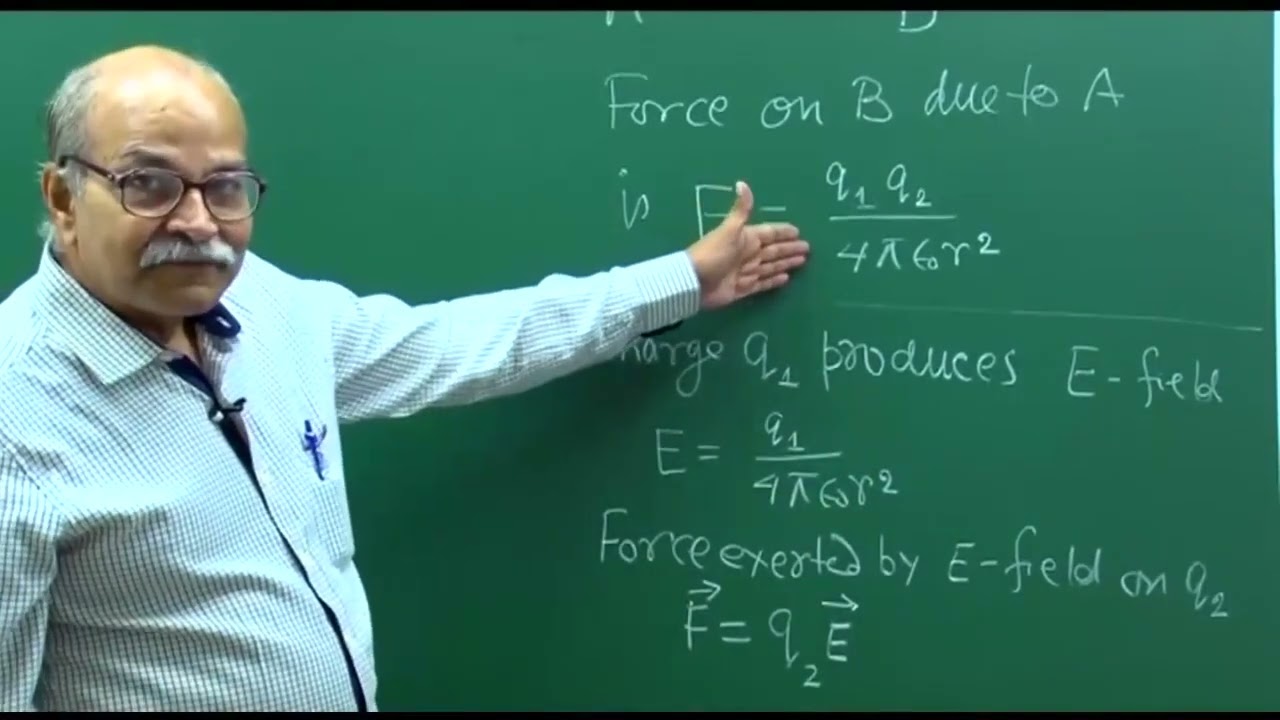
- Explanation of Coulomb's law and the two-step process of force via electric field
- Introduction to electric potential and its relation to electric field
- Experimental setup: measuring potential differences in a water dish with concentric circles
- Measurements of potential on different circles and observation of equipotential surfaces
- Discussion of the functional dependence of potential on distance
Contribution & Novelties
The video provides a clear pedagogical demonstration that electric fields, not charges directly, exert forces, and illustrates the concept of equipotential surfaces with a simple experiment. It reinforces the fundamental idea that fields are real physical entities.
Pour aller plus loin :
- Electric field — Wikipedia article providing a comprehensive overview of electric fields.
- Coulomb’s law — Wikipedia article on Coulomb’s law, including its vector form and limitations.
- Electric potential — Wikipedia article explaining electric potential and its relationship to electric field.
- Equipotential surface — Wikipedia article on equipotential surfaces and their properties.
93 words
Radar Profile
The radar profile shows a balanced performance across all dimensions, with slightly higher scores in quality and reliability compared to quantity and technical level. This indicates a solid but not exceptional educational video, suitable for beginners.