Keywords
Summary
155 words
Critical Evaluation
Value of the Information & Strength of the Argument
The lecture provides valuable worked examples that illustrate the application of theoretical concepts to practical problems. The argumentation is logical and step-by-step, making it easy to follow. The instructor carefully explains each step, from setting up the problem to deriving the final expression, ensuring that the reasoning is transparent. The problems are well-chosen to cover different scenarios and to highlight common pitfalls, such as the distinction between steady and non-steady currents. The value lies in the pedagogical clarity and the reinforcement of foundational ideas.
Scientific Rigor, Source Quality, Title Accuracy
The scientific rigor is high; the instructor uses a textbook as a basis and provides correct derivations. The quality of sources is limited to the textbook, which is a standard reference in the field. The title accurately describes the content, which is a problem-solving session. The lecture is well-structured and the explanations are precise, though it would benefit from citing additional references or real-world applications to enhance its scientific depth.
169 words
Title / Content Match
The title accurately reflects the content, which is a problem-solving session on current densities and steady currents.
Quality & Reliability
7/10
The lecture is a problem-solving session based on a textbook, with clear derivations and explanations. The instructor demonstrates a solid understanding of the subject, but no external sources are cited beyond the textbook. The content is accurate and well-structured, though it lacks references to original research or advanced literature.
Key Moments
Markers derived by PSI from the transcript: the creator did not define chapters.
- Introduction and review of current densities and steady currents
- Problem 1: Rotating ring with uniform linear charge density about its axis - steady current
- Problem 1: Rotating ring about a diameter - not steady current
- Problem 1: Rotating ring with non-uniform charge density - not steady current
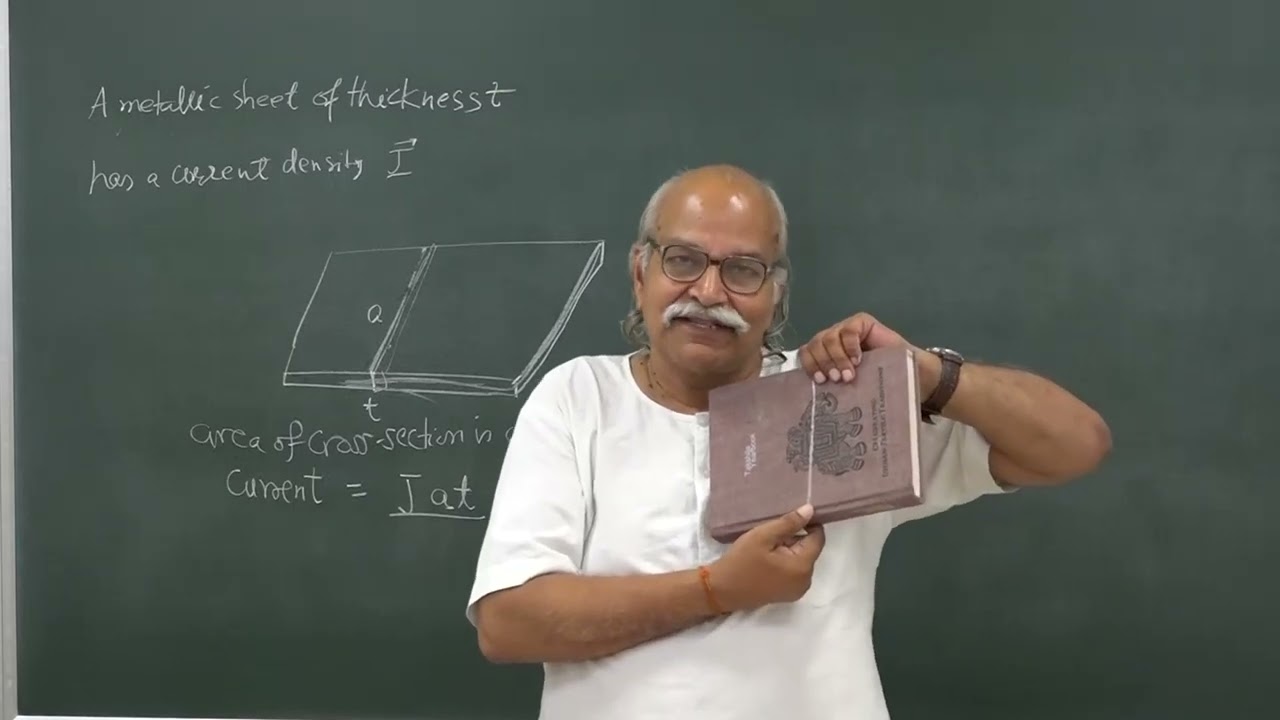
- Problem 2: Surface current density from volume current density for a thin sheet
- Problem 3: Current density through a spherical surface from a radioactive source
- Problem 4: Surface current density on a cylindrical pipe
- Problem 5: Surface current density on a rotating charged sphere
Cited Sources
- Classical Electromagnetism — The textbook by the instructor, from which the problems are taken.
Concurring Sources
- Classical Electromagnetism — The textbook used as the basis for the problems, providing consistent theoretical framework.
Contribution & Novelties
This lecture provides a clear and systematic approach to solving problems on current densities, which are fundamental to understanding magnetic fields. The instructor’s method of breaking down each problem and explaining the physical reasoning is instructive. The lecture reinforces the importance of distinguishing steady from non-steady currents and correctly applying surface and volume current densities.
Pour aller plus loin :
- Maxwell’s equations — Provides the broader context of electromagnetism, including the role of current densities.
- Biot–Savart law — Directly related to calculating magnetic fields from current distributions, a natural next step.
- Continuity equation — The equation of continuity for charge is discussed in the lecture and is essential for understanding steady currents.
112 words
Radar Profile
The radar profile shows high scores in information quantity and quality, with a moderate technical level and reliability. This indicates a well-structured educational content that is informative and accurate, though not extremely advanced or heavily sourced.