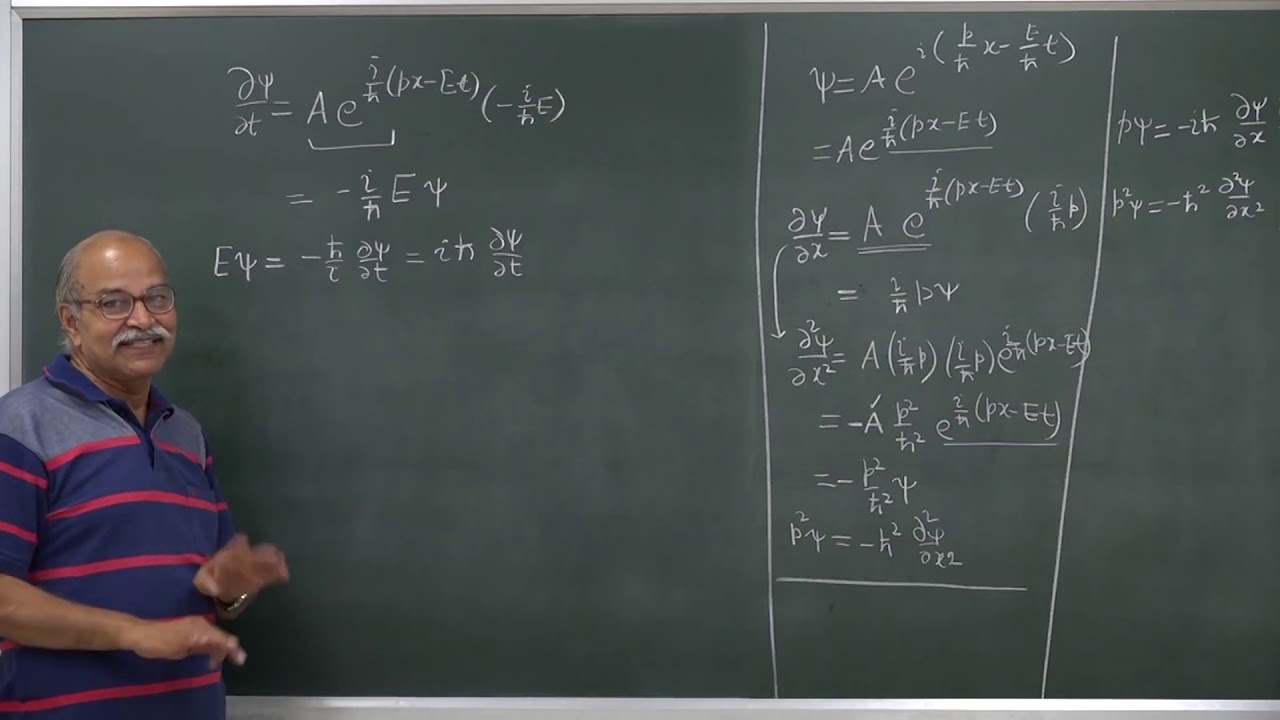
Lec 10 Getting to Schrodinger's Equation
Keywords
Summary
159 words
Critical Evaluation
Value of the Information & Strength of the Argument
The lecture provides a clear and logical derivation of the Schrödinger equation, which is a fundamental result in quantum mechanics. The argumentation is solid: starting from the plane wave ansatz, the instructor carefully derives the momentum and energy operators, and then combines them using the classical energy relation. The introduction of operators is well-motivated and helps to bridge the gap between classical and quantum mechanics. However, the presentation is somewhat informal and includes several digressions, which may distract from the main line of reasoning. The mathematical steps are correct, but the lack of rigorous justification for some assumptions (e.g., the form of the wave function) could be improved.
Scientific Rigor, Source Quality, Title Accuracy
The lecture is a self-contained derivation and does not cite external sources. The title accurately reflects the content, as the lecture indeed focuses on deriving the Schrödinger equation. The scientific rigor is adequate for an introductory course, but the informal style and lack of references reduce the overall quality. The derivation is standard and correct, but the presentation could be more structured and precise.
187 words
Title / Content Match
The title accurately reflects the content: the lecture derives the Schrödinger equation step by step.
Quality & Reliability
7/10
The lecture is a formal derivation of the Schrödinger equation from a plane wave ansatz, with clear mathematical steps. However, the audio quality is poor and the presentation is somewhat disorganized, with frequent digressions. The physics is standard and correct, but the lack of references and the informal style reduce the overall reliability.
Key Moments
Markers derived by PSI from the transcript: the creator did not define chapters.
- Introduction and recap of previous lecture on wave function for free particle
- Start of derivation: writing the plane wave ansatz and introducing momentum and energy operators
- First differentiation with respect to position to obtain momentum operator
- Second differentiation to obtain kinetic energy operator
- Differentiation with respect to time to obtain energy operator
- Combining operators to derive the Schrödinger equation for a free particle
- Generalization to particles in a potential, introducing potential energy operator
- Discussion of operators for position and potential energy
- Summary and significance of the Schrödinger equation
- Preview of future topics and conclusion
Contribution & Novelties
The lecture provides a pedagogical derivation of the Schrödinger equation, which is a cornerstone of quantum mechanics. It emphasizes the operator formalism, which is essential for understanding quantum mechanics. The lecture is part of a series that aims to build intuition from scratch.
Pour aller plus loin :
- Schrödinger equation - Wikipedia — For a comprehensive overview of the equation and its applications.
- Operator (physics) - Wikipedia — To understand the role of operators in quantum mechanics.
- Wave function - Wikipedia — For more details on the interpretation and properties of wave functions.
93 words
Radar Profile
The radar profile shows high scores in technical level and information quality, indicating a mathematically rigorous lecture. However, the lower score in information quantity suggests that the lecture is focused and does not cover a wide range of topics. The overall reliability is moderate, reflecting the informal presentation style.