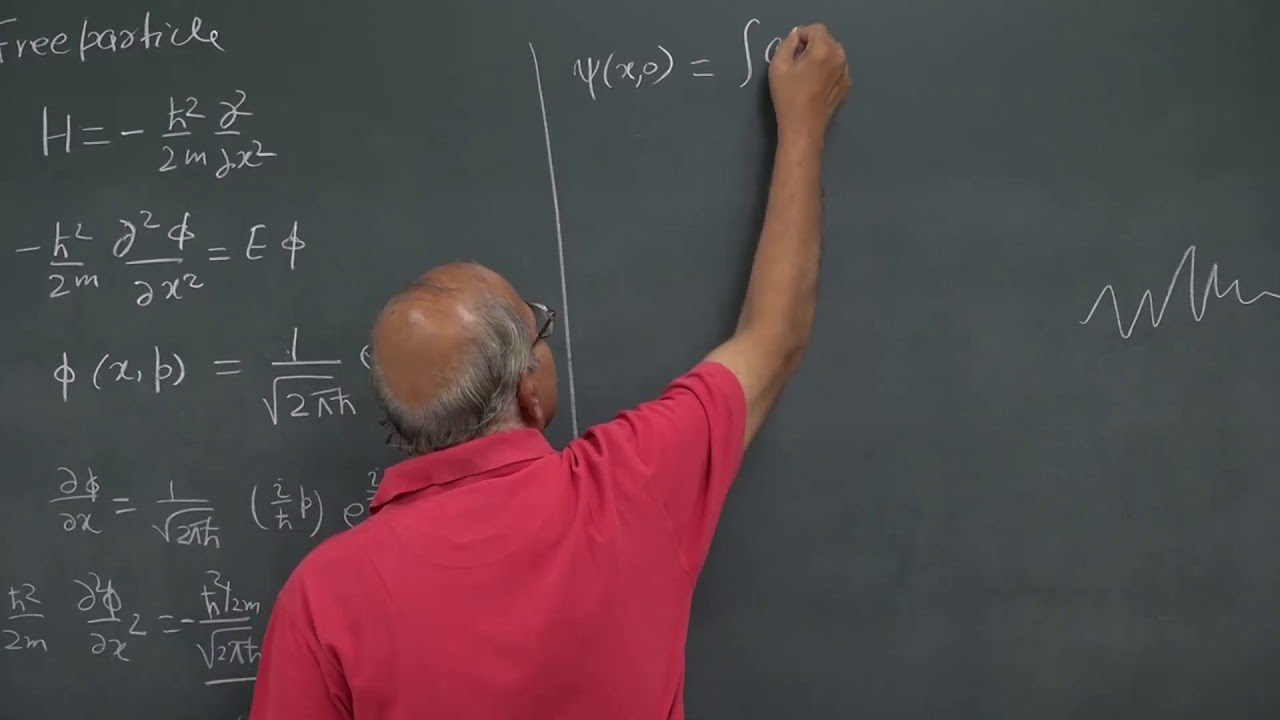
Lec 22 Constants of Motion
Keywords
Summary
168 words
Critical Evaluation
Value of the Information & Strength of the Argument
The lecture provides a solid introduction to the concept of constants of motion in quantum mechanics. The argumentation is logical and builds on previous material, using the free particle as a concrete example. The instructor carefully derives the time evolution of wave functions and shows how the probability distribution for momentum remains unchanged, illustrating the key idea. However, the presentation is somewhat informal and lacks rigorous mathematical notation at times, which may make it less accessible to beginners. The value of the information is high for students seeking to understand the physical meaning of constants of motion and the role of commutators.
Scientific Rigor, Source Quality, Title Accuracy
The lecture is scientifically rigorous in its derivations, but it does not cite any external sources or references. The title accurately reflects the content, focusing on constants of motion. The lack of citations is typical for a lecture, but it limits the ability to verify the material independently. The content is consistent with standard quantum mechanics textbooks, but no specific sources are mentioned.
180 words
Title / Content Match
The title accurately reflects the content, focusing on constants of motion in quantum mechanics.
Quality & Reliability
7/10
The lecture provides a clear derivation of the time evolution of wave functions and introduces constants of motion via commutators. The content is mathematically sound, but the presentation is informal and lacks citations to external sources.
Key Moments
Markers derived by PSI from the transcript: the creator did not define chapters.
- Introduction and review of the Schrödinger equation
- Expansion of wave function in energy eigenfunctions
- Free particle example: finding eigenfunctions of Hamiltonian
- Construction of wave packet and time evolution
- Probability distribution for momentum remains constant
- Definition of constant of motion and commutator condition
- Conclusion: momentum as a constant of motion for free particle
Contribution & Novelties
The lecture provides a clear pedagogical explanation of constants of motion in quantum mechanics, using the free particle as a simple example. It emphasizes the physical interpretation of time-independent probability distributions and connects it to the commutator condition. This is a fundamental concept that is often presented abstractly, and the lecture makes it more tangible.
Pour aller plus loin :
- Ehrenfest theorem — Relates the time derivative of expectation values to commutators, providing a deeper understanding of constants of motion.
- Heisenberg picture — An alternative formulation of quantum mechanics where operators evolve in time, making constants of motion more apparent.
- Conservation law — General concept of conserved quantities in physics, relevant to constants of motion.
115 words
Radar Profile
The radar profile shows high scores in quantity of information and technical level, indicating a dense and advanced lecture. The quality and reliability scores are moderate, reflecting the lack of citations and informal style. Overall, the lecture is informative but could benefit from more rigorous referencing.