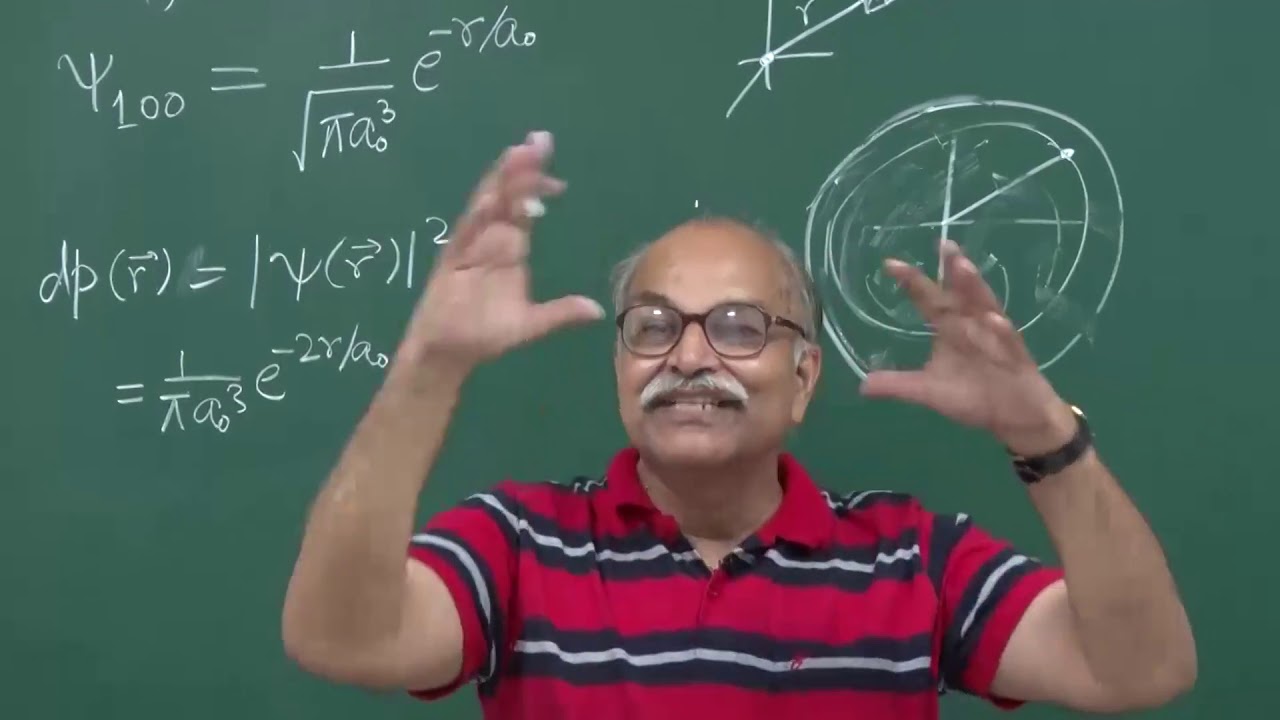
W2-03 Coming out of circular orbits #SemiconductorPhysics
Keywords
Summary
194 words
Critical Evaluation
Value of the Information & Strength of the Argument
The lecture provides a solid conceptual and mathematical foundation for understanding the quantum mechanical hydrogen atom. It clearly explains the transition from Bohr’s model to the probabilistic interpretation, highlighting the key differences: the electron’s position is not definite, and angular momentum can be zero in the ground state. The derivation of the radial probability density is well-presented, and the discussion of quantum numbers and degeneracy is thorough. The argumentation is logical and builds step-by-step, making it accessible to students with some prior knowledge of quantum mechanics. The value lies in its clarity and pedagogical effectiveness, though it does not introduce new research or novel perspectives.
Scientific Rigor, Source Quality, Title Accuracy
The scientific rigor is high; the content aligns with standard quantum mechanics textbooks. The instructor does not cite specific sources, but the material is well-established. The title accurately reflects the content, as the lecture indeed moves beyond Bohr’s circular orbits to the quantum cloud picture. The lecture is self-contained and does not rely on external references, which is acceptable for an educational context. The adequacy between title and content is excellent, as the title captures the essence of the lecture’s focus.
201 words
Title / Content Match
The title 'Coming out of circular orbits' aptly describes the transition from Bohr's circular orbit model to the probabilistic cloud picture of quantum mechanics, which is the central theme of the lecture.
Quality & Reliability
8/10
The lecture is a clear, mathematically rigorous exposition of the Schrödinger equation and its solutions for the hydrogen atom, consistent with standard quantum mechanics textbooks. The instructor correctly derives the radial probability density and discusses quantum numbers, spin, and degeneracy. The content is accurate and well-structured, though it lacks citations to external sources.
Key Moments
Markers derived by PSI from the transcript: the creator did not define chapters.
- Introduction and review of the Schrödinger equation
- Application to hydrogen atom and energy levels
- Discussion of quantum numbers and spin
- Derivation of radial probability density for ground state
- Comparison with Bohr model and probability cloud picture
- Introduction of first excited state and degeneracy
- Nomenclature of orbitals (s, p, d, f) and counting quantum states
- Summary and preview of future lectures
Contribution & Novelties
The lecture provides a clear pedagogical bridge from Bohr’s model to the full quantum mechanical treatment of the hydrogen atom, emphasizing the probabilistic nature of the wave function. It effectively explains the concept of orbitals and quantum state counting, which is fundamental for understanding atomic structure and later solid-state physics.
Pour aller plus loin :
- Hydrogen atom - Wikipedia — For a comprehensive overview of the hydrogen atom in quantum mechanics.
- Schrödinger equation - Wikipedia — For the fundamental equation governing quantum systems.
- Quantum numbers - Wikipedia — For a detailed explanation of the quantum numbers used to describe atomic states.
101 words
Radar Profile
The radar profile shows high scores in information quantity, quality, technical level, and reliability, indicating a well-rounded and authoritative lecture. The strengths are in the clarity and accuracy of the content, with no significant weaknesses.