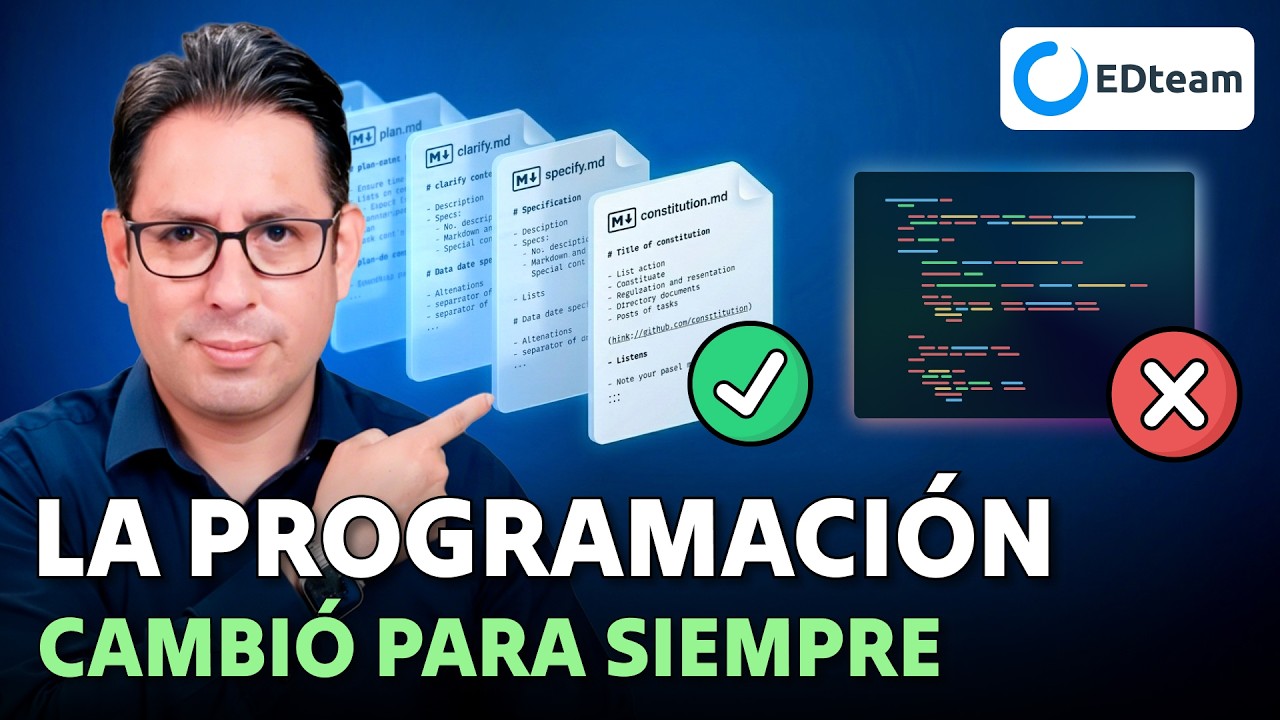
La forma CORRECTA de programar con IA en 2026: Spec Driven Development
Keywords
Summary
129 words
Critical Evaluation
The video provides a compelling argument for adopting Spec Driven Development (SDD) in AI-assisted programming. It effectively contrasts the pitfalls of ‘vibe coding’ with the structured approach of SDD, using a relatable analogy of building a house without a plan. The explanation of SDD’s five stages (Constitution, Specification, Clarification, Plan, Code) is clear and actionable, making it accessible to developers. The emphasis on documentation as a first-class deliverable is a valuable insight, addressing a common pain point in software maintenance. The video also correctly identifies that AI can generate documentation quickly, reducing the traditional burden. However, the presentation is largely anecdotal and opinion-based, lacking empirical evidence or case studies to substantiate claims of SDD’s superiority. While it references Spec Kit as a popular framework, it does not provide detailed technical guidance or compare it with other methodologies. The video also serves as a promotional vehicle for EDteam’s courses, which may introduce bias. The technical depth is moderate, suitable for intermediate developers, but it does not delve into potential challenges or limitations of SDD. The title accurately reflects the content, and the overall message is coherent and well-structured. The video’s strength lies in its clear articulation of a practical methodology, but its reliance on personal experience and promotional tone slightly detract from its scientific rigor.
214 words
Title / Content Match
The title accurately reflects the content, which focuses on Spec Driven Development as the correct way to program with AI in 2026.
Quality & Reliability
8/10
The video presents a coherent methodology (Spec Driven Development) with practical steps and references to a known framework (Spec Kit). The argumentation is clear and based on real-world software development challenges. However, it is primarily an opinion/educational piece without empirical data or peer-reviewed sources, and it promotes the channel's courses.
Chapters
Cited Sources
- EDteam free courses — Mentioned as a resource for learning programming and AI.
- EDteam all courses — Referenced for accessing the full catalog of courses.
- EDteam scholarships — Mentioned for students applying for scholarships.
- EDteam Instagram — Social media link provided in description.
- EDteam LinkedIn — Social media link provided in description.
- EDteam premium — Mentioned for accessing all courses with a subscription.
- EDteam teachers — Link for those interested in teaching at EDteam.
- EDteam TikTok — Social media link provided in description.
Concurring Sources
- Spec Kit GitHub repository — The framework mentioned in the video for implementing SDD, providing a concrete tool for the methodology.
- Vibe Coding Wikipedia — Provides background on the term 'vibe coding' that the video contrasts with SDD.
Dissenting Sources
- No direct discordant sources found — The video does not cite any sources that contradict its claims. However, some might argue that SDD is not a new concept and is essentially a rebranding of traditional software engineering practices.
Contribution & Novelties
The video provides a clear introduction to Spec Driven Development (SDD) as a methodology for AI-assisted programming, emphasizing the shift from code-centric to documentation-centric development. It offers a practical framework (Spec Kit) and highlights the importance of structuring AI interactions to ensure maintainability and scalability.
Pour aller plus loin :
- Spec Kit GitHub repository — The official framework mentioned in the video for implementing SDD.
- Vibe Coding: A New Era of Programming? — Wikipedia article on the concept of vibe coding, providing context and background.
- Software Design Document — Wikipedia article on software design documents, relevant to the documentation-centric approach.
- Test-Driven Development — A related methodology that also emphasizes specifications and iterative development, though focused on tests.
117 words
Radar Profile
The radar profile shows high scores in quality of information and reliability, reflecting the video's clear and structured presentation. The quantity of information is moderate, and the technical level is average, indicating a balance between depth and accessibility.
💬 Très positif. Sur les 30 commentaires analysés, la majorité exprime une approbation enthousiaste, saluant la clarté de l'explication et l'utilité pratique de la méthodologie SDD, avec quelques retours d'expérience personnels et des remerciements.