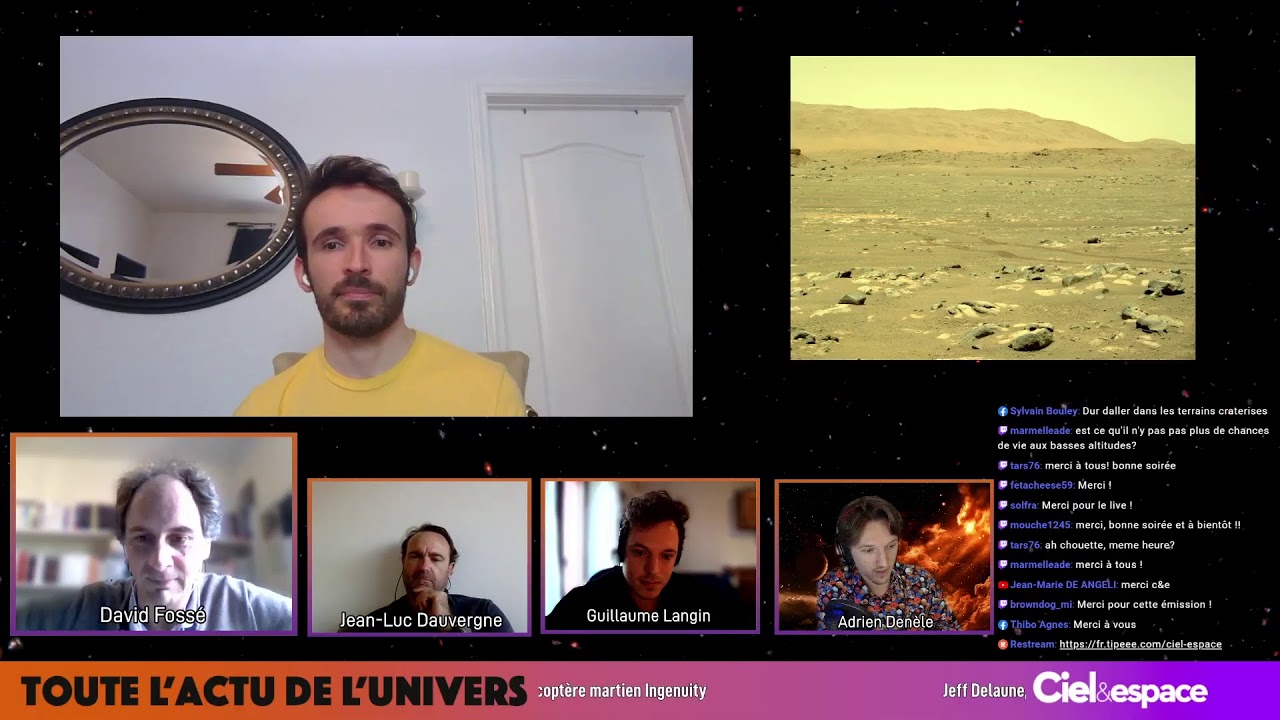
Ingenuity, Vie sur Mars, Phémus, Carbonates - L'actu de Ciel & Espace (15/04)
Keywords
Summary
161 words
Critical Evaluation
Value of the Information & Strength of the Argument
The video provides valuable information for both amateur astronomers and those interested in Mars exploration. The discussion on phémus is particularly instructive, explaining the scientific rationale behind observing these events and how amateurs can contribute to real research. The hosts argue convincingly for the importance of precise timing and data submission. The segment on Mars life search offers a balanced perspective, clarifying the difference between Curiosity’s findings (organic molecules) and the search for actual biosignatures. The interview with Olivier Poch adds expert insight into the potential for life on Mars and the significance of studying its surface. The argumentation is generally solid, with hosts acknowledging uncertainties and correcting themselves when needed.
Scientific Rigor, Source Quality, Title Accuracy
The show maintains a high level of scientific rigor, with hosts referencing specific researchers (e.g., Caroline Freissinet), instruments (SAM, ChemCam), and missions (ExoMars). They point to the Institut de mécanique céleste for ephemerides and recommend reliable sources. The title accurately reflects the content, covering the announced topics. The hosts are careful to distinguish between confirmed findings and hypotheses. The live format allows for immediate clarification of questions, enhancing the reliability of the information presented.
200 words
Title / Content Match
The title accurately reflects the content: the video covers the latest news on Ingenuity, the search for life on Mars, the observation of mutual phenomena (phémus), and the analysis of carbonates.
Quality & Reliability
8/10
The video is a live discussion by the editorial team of a recognized French astronomy magazine. It presents scientific information with references to specific researchers, instruments, and publications. The tone is rigorous, and the hosts correct themselves when uncertain. However, the format is conversational and not peer-reviewed, and some details are approximate.
Key Moments
Markers derived by PSI from the transcript: the creator did not define chapters.
- Introduction and overview of the show's topics.
- Discussion on phémus (mutual phenomena) of Jupiter's moons, including how to observe and their scientific importance.
- Practical advice for amateur astronomers on observing phémus and contributing data.
- Segment on the search for life on Mars, summarizing Curiosity's findings and Perseverance's objectives.
- Interview with Olivier Poch about the potential for life on Mars and the importance of studying carbonates.
- Update on the Ingenuity helicopter's status and the recent communication issue.
- Discussion on carbonates on Mars and what they reveal about past water and habitability.
- Q&A with viewers and closing remarks.
Cited Sources
- Institut de mécanique céleste - éphémérides — Recommended for generating ephemerides of mutual phenomena.
- Ciel & Espace hors-série sur Mars — Mentioned as the source of the interview with Olivier Poch and articles on Mars.
Concurring Sources
- NASA Mars Exploration Program — Official NASA site for Mars missions, including Curiosity and Perseverance.
- Institut de mécanique céleste — Provides ephemerides and scientific data for celestial mechanics.
Contribution & Novelties
The video provides a timely update on Mars exploration and amateur astronomy opportunities. It clarifies the scientific goals of Perseverance and the significance of Curiosity’s organic molecule detections. The discussion on phémus highlights a citizen science opportunity that is often overlooked.
Pour aller plus loin :
- Mutual phenomena of Jupiter’s moons — Overview of the phenomenon and its scientific use.
- SAM instrument on Curiosity — Details on the instrument that detected organic molecules.
- Perseverance rover — Mission objectives and sample caching plans.
- Olivier Poch — Researcher at IPAG, Grenoble, specializing in planetary science and exobiology.
95 words
Radar Profile
The radar profile shows high scores in information quantity, quality, and reliability, with a slightly lower technical level. This indicates a content that is rich and reliable but accessible to a broad audience, balancing depth with approachability.
💬 Sur les 0 commentaires analysés, aucune tendance n'a pu être dégagée.