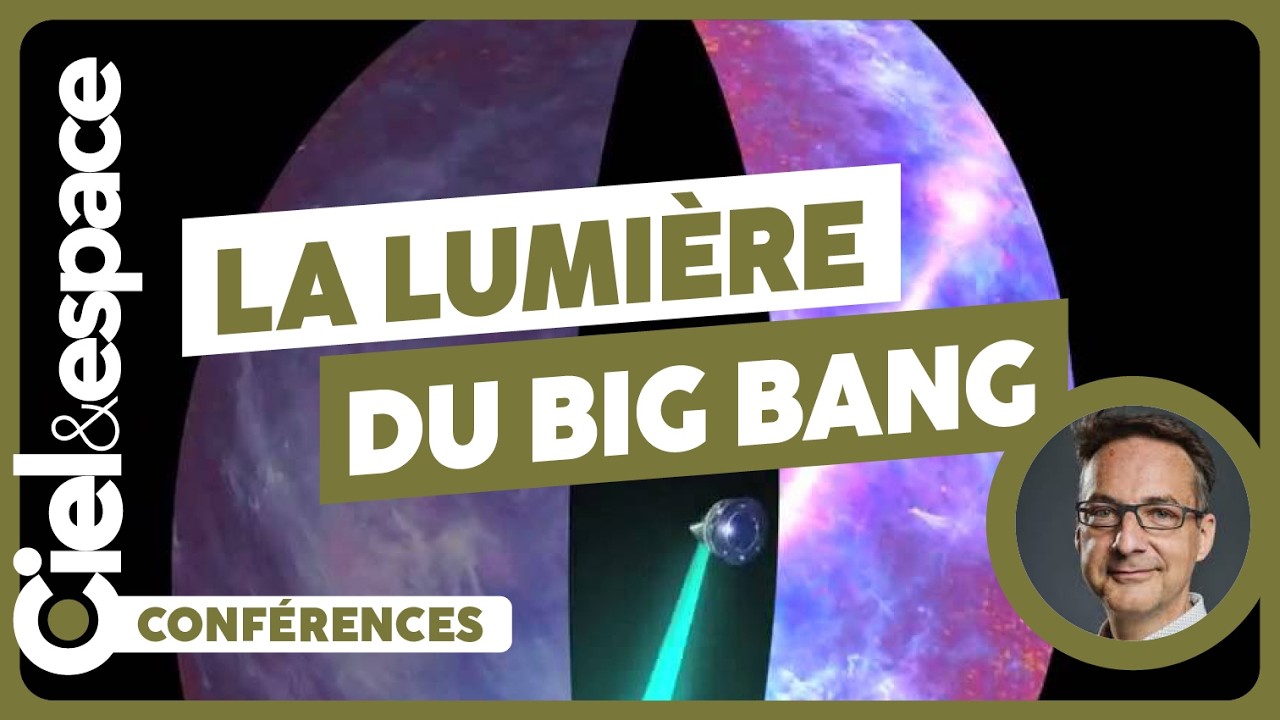
L'image qui a changé notre vision de l'Univers
Keywords
Summary
167 words
Critical Evaluation
The conference provides a comprehensive and accessible overview of modern cosmology, focusing on the cosmic microwave background and its implications. Hervé Dole demonstrates a strong command of the subject, presenting complex ideas in a clear and engaging manner. The historical narrative, from the discovery of the CMB to the precise measurements by Planck, is well-structured and highlights the collaborative nature of science. The speaker is careful to distinguish between what is known and what remains speculative, such as the nature of dark matter and dark energy. He emphasizes the methodological approach of constraining unknown quantities through indirect observations, which is a key aspect of scientific inquiry. The content is scientifically accurate and up-to-date, with references to recent results and future missions. The presentation includes a brief promotional segment for the magazine, but it does not detract from the scientific content. The title accurately reflects the content, as the CMB image indeed changed our view of the universe. Overall, this is a high-quality science communication piece that would be valuable for both general audiences and those with some background in astronomy.
180 words
Title / Content Match
The title accurately reflects the content, which focuses on the cosmic microwave background and its impact on our understanding of the universe.
Quality & Reliability
8/10
The speaker is a professional astrophysicist from IAS, Paris-Saclay, and the content is based on established scientific results (Planck satellite, CMB). The presentation is rigorous and includes historical context and references to key publications.
Key Moments
Markers derived by PSI from the transcript: the creator did not define chapters.
- Introduction: the dark side of the universe, methodology, and outline of the talk.
- Why is the night sky dark? The paradox and its resolution.
- Discovery of the cosmic microwave background by Penzias and Wilson.
- The CMB as a fossil light from the Big Bang and its significance.
- Measuring the CMB: from COBE to Planck, and the composition of the universe.
- Dark matter: evidence and methods of detection.
- Dark energy and the acceleration of the universe's expansion.
- Recent results on protoclusters of galaxies at redshift 2.16.
- Future missions: James Webb Space Telescope and Euclid.
- Conclusion and final remarks.
Cited Sources
- Ciel & Espace magazine subscription — Mentioned in the video description as a promotional offer for the magazine.
Concurring Sources
- Planck Collaboration results — The Planck satellite's measurements of the CMB are the basis for the cosmological parameters discussed.
Contribution & Novelties
The talk provides a clear synthesis of how the CMB has shaped modern cosmology, emphasizing the methodology of constraining unknown components like dark matter and dark energy. It also presents recent findings on protoclusters, offering a glimpse into the early stages of galaxy formation.
Pour aller plus loin :
- Cosmic microwave background — Overview of the CMB and its significance.
- Planck (spacecraft) — Details on the Planck satellite and its measurements.
- Dark matter — Comprehensive explanation of dark matter and its evidence.
- Dark energy — Overview of dark energy and its role in the universe’s expansion.
96 words
Radar Profile
The radar profile shows high scores in information quality and reliability, with slightly lower but still strong scores in quantity and technical level. This indicates a well-balanced presentation that is both informative and scientifically sound.