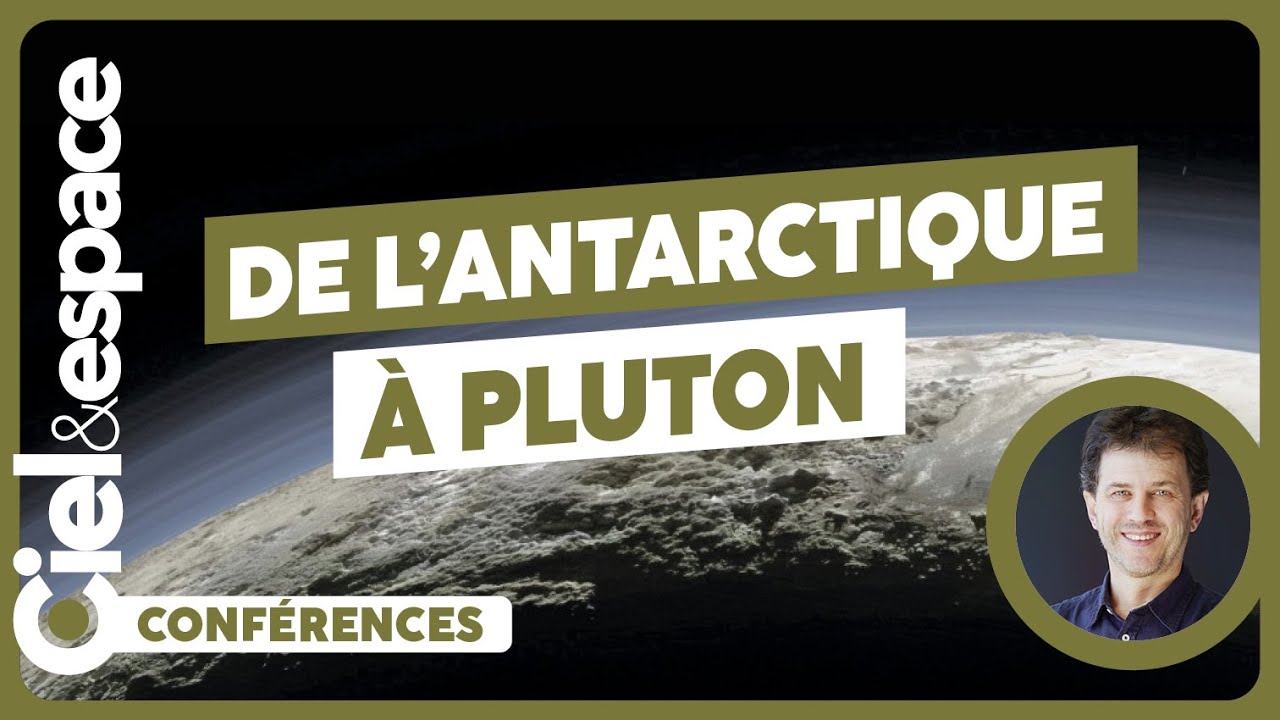
Explorations polaires, de la Terre aux autres planètes par François Forget
Keywords
Summary
264 words
Critical Evaluation
The conference is a masterful synthesis of planetary polar science, delivered by a leading expert. The speaker’s dual background as a polar explorer and planetary scientist lends unique credibility. The presentation is logically structured, moving from Earth to each planet, and effectively uses striking imagery to illustrate key points. The scientific content is accurate and up-to-date, referencing recent missions like MESSENGER, BepiColombo, Cassini, and New Horizons. The speaker carefully distinguishes between confirmed findings and ongoing debates, such as the thickness of Mercury’s ice deposits. The argumentation is solid, with clear explanations of physical processes like cold traps and the role of axial tilt. The inclusion of personal expedition footage adds a human element and underscores the challenges of polar exploration. The talk successfully conveys the importance of polar regions as analogs for extraterrestrial environments and as targets for future exploration. The only minor weaknesses are the lack of detailed citations and the occasional oversimplification for a general audience. Overall, this is an excellent, informative, and engaging presentation that would benefit both enthusiasts and students of planetary science.
177 words
Title / Content Match
The title accurately reflects the content: a journey from Earth's polar regions to those of other planets and moons in the solar system.
Quality & Reliability
8/10
The speaker is a recognized planetary scientist (CNRS) with extensive experience in polar expeditions and space missions. The content is based on established scientific knowledge and recent mission data (MESSENGER, BepiColombo, Cassini, New Horizons). The presentation is clear and well-structured, with appropriate caveats about uncertainties. However, it is a popular science talk, not a peer-reviewed source, and some simplifications are made.
Key Moments
Markers derived by PSI from the transcript: the creator did not define chapters.
- Introduction to polar regions on Earth, showing images from expeditions.
- Discussion of Mercury's polar ice in permanently shadowed craters.
- Venus: no polar ice on surface, but atmospheric polar vortices.
- The Moon: water ice in permanently shadowed craters at the poles.
- Mars: polar ice caps composed of water ice and dry ice, seasonal changes.
- Jupiter's moon Europa and Ganymede: polar ice and subsurface oceans.
- Saturn's moon Titan: methane lakes and seas at the poles.
- Enceladus: geysers at the south pole ejecting water vapor.
- Pluto and Charon: nitrogen glaciers and polar caps.
Cited Sources
- MESSENGER mission — NASA mission to Mercury that provided data on polar ice deposits.
- BepiColombo mission — ESA/JAXA mission to Mercury, currently in cruise, will further study polar ice.
- Cassini mission — NASA/ESA/ASI mission to Saturn that studied Titan and Enceladus.
- New Horizons mission — NASA mission that flew by Pluto and Charon, revealing polar features.
Concurring Sources
- NASA Planetary Science — General NASA resource confirming planetary exploration findings.
- ESA Science & Exploration — European Space Agency's science missions page, corroborating mission details.
Dissenting Sources
- No direct discordant sources found — The talk is based on well-established scientific consensus; no significant contradictions were identified.
Contribution & Novelties
The talk provides a comprehensive overview of polar regions across the solar system, synthesizing recent findings from multiple space missions. It highlights the commonality of cold traps and ice accumulation processes, while also emphasizing the diversity of polar phenomena, from Mercury’s shadowed craters to Titan’s methane lakes. The speaker’s personal polar expedition experience adds a unique perspective on the challenges and importance of studying these extreme environments.
Pour aller plus loin :
- Permanently shadowed craters on Mercury — Relevant for understanding cold traps and ice stability.
- Polar ice caps on Mars — Detailed information on Martian polar processes.
- Titan’s lakes — Overview of hydrocarbon lakes on Titan.
- Enceladus’ geysers — Explanation of the south polar plumes.
116 words
Radar Profile
The radar profile shows high scores in quantity and quality of information, reflecting the speaker's expertise and the breadth of content. The technical level is moderate, suitable for a general audience, while reliability is high due to the use of mission data and peer-reviewed knowledge.