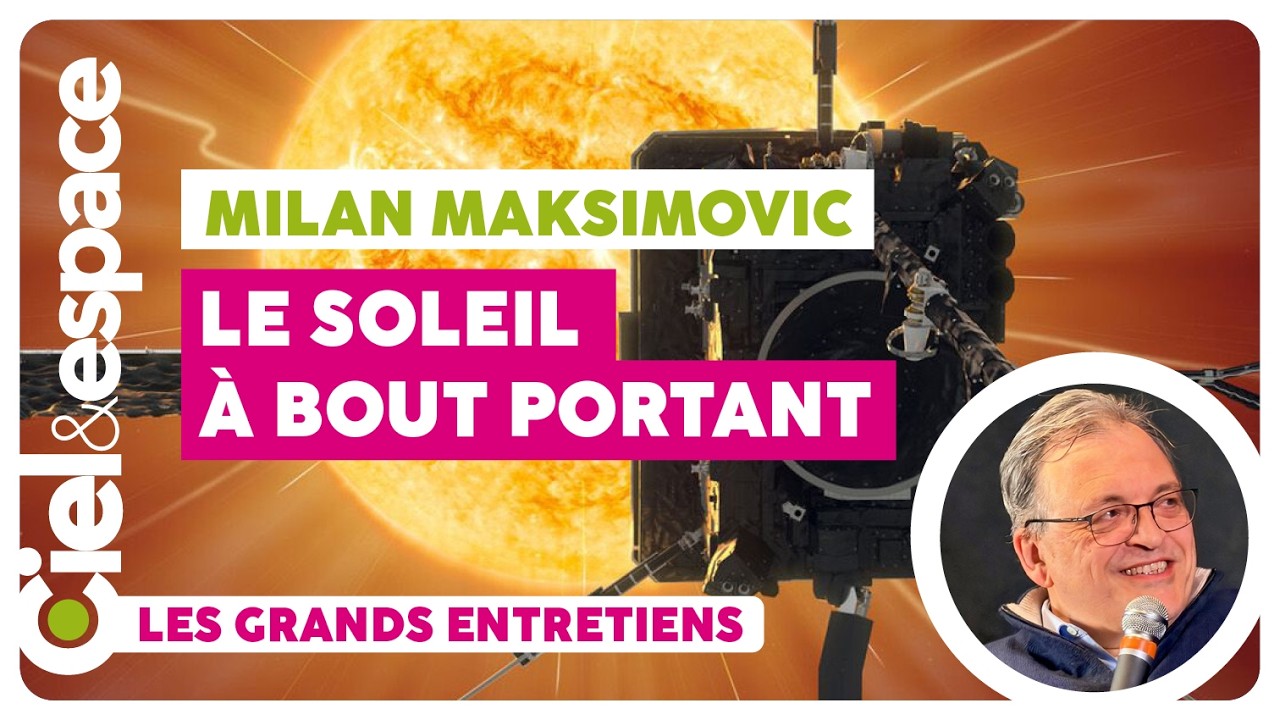
Le Soleil à bout portant, Grand Entretien avec Milan Maksimovic
Keywords
Summary
145 words
Critical Evaluation
The interview provides a valuable and authoritative overview of current solar exploration, featuring Milan Maksimovic, a leading expert in solar plasma physics and principal investigator of the RPW instrument on Solar Orbiter. The content is scientifically sound, with accurate explanations of plasma physics, the solar wind, and the corona. Maksimovic effectively communicates complex concepts, such as the distinction between remote sensing and in-situ measurements, and the significance of the ‘coronium’ mystery being solved by atomic physics. The discussion of the Sun as a plasma laboratory and the importance of understanding the solar dynamo is well-founded. The interview also highlights the practical applications of solar research, such as space weather forecasting, which is crucial for protecting satellites and power grids. The sources mentioned, including the ‘Grand Atlas du Soleil’ and the missions themselves, are credible. The title accurately reflects the content, focusing on close-up solar exploration. The presence of a sponsor segment is clearly identified and does not detract from the scientific value. Overall, the interview is a high-quality, informative discussion suitable for an audience with some scientific background. The main limitation is that it is an informal conversation rather than a structured presentation, but the expertise of the guest ensures reliability. The public comments (not provided) would likely reflect appreciation for the expert insights and the accessible explanation of complex topics.
221 words
Title / Content Match
The title accurately reflects the content, which focuses on close-up exploration of the Sun by Solar Orbiter and Parker Solar Probe.
Quality & Reliability
8/10
The interview features a recognized CNRS research director and principal investigator of the RPW instrument on Solar Orbiter, providing expert insights into solar physics. The content is scientifically accurate, though it is an informal discussion rather than a peer-reviewed presentation. The sponsor segment is clearly identified and does not affect the scientific content.
Key Moments
Markers derived by PSI from the transcript: the creator did not define chapters.
- Introduction of Milan Maksimovic and the topic of solar exploration.
- Discussion on whether the Sun is a typical star.
- Explanation of plasma and its importance in astrophysics.
- Historical discovery of the hot corona and the 'coronium' mystery.
- Galileo's observations of sunspots and the rotation of the Sun.
- Measuring the Sun's energy output and the solar constant.
- Introduction of Solar Orbiter and Parker Solar Probe missions.
- In-situ measurements of the solar wind and corona.
- The RPW instrument and correlating solar eruptions with in-situ data.
- Future prospects: polar observations and understanding the solar dynamo.
Cited Sources
- Ciel & Espace subscription page — Mentioned in the video description as a resource for the magazine and related content.
Concurring Sources
- Solar Orbiter mission page — Official ESA page confirming the mission's objectives and instruments, consistent with the interview's claims.
- Parker Solar Probe mission page — NASA's official page confirming the mission's goals and achievements, supporting the interview's statements.
Contribution & Novelties
The interview provides an expert perspective on the latest solar exploration missions, emphasizing the paradigm shift from remote observation to in-situ measurements. It highlights the unique capabilities of Solar Orbiter and Parker Solar Probe in directly sampling the solar wind and corona, and the importance of correlating remote and in-situ data. The discussion also touches on unresolved questions such as the heating of the corona and the solar dynamo.
Pour aller plus loin :
- Solar Orbiter mission page — Official ESA mission page with detailed information on objectives and instruments.
- Parker Solar Probe mission page — NASA’s official page for the Parker Solar Probe mission.
- Solar wind article on Wikipedia — Overview of the solar wind and its properties.
119 words
Radar Profile
The radar profile shows high scores in information quantity, quality, and reliability, with a slightly lower technical level, reflecting an expert interview that is accessible yet scientifically rigorous.