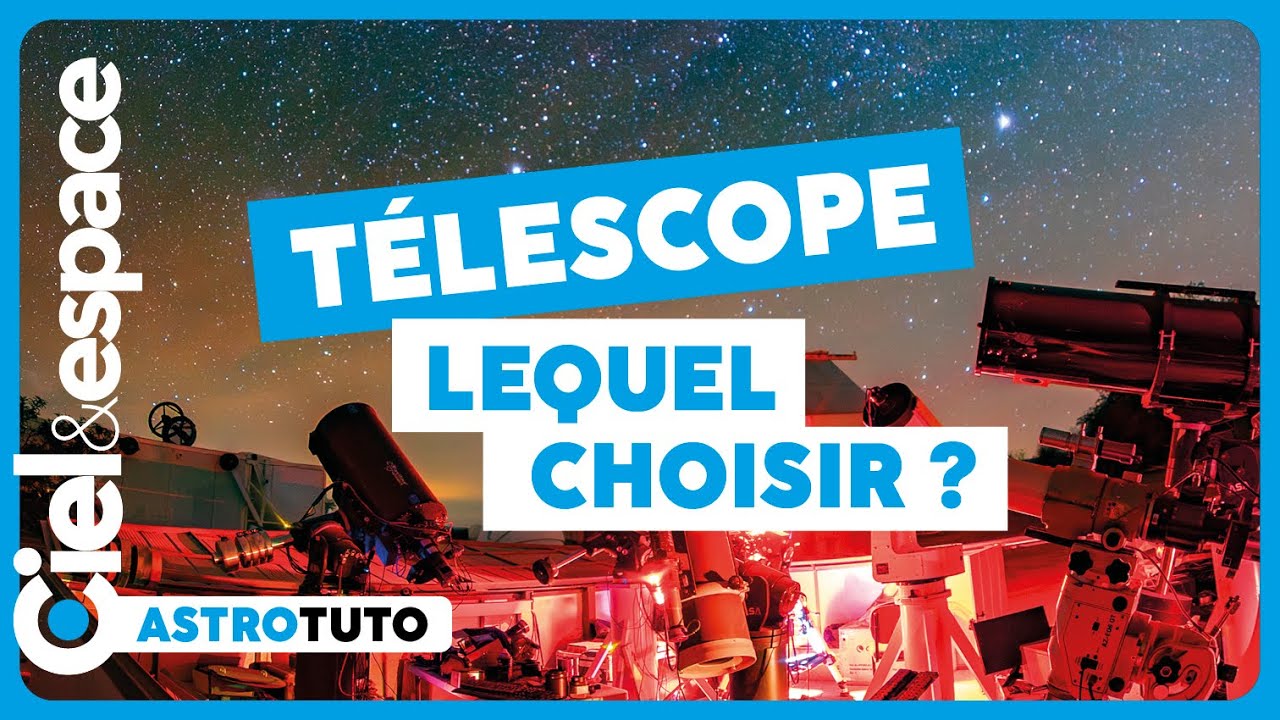
Comment bien choisir son premier télescope en fonction de son budget ?
Keywords
Summary
159 words
Critical Evaluation
Value of the Information & Strength of the Argument
The video provides valuable, practical information for beginners, covering a wide range of budgets and instrument types. The advice is grounded in the presenters’ experience and is presented in a clear, structured manner. They effectively argue for starting with binoculars or a small Dobsonian, explaining the trade-offs between cost, ease of use, and performance. The recommendation to join astronomy clubs for low budgets is sensible and well-justified. The argumentation is solid, with each suggestion backed by reasoning about optical quality, stability, and usability.
Scientific Rigor, Source Quality, Title Accuracy
The scientific rigor is good, with the presenters drawing on their experience as astronomy journalists. They mention specific telescope models and brands, and refer to tests published in Ciel & Espace. The video does not cite external scientific sources, but it is not a research presentation; it is an expert opinion piece. The title accurately reflects the content, and the video stays on topic throughout. The description provides links to the French Astronomy Association’s club directory and the magazine’s website, which are relevant resources for viewers.
184 words
Title / Content Match
The title accurately reflects the content: the video provides guidance on choosing a first telescope based on budget, covering various price ranges and instrument types.
Quality & Reliability
8/10
The video is presented by a journalist from the reputable French astronomy magazine Ciel & Espace, with practical experience in observational astronomy. The advice is concrete, based on field testing, and covers a range of budgets. The information is consistent with general astronomical knowledge and is presented with appropriate nuance (e.g., recommending clubs for low budgets).
Key Moments
Markers derived by PSI from the transcript: the creator did not define chapters.
- Introduction and presentation of the topic: choosing a first telescope by budget.
- Advice for budgets under 100 euros: recommend joining an astronomy club.
- Discussion of binoculars as a good first instrument around 150-200 euros.
- Introduction of the 114mm Dobsonian as a good entry-level telescope around 200 euros.
- Recommendation of Maksutov-Cassegrain telescopes for urban observers.
- Advice for rural observers: larger Dobsonians (200-300mm) for deep-sky.
- Discussion of high-budget options (over 1000 euros): Schmidt-Cassegrain on equatorial mounts.
- Conclusion and encouragement to visit astronomy shops and clubs for personalized advice.
Cited Sources
- Annuaire des clubs de l'Association Française d'Astronomie — Mentioned as a resource to find local astronomy clubs.
- Ciel & Espace website — The magazine's website, mentioned as a source for further information.
- Jean-Luc Dauvergne's YouTube channel — The co-host's personal channel, mentioned in the description.
Concurring Sources
- Sky & Telescope: How to Choose a Telescope — General advice on choosing telescopes, consistent with the video's recommendations.
- Astronomy.com: How to choose your first telescope — Similar guidance for beginners, aligning with the video's suggestions.
Contribution & Novelties
The video offers a clear, budget-oriented guide for beginners, synthesizing common advice from the astronomy community. Its originality lies in the structured approach by price range and the emphasis on practical considerations like storage, stability, and urban vs. rural settings. It also stresses the importance of accessories and community resources.
Pour aller plus loin :
- Dobsonian telescope — The design is central to the video’s recommendations for rural observers.
- Maksutov–Cassegrain telescope — The video recommends this type for urban observers.
- Schmidt–Cassegrain telescope — Mentioned for higher budgets and astrophotography.
- Binoculars — The video suggests binoculars as a first instrument.
- Astronomical seeing — Relevant to the discussion of observing conditions and telescope performance.
112 words
Radar Profile
The radar profile shows high scores in information quantity, quality, and reliability, with a slightly lower technical level. This indicates a well-rounded, trustworthy guide that is accessible to beginners while still providing substantial content.
💬 Très positif. Sur les 29 commentaires analysés, la grande majorité exprime des remerciements et des encouragements, avec quelques retours d'expérience personnels et des suggestions d'amélioration.