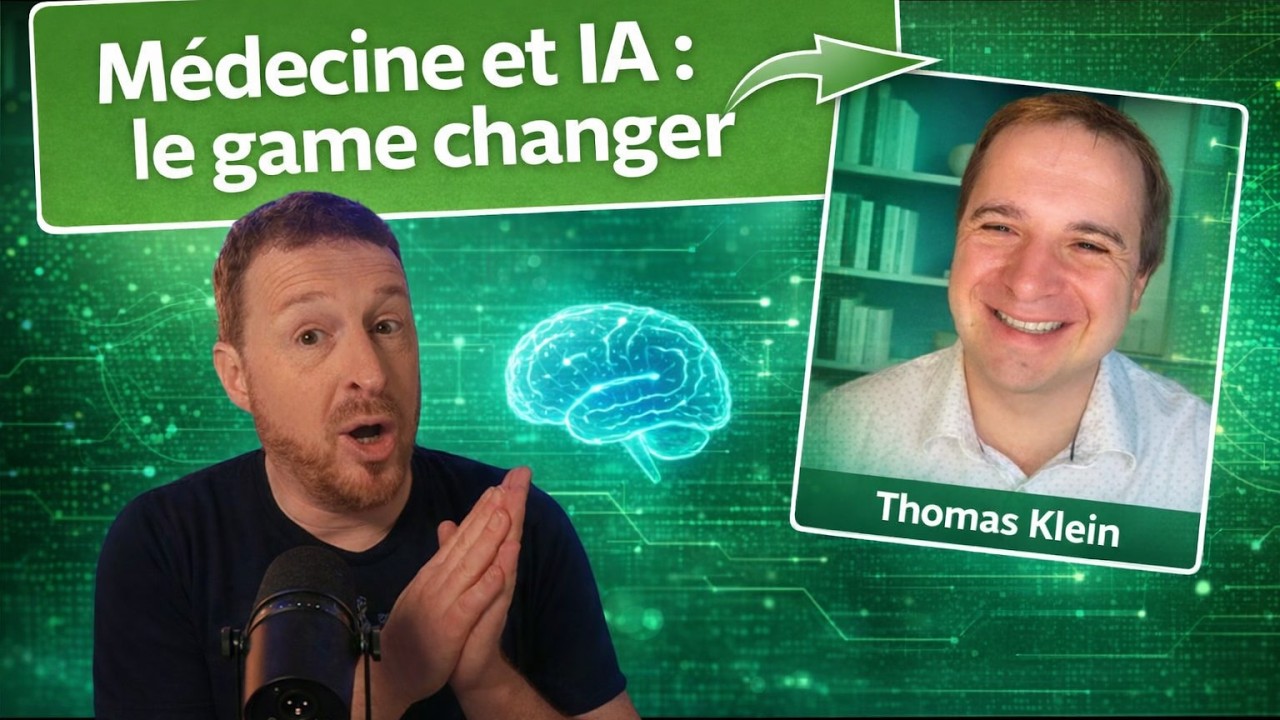
Médecine et IA le game changer. Interview de Thomas Klein
Medicine and AI the game changer. Interview with Thomas Klein
Keywords
Summary
163 words
Critical Evaluation
Value of the Information & Strength of the Argument
The value of the information lies in its practical, grounded perspective on AI in medicine, moving beyond hype to discuss real-world applications and challenges. Klein provides concrete examples, such as AI-assisted imaging and administrative automation, and cites a specific study on breast cancer detection. The argumentation is coherent and balanced, acknowledging both benefits and risks. However, the discussion remains at a high level, lacking deep technical detail or critical examination of the cited studies. The expert’s credibility is established through his background, but the claims are not independently verified within the interview.
Scientific Rigor, Source Quality, Title Accuracy
The scientific rigor is moderate: the expert references studies and his own experience, but does not provide specific citations or sources during the conversation. The description includes a link to his book, which may contain more detailed references. The title accurately reflects the content, focusing on AI as a transformative force in medicine, though the ‘game changer’ claim is somewhat optimistic given the nuanced discussion. The interview does not delve into contradictory evidence or alternative viewpoints, which could strengthen its rigor.
188 words
Title / Content Match
The title accurately reflects the content, which focuses on AI's transformative role in medicine, though it promises a 'game changer' perspective that is more nuanced in practice.
Quality & Reliability
7/10
The interview features an expert with credible background (Telecom Nancy, Harvard, MIT) and provides concrete examples and references to studies, but lacks detailed citations and rigorous verification of claims.
Key Moments
Markers derived by PSI from the transcript: the creator did not define chapters.
- Introduction of Thomas Klein and his background.
- Discussion on concrete AI applications in healthcare, including administrative tasks.
- Example of AI in imaging: 17% increase in breast cancer detection.
- Clarification that AI is not meant to replace doctors but to assist them.
- Discussion on the limits of AI: data biases, explainability, and over-reliance.
- Impact on doctor-patient relationship and the importance of trust.
- Comparison between US and French adoption of AI in healthcare.
- Future of medicine: predictive and personalized approaches.
- Discussion on responsibility and ethical frameworks.
- Conclusion and final thoughts on collective governance.
Cited Sources
- L'IA au service de la santé (book) — Mentioned as the author's book, providing further reading.
- Renaud Dékode website — Channel's website for discussion and additional content.
Concurring Sources
- Artificial intelligence in healthcare - Wikipedia — Supports the claim that AI is used in imaging and administrative tasks.
- Explainable AI - Wikipedia — Aligns with the discussion on the need for explainability in AI decisions.
Dissenting Sources
- AI in healthcare: hype or hope? - Nature — Some studies caution that AI's performance in real-world settings may not match expectations, contrasting with the optimistic tone of the interview.
Contribution & Novelties
The interview provides a balanced, expert perspective on AI in medicine, emphasizing practical applications and the importance of human oversight. It clarifies misconceptions about AI replacing doctors and highlights the potential to improve efficiency and patient care.
Pour aller plus loin :
- AI in healthcare - Wikipedia — Overview of AI applications and challenges in healthcare.
- Explainable AI - Wikipedia — Discusses the importance of transparency in AI systems.
- Medical ethics - Wikipedia — Relevant to the ethical considerations raised in the interview.
83 words
Radar Profile
The radar profile shows balanced scores across information quantity, quality, technical level, and reliability, indicating a well-rounded but not deeply technical discussion. The interview excels in providing practical insights and expert opinion, but lacks rigorous scientific depth.
💬 Sur les 0 commentaires analysés, aucune tendance n'est disponible.